Train takes life of exemplary teetotaller porter

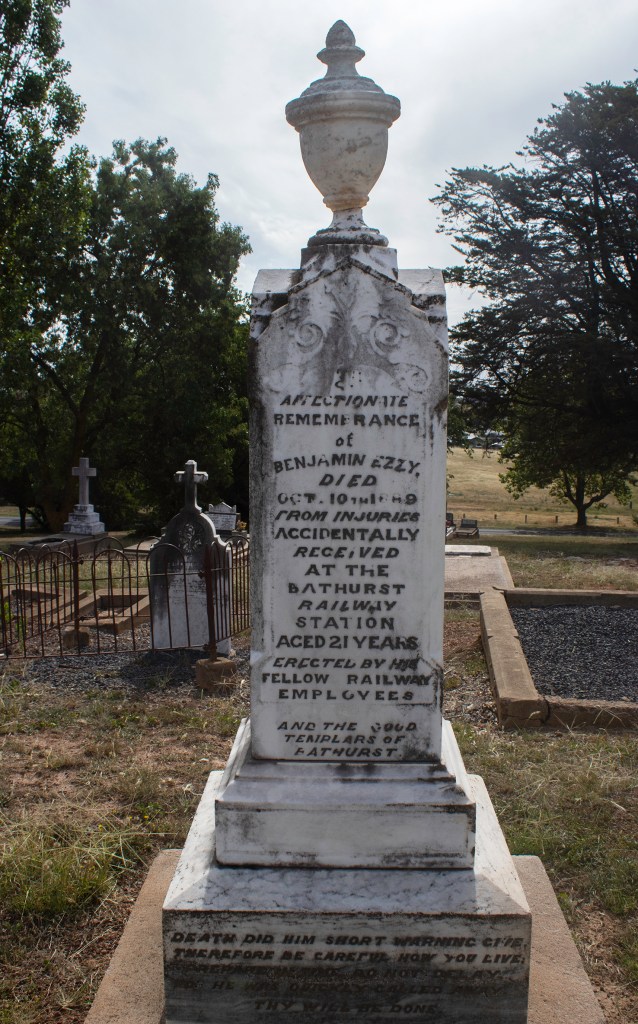
1889 – Benjamin Ezzy was a porter at the Bathurst Railway Station who made a fatal mistake.

The 21-year-old had worked there for four years, having risen from the dirty position of lamp cleaner to porter by 1889.

It was 2.30 one October afternoon when the goods train from Wallerawang arrived on the “up line’.

It usually arrived on the down line, but the inquest into Ezzy’s death heard that it was also known to use the up line if the down line was in use.

Before he died in his hospital room, Ezzy told a visitor that he was in the lamp room, heard the train and rushed out to meet it to do his porterly duties,  was mistaken about which line the train was coming in on, and “did not see his error until it was too late”.

Suffering a dislocated left hip, fractured pelvis and lower left leg, as well as a lacerated thigh from his unscheduled crushing between the train’s engine and the platform, he died at 3am the next  morning.

The inquiry ruled that death was accidental.

Benjamin Ezzy was a brother of the temperance movement, the Good Templars, and his Bathurst lodge, the Pride of the West, “unusually regretted’’ his death.

He seemed to be a favourite among them, as at a meeting dedicated to unveiling a photo of the young teetotaller, they lamented the death of one so  good, so generous, while hundreds of young men who were not only doing injury to themselves, but luring others on to destruction, were left.

To mark their appreciation of Ezzy’s worth, an enlarged and framed photograph of the youth was hung on the wall of the lodge, to the right of the chief templar’s chair.

 But here was, however, a bright side to this dark picture: their loss was Brother Ezzy’s eternal gain.

“They were certain that he was better off, and had been taken from the evil of this world”.

A Mr Farquhar, speaking emotionally to the gathered lodge and visitors, including Ezzy’s mother, said that after the accident and while in terrible agony, his medical adviser ordered him to take some brandy.

 “He protested, saying that he had never tasted any spirits in his life,  and could bear the pain without it”.

In a weird twist of fate, another man called Benjamin Ezzy was killed by a train at a crossing  25 years later near Rooty Hill, Sydney, just after he had alighted from another train.

Below is a portion of a poem written and spoken by fellow Good Templar Brother Lew at Benjamin Ezzy’s send off.

Ezzy is buried at the Millthorpe cemetery, NSW

Ben was on the Bathurst Station

(I need not the case explain),

When, without an intimation,

In there dashed that fatal train,

Down the cruel engine threw him,

Wounded on the railway line,

Bruised until we scarcely knew him,

Taken up by friends so kind.

Carried from the Bathurst Station

To a ward on yonder hill,

There, in calmest resignation,

He submitted to God’s will !

Millthorpe, NSW

SOURCES: Bathurst Free Press and Mining Journal , Saturday 12 October 1889 p 2

 Bathurst Free Press and Mining Journal, Friday 5 September 1890 – Page 2

National Advocate Saturday 12 October 1889 – Page 2
Flow in river claimed two lives

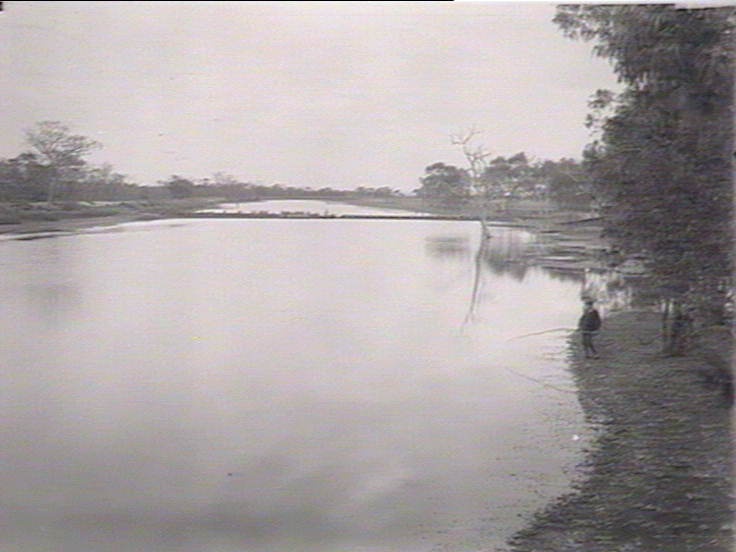
A recent flow of water had been enticing many swimmers to the Bogan River below Yee War’s garden near Nyngan, New South Wales.

Image Bogan River, State Library of New South Wales. https://collection.sl.nsw.gov.au/record/9qoV4Oq1/leQ0zmBGL3b7O

But on February 5, 1931, after 5pm, there were only three present. Only one lived to tell the tale.

Rosie Pines, 44, a strong swimmer who had herself helped rescue a woman in trouble in the water at Tumet in years past, was with her friend Florence Murray, 25,  a much weaker swimmer.

They were accompanied by eight-year-old Marie Graham, who sat on the bank and watched.

Marie was the only eyewitness, and later said the women went into the water to get a motor tube used as a floatation aid, and Mrs Murray appeared to sink.

Mrs Pines went to her assistance.

“The little girl said Mrs Murray appeared to put her arms around Mrs Pines and both went under the water.’’

 After waiting for a while, Marie ran home, which was near the Pines’. Upset and in shock, she told Mr Pines she had lost the women.

Mr Pines set off on foot to the river, thinking the women may have had car trouble but on arrival found the car and the women’s clothes, but no sign of them. 

The bodies were both found in the next three hours, thanks to the efforts of 50 searchers, who quickly gathered at the scene “ostensibly to have a dip, but soon joined in the search effort.”

Rosie Pines is buried in the Nyngan cemetery, while Mrs Murray was laid to rest in Sydney.

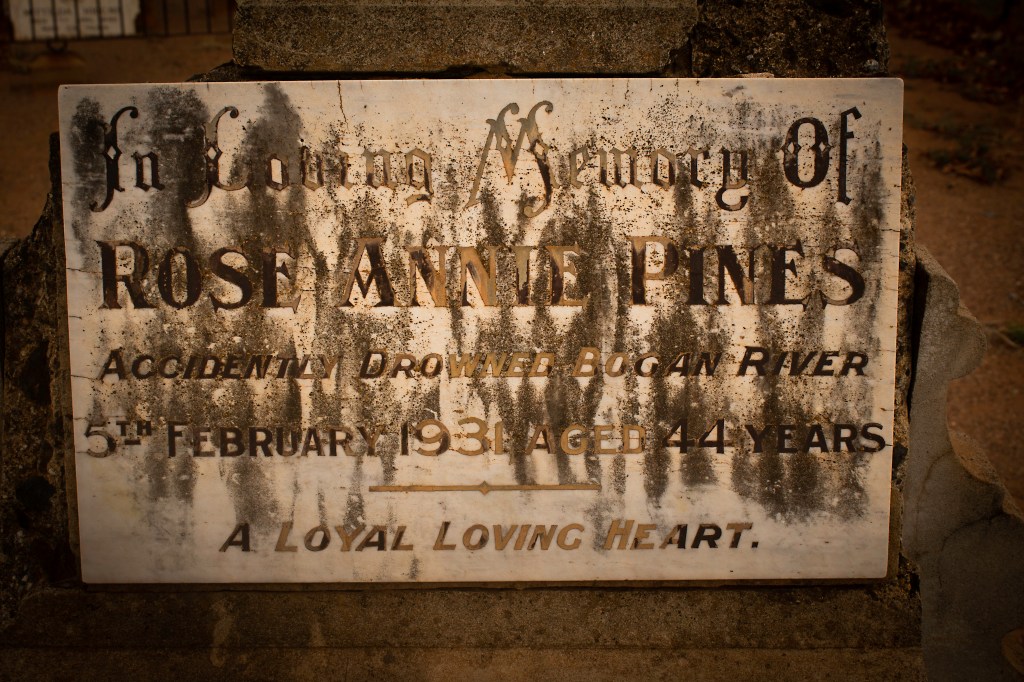
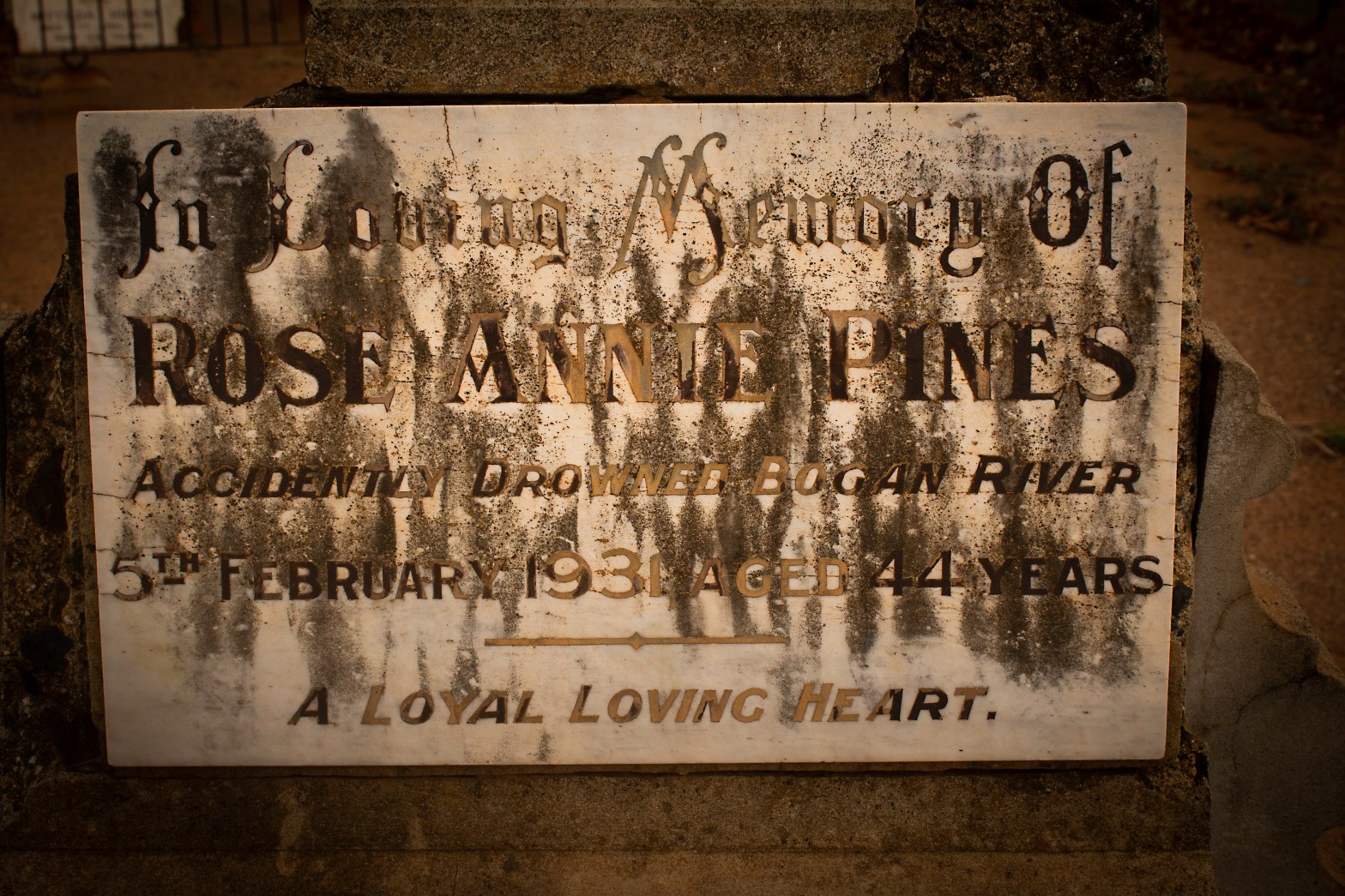
Nyngan cemetery: Rosie Annie Pines accidentally drowned Bogan River, February 5, 1931 aged 44
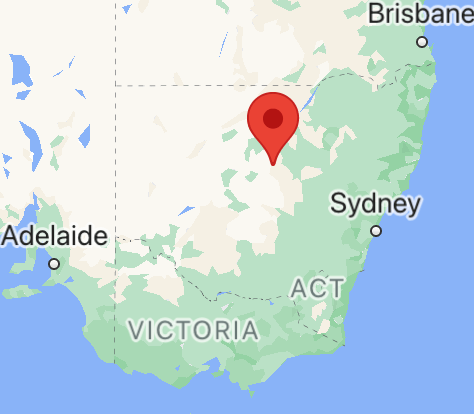
Nyngan, NSW

Source: Lachlander and Condobolin and Western Districts Recorder, Wednesday 25 February 1931 

River image: Courtesy State Library of New South Wales. https://collection.sl.nsw.gov.au/record/9qoV4Oq1/leQ0zmBGL3b7O

Train accidents ran in the family

To have one son killed while working in a railway yard is unfortunate, but to have a second son die almost the same way three years later is beyond words.

Twenty-seven-year old Robert Webster was a shunter at the Kelso railway station, the other side of the Macquarie River to the Bathurst Station, New South Wales, in 1880.

The station had only been open for five years when Robert tried to jump from one moving wagon to another but fell onto the line.

The wheels of the wagon crushed his thigh. He was brought to Bathurst where the leg was amputated.

“…the man got into such a weak state from loss of blood and exhaustion, that he did not rally, and died this evening,” reported the Sydney Morning Herald.

“No blame is attached to any one except the man himself, who met with the accident through his own carelessness.

Sydney morning herald

With those words farewelling her son, his family  surely could not have felt comfortable with his younger brother John working on the nearby Bathurst Railway Station.

Their fears would have been realized when, a week short of the three-year anniversary of Robert’s death, John also made a fatal mistake at work.

He accidentally uncoupled two wagons, and got between them to reattach them – while the train was still in motion.

A wheel went over his arm, crushing it and his leg stopped the truck, breaking it badly.

Both arm and leg were amputated, but again, the injuries were too much and he died.

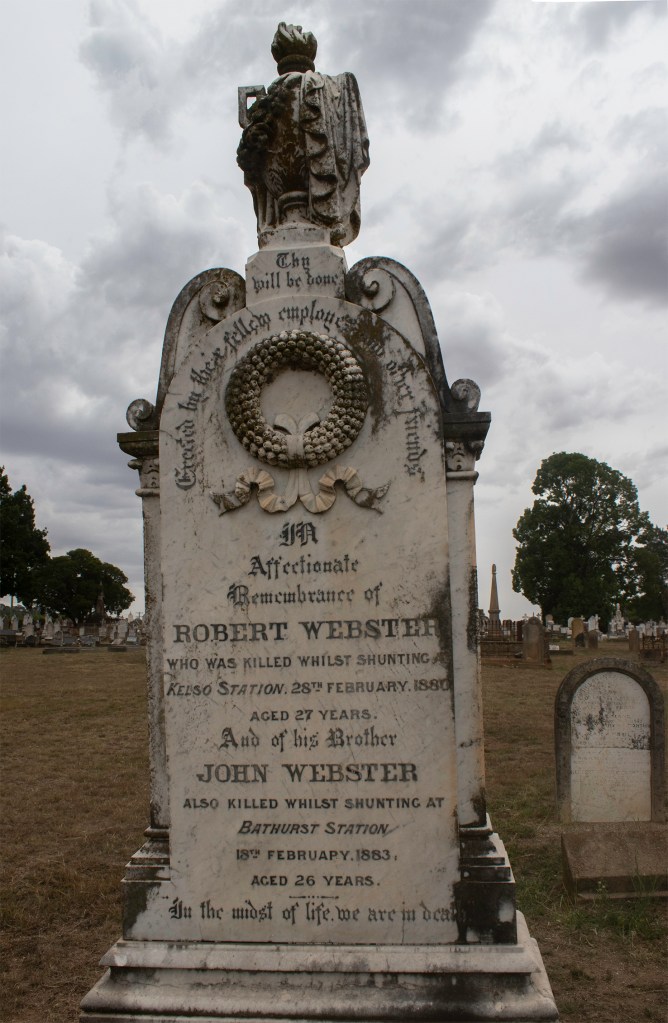
Bathurst cemetery: Robert Webster who was killed whilst shunting at Kelso station, 28th February 1880 aged 27 and of his brother John Webster also killed whilst shunting at Bathurst station, 18th February 1883 aged 26. Images Sharyn Moodie
Bathurst, NSW

SOURCES: Albury Banner and Wodonga Express (NSW : 1881 – 1938) Friday 23 February 1883 p 15

The Sydney Morning Herald (NSW : 1842 – 1954) Monday 1 March 1880 p 5

Swimmer not strong enough

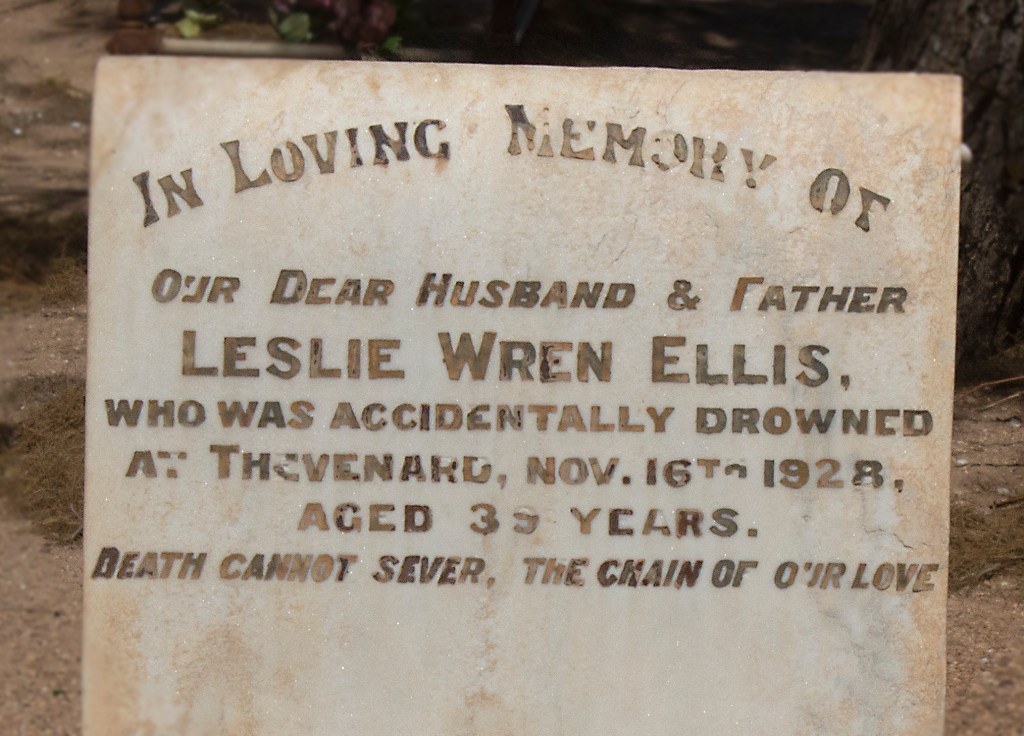
1928 – Leslie Wren Ellis was a waterside worker who perhaps should have stayed waterside.

Willowie cemetery, South Australia. Image: Sharyn Moodie

He planned to buy a fishing boat which was moored in water off the town of Thevenard, South Australia. The best way to inspect it was to swim out to it, and although his friends advised him not to do so, he persisted.

Leslie was known to be good swimmer, according to newspaper reports after his naked body was found four days later washed up kilometres to the north, between Ceduna and Denial Bay. His wife had reported him missing. His clothes were found on a nearby cliff top, opposite the boat he had wanted to visit. No coroner’s inquiry was deemed necessary, and it was assumed he had suffered fatal cramping.

He left a widow and a small child and is buried in the Willowie Garden of Memories cemetery, 500km east of Thevenard.

Thevenard, South Australia

SOURCES:

The Advertiser Wednesday 21 November 1928 p 26

West Coast Sentinel, Friday 23 November 1928 – Page 6

Contrary winds keep Charles from vital medical help

1890 – Charles Frederick Otto Michael had retired as post-master at Gawler, near Adelaide, after a stroke but had “lately been enjoying good health.’’

While visiting his adult son at Fowlers Bay, South Australia, 900km west of his hometown, he broke a leg.

 As there was no doctor in that out-of-the-way place his son had to do the best he could under instructions telegraphed by a medic.

Two days later, Charles and his wife started for home on a sailing ship, the schooner Wollomai.

The Wollomai leaving the jetty at Streaky Bay, South Australia. Image courtesy of State Library of South Australia -B 15265

But the wind  was not blowing in his favour. The vessel was ‘detained many days’, and Mr Michael fell into a coma and finally passed away, still about 500k from home.

This occurred at Scales Bay about 25 miles from Streaky Bay, where he is buried beneath an impressive headstone in a cemetery still swept by the gales which contributed to his death.

Streaky Bay, South Australia

SOURCE: Bunyip  Friday 4 April 1890 p 3

Words written in stone endure

Words written in stone may not always last for ever, but they may endure for a long time.

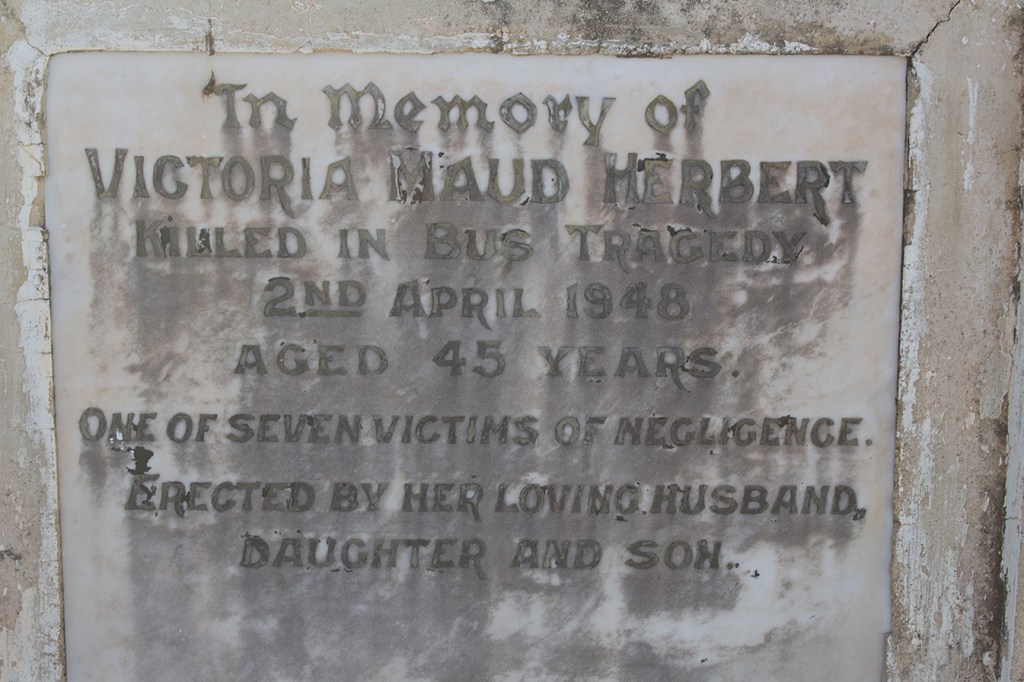
The bitter epitaph above left, “one of seven victims of negligence” was etched in 1948, but still sends a clear message from the family of Victoria Herbert, who lost her life as she took the bus to the Mount Isa aerodrome to meet her married daughter, who was arriving from North Queensland. The grave is in the Mount Isa cemetery.

Victoria was among four killed and five injured in a smash between a goods train and a bus at a Mt Isa level crossing. Which doesn’t add up to seven, but that’s what the stone says.

Charles Reid, the bus driver, received abrasions and shock, but was not admitted to hospital.

Reid told police that he saw the train when it was 100 yards away.

 He said because of the rough road he was travelling slowly over the crossing, and accelerated, but the heavy bus could not clear the line in time.

The train crashed into the last three feet of the bus, dragging it 20 feet.

 Then the bus was crushed against the gateposts, splintering its framework to matchwood.

Longreach leader

Reid was charged with unlawfully killing, but after evidence from 10 witnesses the Stipendiary Magistrate found that “there had been some negligence, but not sufficient to warrant committing Reid to stand trial.

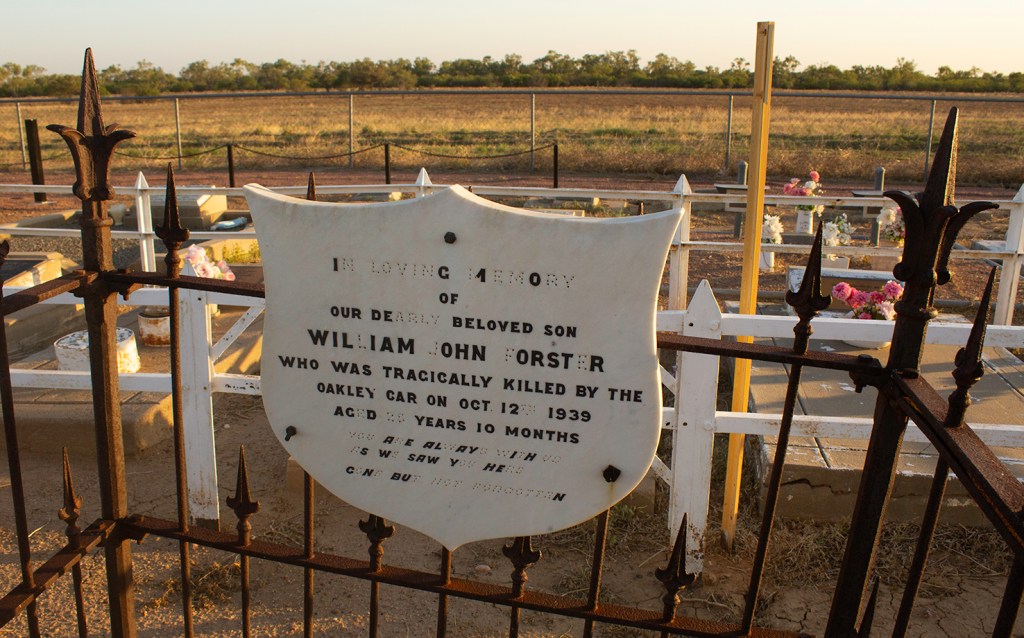
Pictured to the right above is the gravestone of William John Forster, 25, who died in the Longreach Hospital in 1939 after a car collided with him in Pelican Street about 10 o’clock one night.

It is curious that his gravestone, in the Longreach cemetery, states he was killed by “the Oakley car”.

It was reported that he was crossing the street in the vicinity of Turner’s bakery when he was hit by a car, driven by James Alexander Curtis, an employee of Oakley Station, a nearby large  property.

Why the station’s name ended up on the headstone is unknown, but it will forever be associated with his death.

Mount Isa, Queensland

SOURCES: The Longreach Leader, Saturday 14 October 1939 p 16

Townsville Daily Bulletin,  Wednesday 14 April 1948 p 2

The Courier-Mail,  Saturday 3 April 1948 p 1

Townsville Daily Bulletin, Wednesday 14 April 1948 p 2

Lamp post took out railway worker

1890 – Orange, NSW railway employee Edward Morris stepped off a shunting train into a light post and was thrown back onto the line.

Morris had been warned that the post was there. His fellow workers were concerned about the dangerous position of a number of new posts erected that day to provide light for shunting.

Morris is buried in Orange cemetery. Image: Sharyn Moodie

And when Morris was found by the line, with one arm lying four feet away, his scalp and an ear torn off, he said he had hit the post when jumping off the train.

He was taken to hospital, where he died of “nervous shock, induced by the severe injuries received, producing collapse and death’.”

“The poor fellow was at once taken to the hospital, where he succumbed at 11 o’clock.

“Deceased was about 35 years of age, and leaves a wife and four children, one being an infant only a few days old,” it was reported – erroneously, as his gravestone says he was 28.

An inquest was held, where further details emerged.

George Cather, who was shunting with Morris that night, deposed that he and Morris had been shunting No. 4 train from Molong, which arrived at 8.10 in the evening.

Both stepped into the brake van at the platform and the train moved on.

Cather was at the brake about 10-12 feet from Morris, when, noticing; that the train had gone too far, he applied the brake and looked out of the window.

He said he had not heard any noise from Morris, but thought he heard a slight noise like the “jarring of a door”. 

After the train had stopped he immediately noticed Morris was missing.

He and engine driver John Davidson went searching and found Morris unconscious by the track.

Morris recovered his sense enough to speak of the pain in his arm, apparently not realising it was cut off.

Davidson told the inquiry he had warned Morris of the posts along the line before leaving the platform, because he considered they were in a dangerous position and said he had complained about them.

Fred Richardson, local stationmaster, said a large portion of the shunting had to be done at night time, so it was necessary to have the yard lighted.

 However, he said officials from Sydney picked out the position where the posts were placed; he only pointed out which parts of the yard needed lighting.

He did not know by whose order or authority the posts were erected.

Orange, NSW

SOURCES: The Australian Star  Monday 20 October 1890 p 6

Bathurst Free Press and Mining Journal  Thursday 30 October 1890 p 2

National Advocate  Thursday 30 October 1890 p 2

The Sydney Morning Herald  Wednesday 29 October 1890 p 6

Fatal boat ride for non-swimmer

“I don’t think anything could sink this boat”.

Bothwell, just before the boat sank

William Bothwell couldn’t swim. He lived in the driest part of the continent, yet he still managed to drown in a boating accident.

It was also the boat’s maiden voyage.

Image: Sharyn Moodie

It was made of galvanized iron, and was launched on a body of water known as Brickyard Dam, part of the Broken Hill brickworks. It was also known as Simpson’s Dam.

The boat had been launched and tested by a small group of men about 7.30 on a Friday night in spring 1903 when William Bothwell, 30ish, arrived and got in.

The inquest heard that the men  rowed across the dam, and as they rowed back again, Bothwell declared he didn’t think anything could sink the boat.

“To prove his point, he stood up and leant over one side to see if he could tip her over, the boat keeled and Bothwell, alarmed, rushed to the opposite side and the boat capsized”.

The other two men, Isaac Simpson and Warne, made their way to the bank, while Bothwell, who could not swim, clung to the side.  The boat soon sank. A witness on the bank said Bothwell made one or two strokes and also sank, and was not seen again.

Simpson, a tinsmith, was the brother of the brickwork’s owner.

Dr. Groves, Government medical officer, was scathing at the inquest.

While he stated that death was due to drowning he also said…

“It is a pity  that anyone was foolhardy enough to trust themselves in such a punt as I saw at the dam. It is a wonder the thing did not tip over the first time they tried it.

Government medical officer Groves

“It was a flat bottomed, shallow affair, and, to make it still more dangerous, the men had placed two air tubes along the side not on the gunwales, but just above the waterline where, as soon as the boat keeled over, the tube would be below the centre of gravity,” he continued.

Bothwell is buried in Broken Hill cemetery.

Broken Hill, NSW

SOURCE: Barrier Miner Monday 5 October 1903 p 3

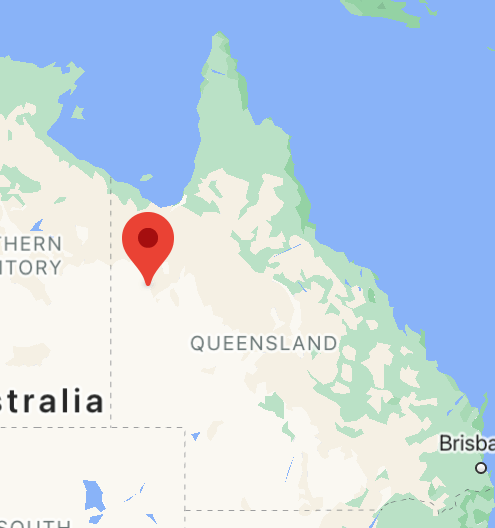
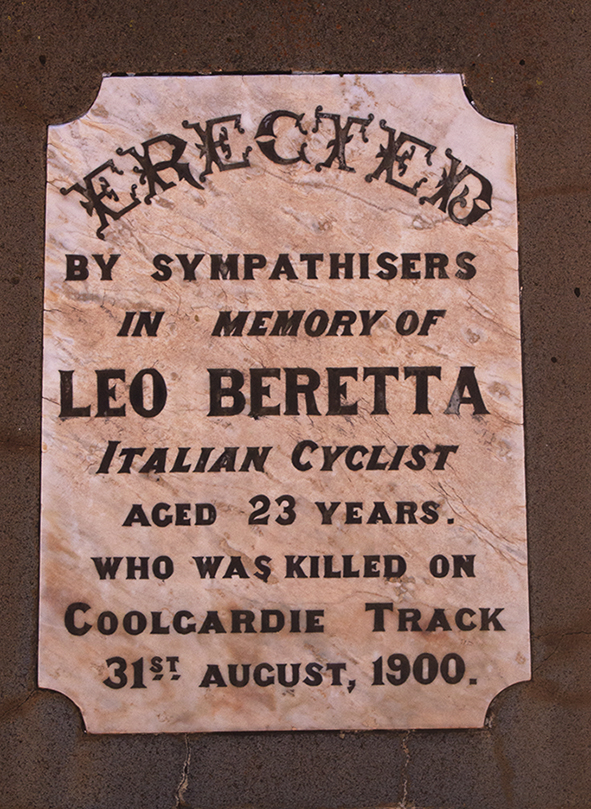
Italian cyclist lauded in outback cemetery

Although Italian cyclist Leo Beretta lived far from home in the dusty mining town of Coolgardie, he was so esteemed among locals that an eight-foot granite memorial was raised in his memory.

Beretta died when he was training at the Coolgardie Recreation Reserve.
Cycle racing was the world’s most popular and lucrative sport at the turn of the century.

He was travelling at about 40 miles an hour, with the wind behind him when his bicycle’s fork broke and he was pitched to the ground.

He was taken to Coolgardie Hospital but did not regain consciousness before dying the following morning.

The town’s Mayor, about 50 cyclists, and a number of townsfolk attended the unveiling of the memorial.

The memorial took the form of a marble cross, placed on a pedestal of granite, and resting on a square block of cement, enclosed by ‘handsome’ iron railings.

Mayor Chas Sommers said many friends had proposed the erection of a monument, and he was pleased to see that they had succeeded.

 “Leo Beretta was a true sportsman and a straight goer, and had gained the respect of all who knew him.

Coolgalrdie mayor

 Australians, as a nation, when any calamity came amongst them, were always willing, no matter what nationality a man might be, who had resided amongst and made friends with them, to show their appreciation of him.

The grief of the relatives of Beretta would be in a great measure softened by the thought that although their relative was lying away from home in a foreign country, he had not been forgotten by the many good friends he had made, who had erected that handsome memorial to his memory, he said.

At the conclusion of the ceremony, a photograph of the proceedings was taken, after which the gathering returned to town.

Coolgardie, WA

SOURCES: Kalgoorlie Western Argus, Thursday 13 September 1900 p 36

Kalgoorlie Miner, Monday 26 November 1900 p 4

Fitzpatrick, Jim. “A Glimpse at Australiaʹs Cycling History.” In Cycling Futures, edited by Bonham Jennifer and Johnson Marilyn, 25-42. South Australia: University of Adelaide Press, 2015. Accessed February 9, 2021. http://www.jstor.org/stable/10.20851/j.ctt1sq5x1g.7.

Wrong brother named drowned

It is bad enough to lose a child to drowning, without the press reporting the wrong child had died.

In 1897, The Gympie Times correctly reported that Robert Oxlade, aged eleven years, son of a respected townsman, whilst fishing in the river (most likely the Macintyre) with two other lads, fell into the water.

“The body was quickly recovered but all attempts at artificial respiration failed,” it said in its pages the next day

But a week later, Brisbane paper The Week reported that Arnold Oxlade, aged 11 years, had fallen into the river while fishing with his brother Robert and a lad named O’Connor. It said Arnold fell in, but was rescued by Robert and O’Connor.

“The boys gave the alarm, but the lad had been too long in the water, and artificial respiration was found useless,”

The week

Robert’s broken headstone, shared with his father Charles, lies on the ground in the Goondiwindi cemetery.

SOURCES: Gympie Times and Mary River Mining Gazette  Saturday 13 February 1897 p 5

The Week  Friday 19 February 1897 p 11