Charles Dunbar’s stark headstone in the Yalgoo cemetery. Image Sharyn Moodie 2020
The workman was camped out about 50 miles north of Yalgoo, WA, which is still a remote place to be today.
He was with his boss, Mr McPherson and the boss’s son Ross, when the three of them were hit by lightning.
It was about 7pm and the trio had been clearing bush away from a new well, in preparation for erecting a windmill.
After tea, Mr McPherson went about 20 metres away to keep the fires going on some stumps which were being burnt out, when all three men were struck by lightning.
Mr McPherson lost consciousness, but when he came to he crawled to where his son and Dunbar were lying on the ground.
He said his son got up and “staggered around for a while, but Dunbar was killed outright.’’
After the two survivors had recovered from their shock – both physical and emotional, Dunbar’s body was brought into Yalgoo.
Mr McPherson said the experience was as if he had been struck on the head with a lump of wood.
Dunbar, 25, was Scottish and single.
He was buried in the Anglican portion of the sun-bleached Yalgoo cemetery.
Yalgoo, Western Australia
Sources: Daily Telegraph and North Murchison and Pilbarra Gazette, Saturday 15 December 1928, p2
Geraldton Guardian, Thursday 6 December 1928, p2
The West Australian, Thursday 20 December 1928, p20
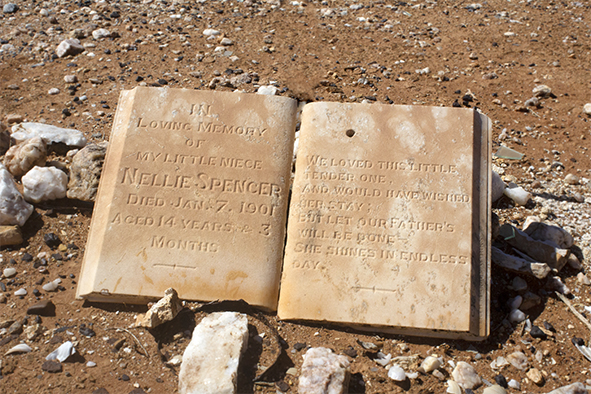
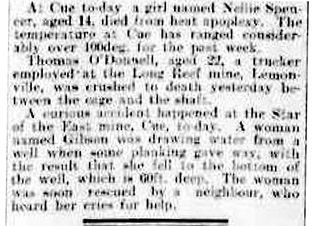
1901 – Eleanor Mary Spencer was one of two people to die of ‘heat apoplexy’ (heat stroke) at Cue on January 7, 1901, claimed The Southern Cross Times and numerous other newspapers.
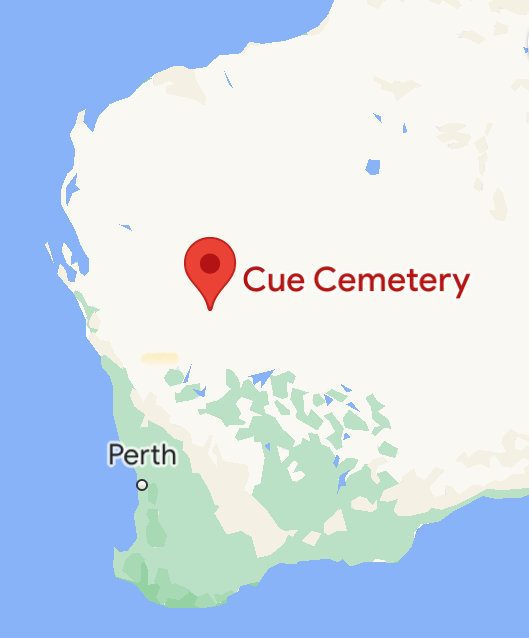
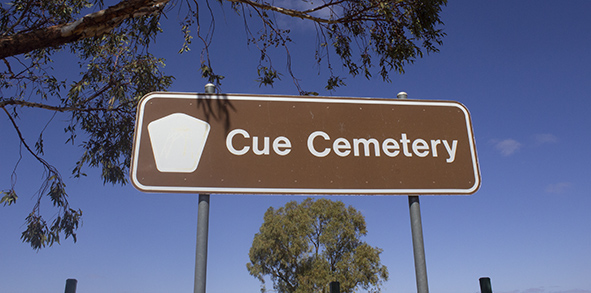
Nellie’s grave, which she shares with a baby brother, in tihe bone-dry Cue cemetery. Image: Sharyn Moodie 2020.
It was a week of temperatures above 38 degrees, in the remote Western Australia outback mining town.
The other victim, they said, was 22-year-old Thomas O’Donnell.
Unfortunately, it seems some papers got the story wrong.
Others more correctly reported that O’Donnell was killed at the Long Reef Mine, at Lennonville, not far from Cue, at about 9.20 am on Saturday, January 5.
Article image from the National Library of Australia’s Newspaper Digitisation Program
It was thought that he had gotten into the cage to go to the surface, dropped his billy lid, and in leaning to retrieve it somehow got caught between timber and the cage.
The lid was later found at the bottom of the shaft.
Cue, WA
Sources: The Southern Cross Times, Wednesday 9 January 1901, p3
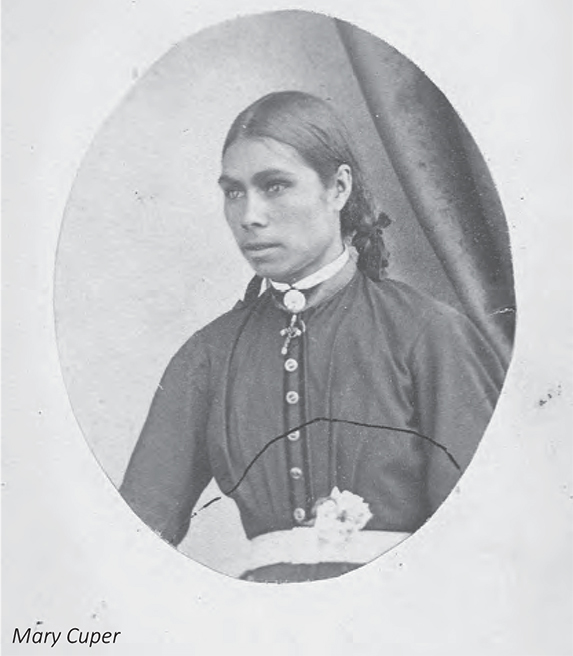
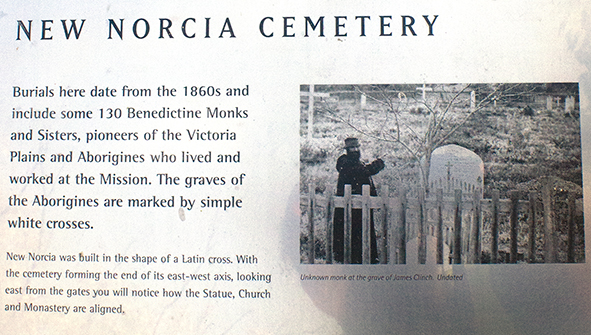
The headstone of half-Aboriginal woman Mary Cuper stands tall and proud, set apart from the simple white crosses and the myriad unmarked graves belonging to other Noongar inhabitants of the New Norcia cemetery.
Intriguingly, the words “at her sorrowful husband’s expences (sic) are found at the bottom of a description of her achievements.
The town itself, Australia’s only monastery town, was established in 1847 as an Aboriginal mission by Spanish Benedectine monk Rosendo Salvado – and like many such places, has a controversial history.
Rosendo Salvado aimed to educate the First Nation’s people, and to save them – both through knowledge of their Lord and through work, which was considered a prayer by the Benedectines.
Mary was considered a success story in his social experiment.
She was born to a European father and an Aboriginal mother in Bunbury. After her father deserted the family, she was sent to be raised at New Norcia.
Weddings between the Aboriginal inhabitants seemed to be encouraged, and Mary, aged 15, married in 1862. However, her husband died shortly after and she married Benedict Cuper the next year.
He also had an English father and an Aboriginal mother and was lauded by the mission as one of their success stories, being a farmer and cricketer. Was it that success that enabled him to afford such a grand headstone? Had his exposure to the European way of life encouraged him to desire the memento of his wife’s life? Or did the church encourage the testament to one of its success stories?
The couple had one short-lived child, and their 15 acres of farmed mission land was often shown off to important mission visitors.
Salvado trained Cuper as a telegraphist, teaching her Morse code.
When the postmaster position in the newly opened line to Geraldton became available in May 1873, he put her forward for the job.
The superintendent of telegraphs, James Fleming, feared Cuper would be an “inconstant worker” and thought “it will be necessary to appoint someone to whom the quarters and a small salary will suffice.”
However, with Salvado’s support, she was appointed to the role in August, becoming the first female in that position, and was paid the same as a European employee – thirty pounds a year.
Her capabilities were described as exceeding “any apprentice the superintendent of telegraphs had ever seen.”[3]
But it was not long before the ravages of tuberculosis affected her health. She had already trained another Aboriginal woman Sarah Caruingo Ninak, who took over as she became more ill.
Mary was inducted into the WA Women’s Hall of Fame in 2021.
And while her sorrowing husband paid for her simple yet poignant headstone, Salvado, who died in Italy in 1900, is interred in a marble tomb in the New Norcia Abbey church.
The New Norcia Cemetery
In the cemetery itself are more than 300 graves, some elaborate, some unnamed, some unmarked.
In an ABC story, current Abbott Father John Herbert, said many Aboriginal graves were unmarked because “that was the Indigenous community’s custom at the time of the burials”.
Interpretive sign at the gates of the New Norcia cemetery. An un-named Aboriginal grave, in front of the graves of some of the clergy who died in the the town. Image: Sharyn Moodie 2020
Image: Sharyn Moodie 2020
Another poignant headstone in the cemetery belongs to Lila, aged 10, who died of dysentery in 1909. She was a boarder at the town’s school St Gertrude’s opened the year before. It was considered too dangerous to send her body home to her parents at Beverley, 170 kilometres away, so she was buried at New Norcia.
1917 – Alfred Chesson, 19, accidentally shot himself on the way home from a hitherto-successful shooting expedition.
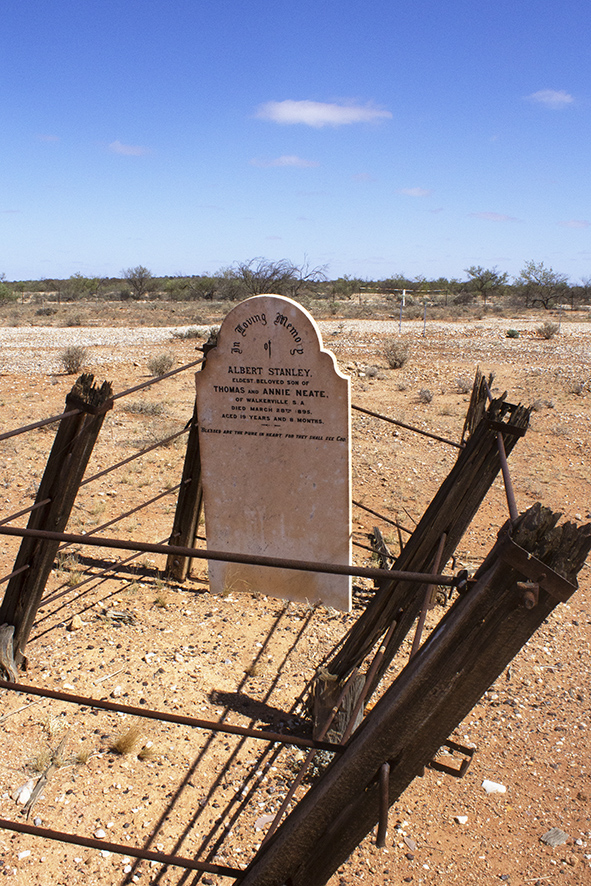
Alfred Chesson, Cue cemetery, accidentally shot 1/4/1917. Image Sharyn Moodie
The family lived at Day Dawn, a Western Australian gold mining settlement which today is a whisper of a ghost town, 6 kilometres from Cue.
On Saturday afternoon Alf, his father, also Alfred, and a younger brother had taken their sulky on a shooting excursion, and camped that night at thea local water hole.
According to a local newspaper, on Sunday “they had an enjoyable day amongst the game, and were on their way home with a good bag on Sunday afternoon, when some plovers were seen off the road”.
Alf got out and shot at the birds, which flew away but landed a short distance away. He decided to try again, but did not fire at them.
This is where he made a fatal error – he did not unload the gun again.
As he was getting back into the sulky, he was helping his father and brother bring a rug over their knees, and the gun, in his left hand, went off.
“The charge entered the lad’s head above the left ear blowing part of the skull away.”
The Murchison Times and Day Dawn Gazette
“Death was instantaneous. The father and brother received a great shock, and it was some moments before they fully realized that Alf was dead.’’
The newspaper sun his praised as a reliable young eldest son.
“Young Alf was employed at the Telegraph Office at Day Dawn, and had only recently celebrated his nineteenth birthday.
“He was due for his holidays, and was looking forward to a trip to Perth at an early date.
“He was a lad who had gained the respect of all, for smartness and courtesy in his position, and was looked upon as being one who would rise in the Department.
Sources: The West Australian, Tuesday 3 April 1917, p8
The Murchison Times and Day Dawn Gazette, Friday 6 April 1917, p2
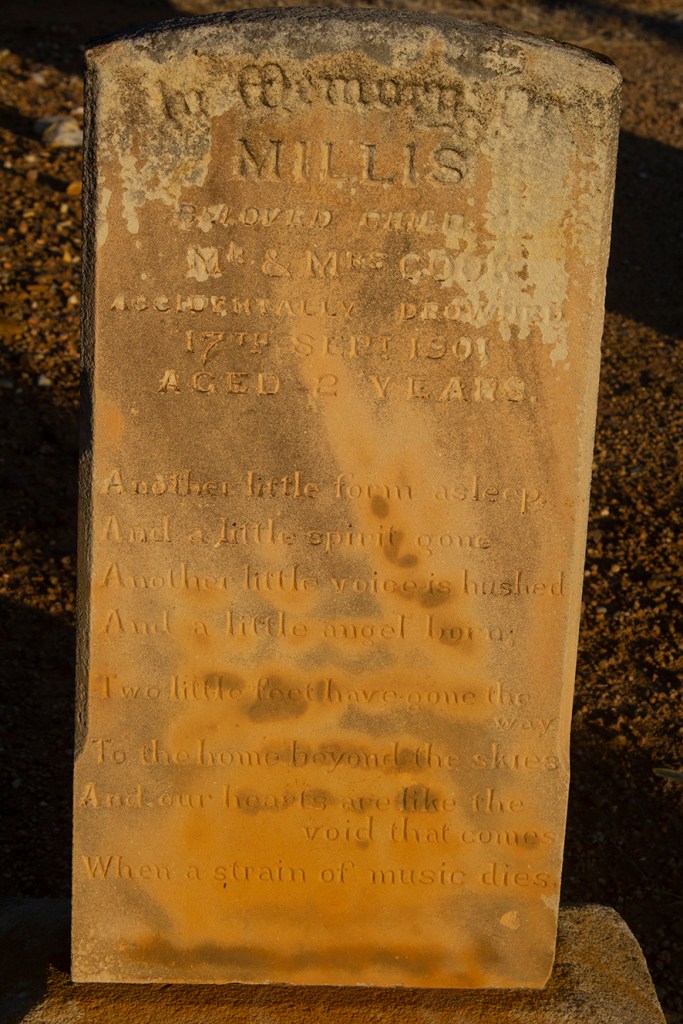
1901 – Farmer Ernest Pye was walking near the Mudgee Racecourse, central New South Wales, about 7pm one evening when he heard a woman cry.
Turning around, he saw a woman sitting outside her house with a child’s wet body in her arms.
The woman was Helen Cook, the mother of ten children.
She had missed her two-year-old daughter Millie about 6pm, but her other children said she was in another room of the house.
When she went to check a little later, she could not find the girl.
She quickly found Millicent’s body floating in the dam.
Her 10-year-old sister told the inquest she had been at the back corner of the house with Millicent, but when she tried to lift her up she “got in a scot and ran away towards the road; I went inside”.
Poor Mr Pye tried to “pump the water from the body, but he could get none from it, and said he thought the child was dead’’.
The doctor soon arrived and confirmed that he was right.
The gravestone records she is the daughter of Mr and Mrs Cook, although the inquest heard Mrs Cook had been living apart from her husband for nine years, and declined to say who the child’s father was.
Millis accidentally drowned, beloved child of Mr and Mrs Cook, aged 2, 7 September 1901. Mudgee cemetery. Image: Sharyn Moodie.
Mudgee, NSW
Source: Mudgee Guardian and North-Western Representative, Thursday 19 September 1901 p 9
Patrick Hackett’s impressive gravestone in the York cemetery also contains a memorial to his short-lived first son.
Beverley, WA, 1884 – Constable Patrick Hackett, 26, may have been in a great mood the Friday he was murdered. He had, after all just become a father.
His first child, a boy, had died ten days after being born, but now he and his wife of two years, Mary Anne, were the proud parents of a week-old infant.
He was the sole policeman in the small farming town which also serviced the local sandalwood industry.
So, life being good, Hackett made a decision which probably cost him his life.
It was September 12 and two drunken ex-convicts had started an argument in the bar of the town’s only hotel, the Settlers Arms, having arrived in town on the York mail cart late that morning.
The publican called Hackett to sort out Andrew Miller and Thomas Carberry (also spelt Carbury).
Mid-afternoon, Hackett arrested both men for drunkenness and “marched them to the station”.
The prisoners had with them a bundle of clothing which Hackett suspected was stolen, so he arranged for them to appear before the court on Monday morning. But here Hackett made his fateful decision – he allowed both men bail, Carberry apparently promising to return later with the one pound of bail money.
Later that evening Hackett went to search for the men – some reports say for the bail money, others that he was just going to the hotel (where the duo were staying), to make sure they were behaving.
He never made it to the hotel. The next morning his severely beaten-about-the-head body was discovered near the Beverley showgrounds by his in-laws, who were out searching for him.
Always keen to describe a good murder, one newspaper gave this description-
“The deceased’s head and face had been so crushed in by violent blows of some heavy weapon, as to be almost unrecognizable; in addition to which the poor man had received several stabs in the face, neck, and breast, while his pockets had been rifled of all their contents.”
Two recently washed hammers were found in the nearby blacksmith shop, apparently stolen before being used for the ‘’horrible deed’’ and then returned.
A police posse spent the following four days pursuing the wanted men over the local countryside.
Carberry and Miller had been joined by another ex-convict, William Brown, by the time the police party caught up with them at the Dale River near Waterhatch Farm, east of Beverley.
A dramatic “Kelly-gang style shoot-out’’ followed, with numerous shots exchanged.
Brown was shot and killed, Miller was wounded and died a short time later – but not before confessing to his involvement in Hackett’s murder.
Carberry escaped and continued to elude them until he was recognized by the police constable at The Lakes and was captured.
By then, Hackett had been under the ground four days, having been buried at the York cemetery on September 14, at a funeral attended by over 200 people including his widow and his one-week old son.
Carberry was found guilty of Hackett’s murder and hanged in the Perth Gaol on October 23, 1884.
Perth Gaol in 1860 – the prisoners’ yard is where Carberry was hanged in 1884. Image courtesy Museum of Perth.
While in jail, he made a will, attempting to leave all his property (some cut sandalwood, two horses and a few pounds owed to him as wages) to Mrs Hackett.
A newspaper said that after his conviction he never mentioned Hackett by name, but always “alluded to the poor fellow as ‘that man”’ and never giving any hint as to why he killed him.
He did not go to his death easily and the description of his hanging makes for fascinating reading.
He was restless the night before, and on the morning of his death “he became so extremely agitated that the Head Gaoler thought prudent to give him a small glass of brandy’’.
This did not calm him enough, and he was in such a state they decided to knock off his irons in his cell, rather than in the exercise yard (also where he was to be hung).
“Owing to the bolts of the rivets being too hard, and the chisels being too soft, nearly half an hour was spent in striking off the irons, during which time the wretched man gave vent to heart-rending groans which resounded throughout the building.”
He was so distressed the decision was made to hang him in a chair and one was readied on the drop “but after, further consideration it was removed, and two short planks were placed across the drop to afford, standing space for two constables to hold the man up.
“At three minutes to eight the hangman entered the prisoner's cell in order to pinion the condemned man, but he was in such an agitated state that he was unable to stand, and two warders, assisted by two constables, had to hold him up while his arms were being tied behind his back.
“During the operation the prisoner gave vent to the most lamentable groans, and seemed to be quite delirious with fear.
“The order was then given to conduct him to the scaffold, but Carbury was totally incapable of standing, much less of walking.
“A policeman then took hold of either arm and literally carried him into the execution yard, but great difficulty was experienced in getting him up the winding staircase leading to the drop.
“At last the culprit was placed on the drop in his stockened feet, the cap was pulled over his head, and the fatal noose adjusted round his neck.
“The unfortunate man seemed to be in a perfect paroxysm of terror, and although he was firmly held he kept blindly staggering upon the drop evidently trying to get off the fatal spot. His attendants, however, led him back to his proper place, when the lever was drawn and Thomas Carbury was launched into eternity.
“So skillfully had the fatal knot been adjusted that the criminal died instantaneously, for after he fell not even a single quiver was to be seen in any of the limbs.
So ended a tale which began with a hopeful young family man going about his work, and ended with two men chased down and killed and the terror-filled execution of his third murderer.
York cemetery, where Hackett is buried, is about 30 kilometres north of Beverely, where he died.
Want to read more fascinating accounts of deaths, originating from trawling around some of Australia’s most remote cemeteries? Then please subscribe.
Sources: The Daily News, Thursday, 23 October 1884 – p3, Thursday 18 September 1884 – p3, Saturday 20 September 1884 – p3
The Inquirer and Commercial News, Wednesday 17 September 1884 – p3
York Cemetery Historical Walk Trail, compiled by Anthony Clack and Julie Rae. Published by The York, Society Inc 2006.
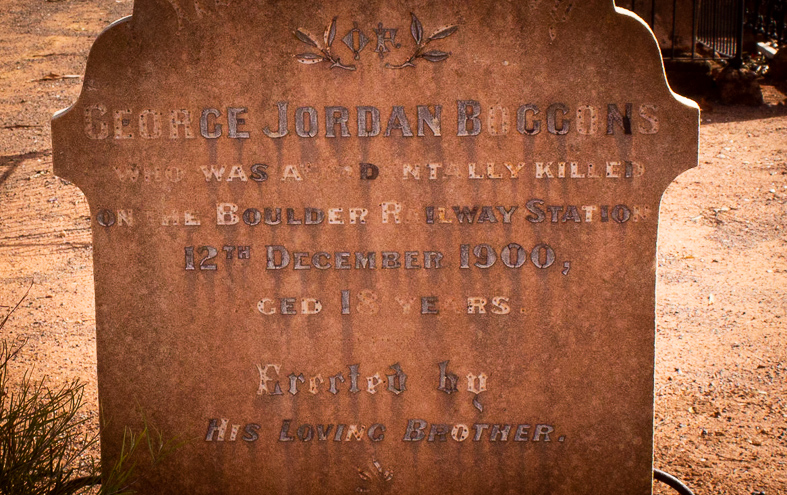
1900 – While accidents abounded in the Western Australia goldfields, poor young George Boggons died before he even got to work.
The 18-year-old worked as a blacksmith’s striker on the Boulder Main 1 Reef, and usually caught a morning train to save himself some of the walk to work.
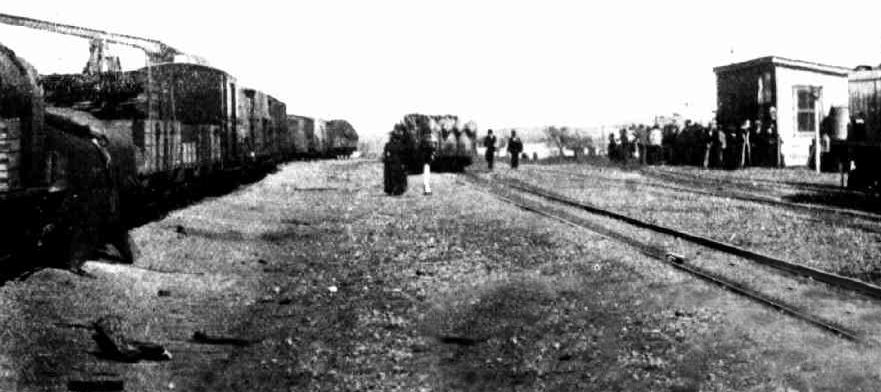
The Boulder Railway station a year before George’s death
Unfortunately, on this Wednesday in December, he arrived at the Boulder Railway Station as the train started to move.
“Though it had got up a good speed he tried to board it,’’ said a newspaper report.
But before he could get abreast of the carriage, he was somehow knocked off and fell between the carriage and the platform.
Nobody on the train noticed, but station officials rushed to his aid.
Although he did not look badly injured, he knew things were not right, telling one of the porters
‘My God, I won’t live through this.”
George Boggons
and he was right. At the hospital, it was discovered he had broken ribs, but more seriously, torn lungs.
George’s parents had recently moved away from Boulder, so his only nearby relative, his brother, was sent for and stayed with him until he died just before midday.
The coroners inquiry found the death was due to George’s attempt to board a moving train and laid no blame on the railway station.
George’s headstone at the Kalgoorlie cemetery. How long until it is illegible? Images Sharyn Moodie
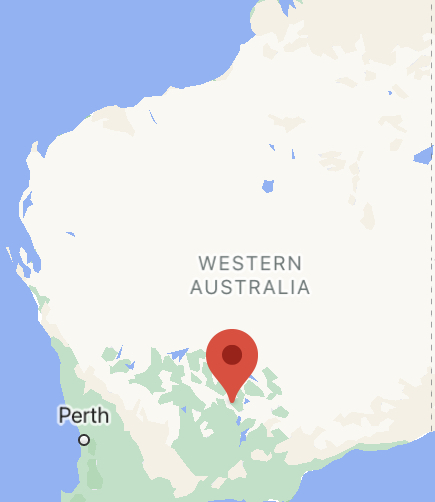
Kalgoorlie/Boulder, WA
Sources: Kalgoorlie Miner Thursday 13 December 1900 p 4 and Tuesday 18 December 1900 p 4
Coolgardie Pioneer, Saturday 2 September 1899 – Page 2
If you want an email each time I post a new blog, enter your email address below.
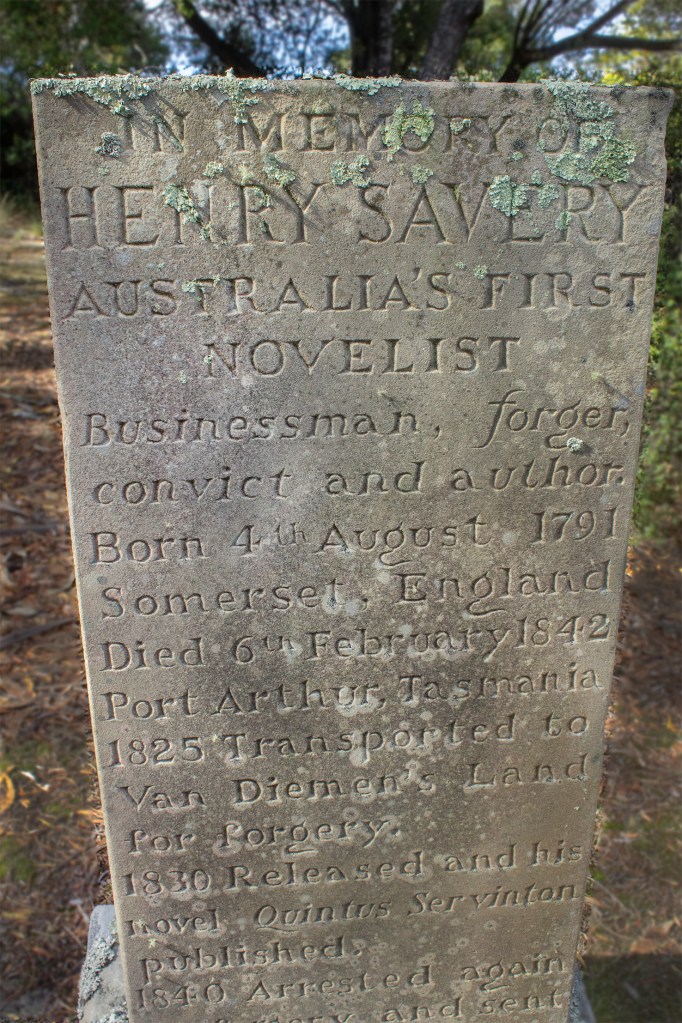
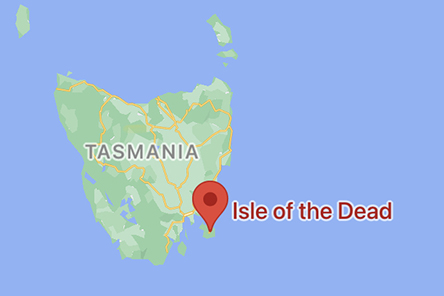
Port Arthur’s eerily-named Isle of the Dead is the repository of more than 1000 convicts, officials and their families who died at Tasmania’s infamous penal settlement.
Many graves were not marked, and their stories are lost to time.
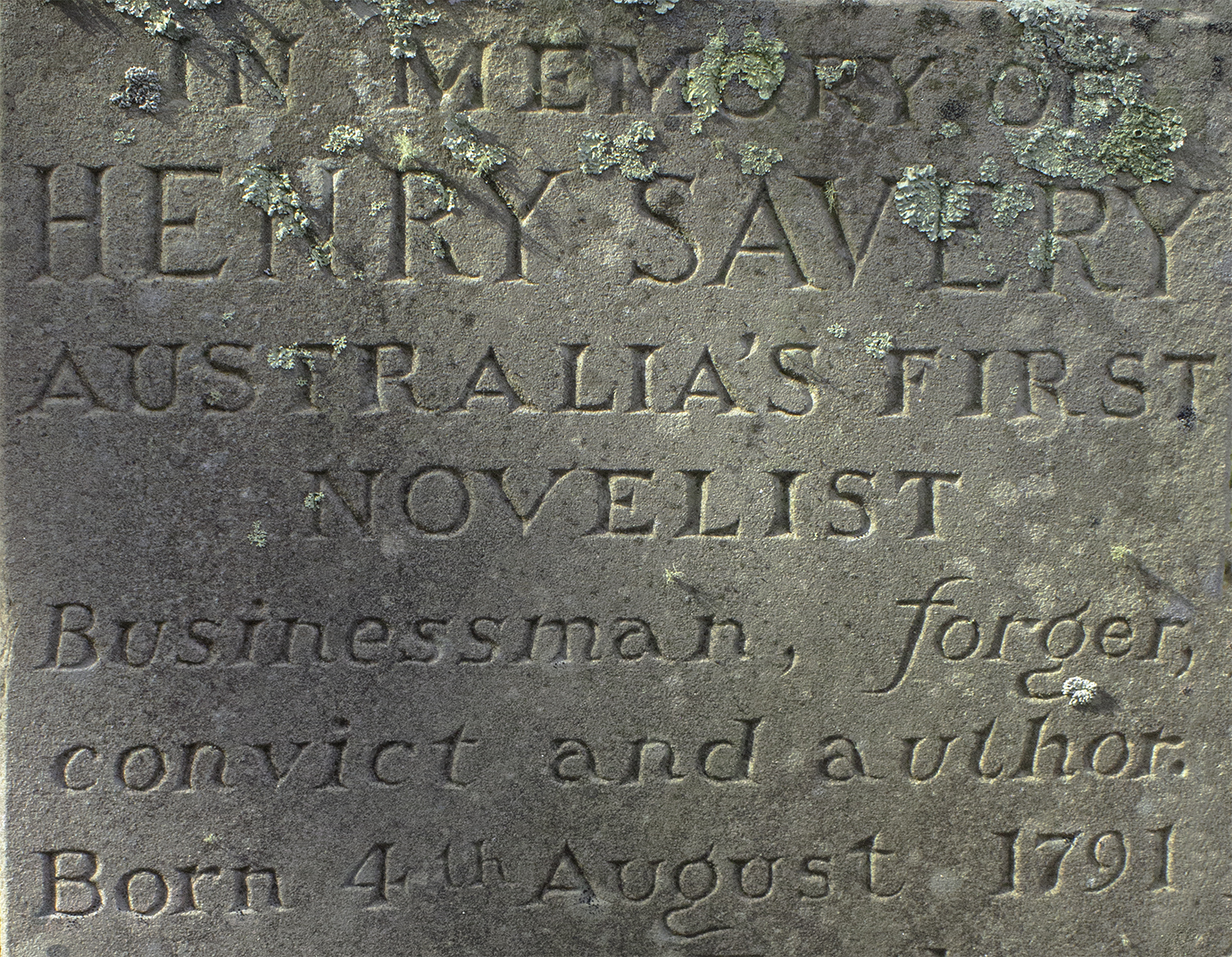
But one convict has been remembered, due to his special place in history.
Henry Savery’s writing skills led him down two very different paths – forger and novelist.
But it seems his accounting skills were to blame for his forgery, as he tended to commit forgery as a way to avoid his businesses’ bankruptcy. He also tended to try suicide.
The headstone above was placed on Port Arthur’s Isle of the Dead in 1992 to honour the 150th anniversary of his death.
Born in London, and with a grammar school education finished with a business apprenticeship, he was a partner in a sugar refining business when he forged some bills. He was found out and fled by ship (with a good amount of stolen money) but was caught within half an hour of sailing. He threw himself overboard but didn’t get far.
The resultant death sentence was commuted to transportation for life the day before he faced the gallows.
He sailed for Hobart in 1825, leaving behind his young wife and child. While his education led to him serving his time working in colonial offices, there was political tension over a convict being employed by the unpopular Lieutenant, Governor George Arthur.
Savery paid the price – he was penalized by having his possessions sold off – meaning that when his wife Eliza and son Oliver arrived by ship in 1828, having survived a shipwreck and become very close to fellow shipmate and attorney-general Algernon Montagu, he was still bonded and penniless.
His wife had expected him to provide more comfortable circumstances, and this, along with doubt about his wife’s fidelity led to a suicide attempt – cutting his throat.
He survived, but after Savery was back in prison for debt, his wife left, never to return.
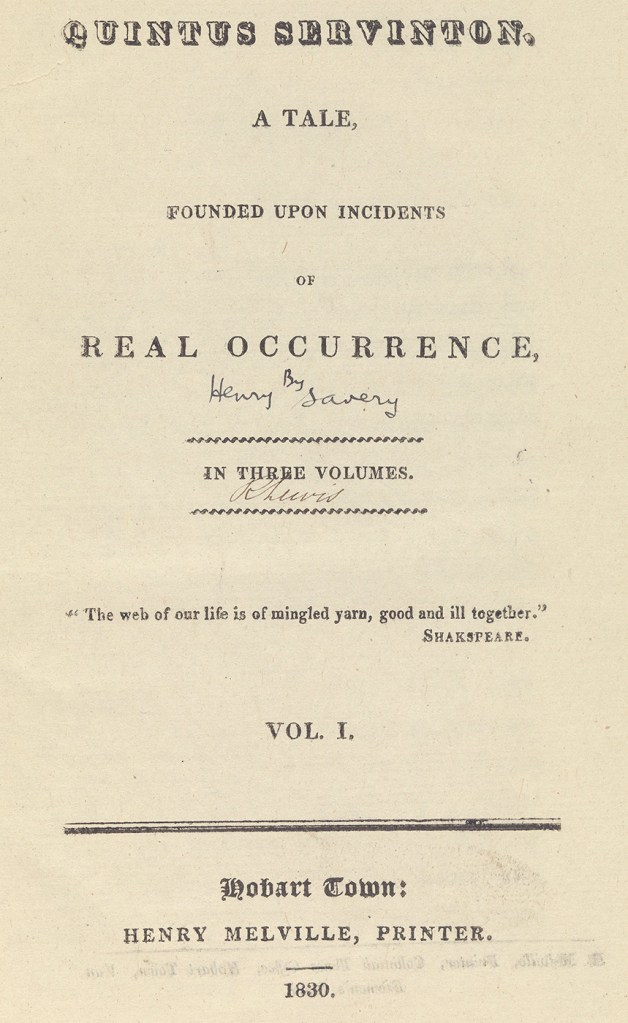
While in prison, Savery wrote satirical sketches under a pseudonym, which was gathered into a volume and published as Australia’s first book of essays in 1829. He also started his semi-autobiographical novel Quintus Servinton. It is considered important because of its unique position as a first-hand account of convict life.
His book was published anonymously in 1831.
While Savery was given a ticket-of-leave in 1832, his problems were far from over. It was revoked when he was again caught up in anti-Arthur sentiment, and it wasn’t until 1838 he was given a conditional pardon.
He gave farming a try, but as a farmer, was a more successful novelist, and his attempts to get out of financial trouble meant that two years later he was again found guilty of forgery and sent to Port Arthur – condemned by his wife’s former protector, Montagu.
After two years on that remote and unforgiving settlement, he died in 1842, after at least one more throat-slitting suicide attempt, possibly from a stroke.
Despite its aged appearance, the headstone above was only placed on Port Arthur’s Isle of the Dead in 1992 to honour the 150th anniversary of his death.
Isle of the Dead, Port Arthur, Tasmania, Australia
1909 – Mining accidents were common in the early days of the 20th century, yet when Ambrose Fox was burnt to death by an explosion of molten metal in the Great Cobar mine, his funeral was said to be the largest the town had ever seen.
The 44-year-old was killed after a repaired appliance known as a settler was put back to work.
Ambrose was tapping the No. 2 furnace, when the metal shot out, burning him on the chest, arms, legs and head. He was only three yards away.
He was rushed to hospital but died the same day.
A four-day inquest was held into the incident.
The 44-year-old was a recently remarried widower, with three children to his first wife and a toddler daughter to his second.
He had been a butcher, most likely in Warren, but went bankrupt during a drought in 1902. Ater the death of his first wife Ellen in 1899, the children were sent to live with their grandmother in Gilgandra.
Ambrose went to Cobar to work in the copper mines, staying at the Great Western Hotel or the Railway Hotel, run by a Tom Clark/e and his two sisters. Fox married one of them, Rose, in 1906.
Several witnesses testified that prior to the explosion leaks had been noticed, and the men refused to work.
The repairs included the substitution of a spray pipe inside a steel casing in the ordinary jacket appliance.
This and the alleged dampness of the new brick-work were said to be responsible for the explosion, “but the mine authorities claimed that no undue haste was made in putting the settler into operation after the repairs.
“The jury returned a verdict of accidental death, but added a rider to the effect that in cases of any accident in future the damaged jacket should be taken out, and properly repaired, that the brickwork be allowed to thoroughly dry before being used, and that proper provision be made for safety of tappers and others in anticipation of explosions.
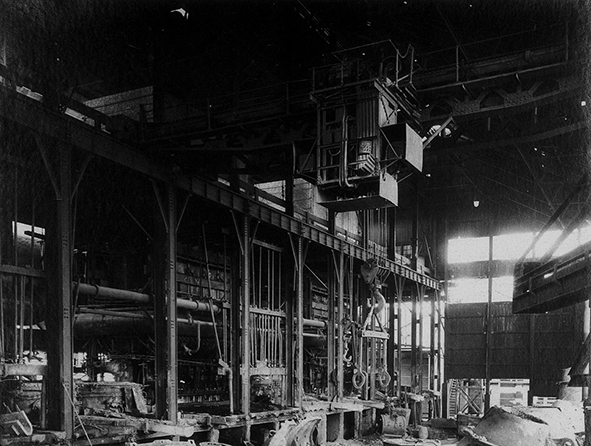
The Great Cobar mine furnaces in 1912, three years after Fox died.
“The funeral took place on Friday afternoon, starting from the Roman Catholic Church, where the remains had lain throughout the day.
The solemn procession wended its way along Barton Street to Becker Street, and was the most largely attended funeral ever seen in Cobar, or, at all events, for a great number of years.
“Along the route of the sad procession people were lined in big numbers.
“The cortege was headed by the President, Secretary and Treasurer of the Amalgamated Miners Association (AMA), to which Society the deceased had belonged.
The Town Band came next, playing the Dead March by Handel, followed by 340 members of the AMA, walking four and five deep.
This was followed by about 60 cyclists, the hearse, mourning coach and about 50 vehicles, several horsemen bringing up the rear.
The remains were interred in the Catholic portion of the cemetery.
Ambrose’s son Alfred, who was about 18 when his father died, was working as a junior clerk in Dubbo. He went on to become Town Clerk of Parkes Municipal Shire for a record-breaking 42 years and there is a park named after him in Parkes today.
Cobar, NSW, where Fox is buried.
SOURCES: The Argus Friday 5 November 1909 p 7
The Cobar Herald Tuesday 2 November 1909 p 2
The Sydney Morning Herald Friday 29 October 1909 p 6
1873 – Joseph Paxton’s mining company was said to be one of the best-managed in the Hills End district of New South Wales.
However, when it came to mining in the early years of Australia, anything could happen. And unfortunately it did, to one William Oliver.
Basically, Oliver heard a bang, thought the explosive charge he had just set had gone off, went to attend to it, whereupon it did go off – and killed him.
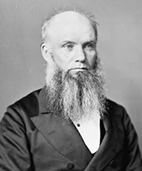
Joseph Paxton
Paxton’s was the biggest of 255 companies at Hill’s End at the time, and had a number of mine sites and ventures.
Paxton was big on safety. A few years earlier he had joined a deputation to the Minister for Lands to seek the appointment of a mines inspector for gold mines.
However, no appointment of any man would have saved William Oliver’s life. It was taken by simple human error.
Oliver and another man had drilled three-foot hole in the side of a wall late on the morning of May 24, as part of an effort to bring down mullock.
They lit a charge, but it went out. They cleaned out the hole, carefully recharged it, relit the fuse and retreated again.
The Evening News in Sydney gave this quite wordy explanation of what happened next.
“When after waiting the customary time a blast was heard to go off in the direction of the charge they had fired, and the deceased there-upon, pick in hand, sallied out to resume his work, but, horrible to relate, the report which had been heard was one, it appeared, from the adjoining claim Star of Peace — the workings of which open into Paxton’s, and no sooner had the deceased returned to the place where the charge had been put in than the blast went off, inflicting such serious injuries on the deceased as resulted in his death in about an hour after his admisssion into the Hospital.
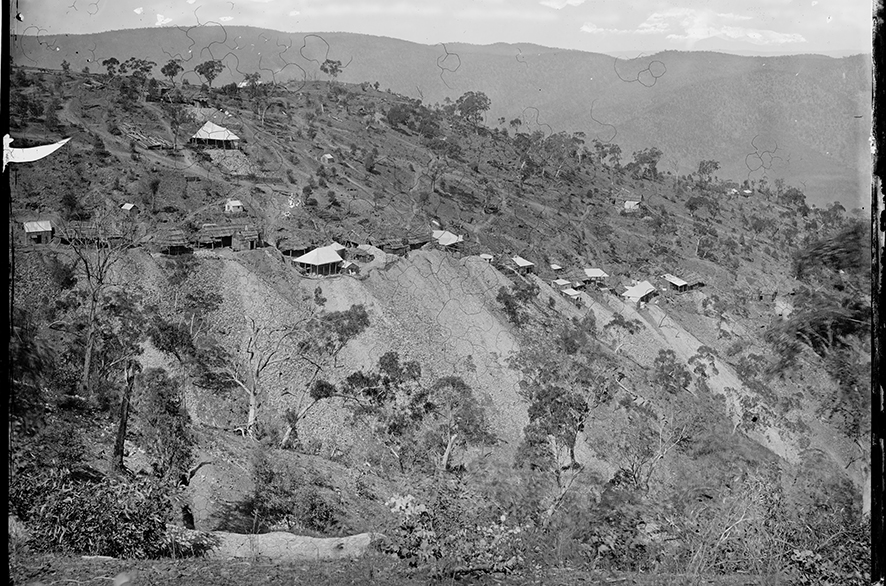
The Star of Hope mine adjacent to Paxton’s mine, where an explosion misheard by Oliver lead to his death.
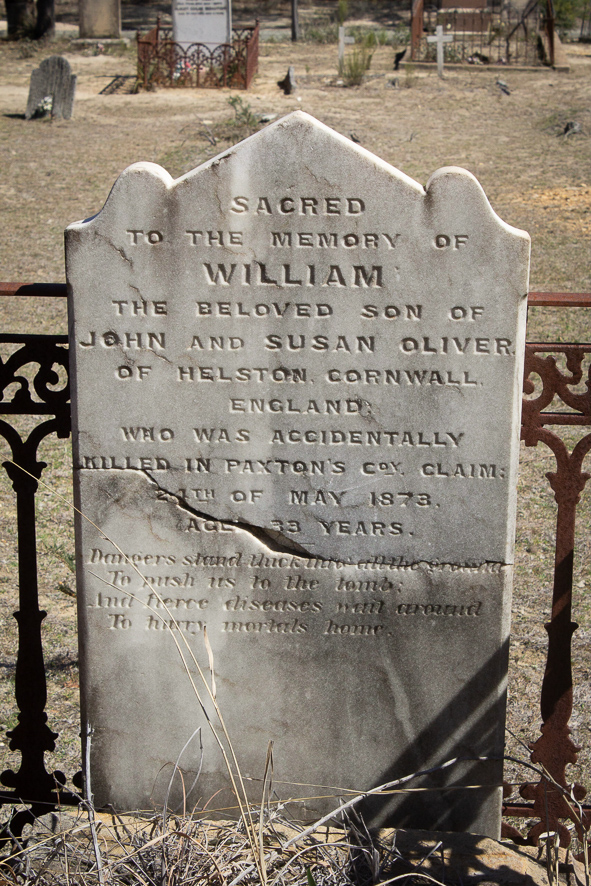
The inquest jury heard Oliver’s pockets contained receipts for large amount of money, as he planned to return home to Cornwall, England. He had two brothers also in Australia.
The funeral took place on an inclement Sunday afternoon, where a large number of people followed the remains to the cemetery at Tambaroora “amidst the touching and solemn strain of choir of miners”.
Oliver’s headstone stands still at the small cemetery which still stands just a few kilometres from the National Parks-run Hill End township.
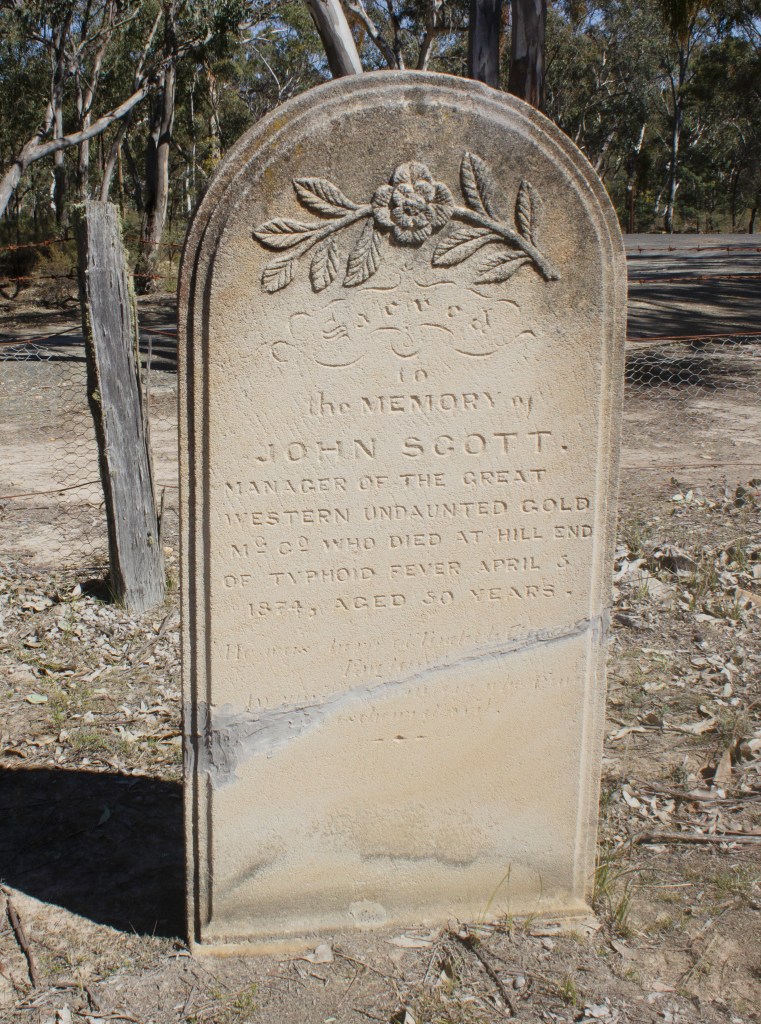
Not far from his grave lies a fellow countryman, also from Cornwall. John Scott’s position as a mine manager did not protect him from the ravages of the mine fields.
Mitchell Library, State Library of New South Wales Goldmines in the southern section of Hawkins Hill, (showing Star of Hope two-storey mine), Hill End, viewed at https://collection.sl.nsw.gov.au/digital/ePqZ6o3LyXexp














 Way to go Australia