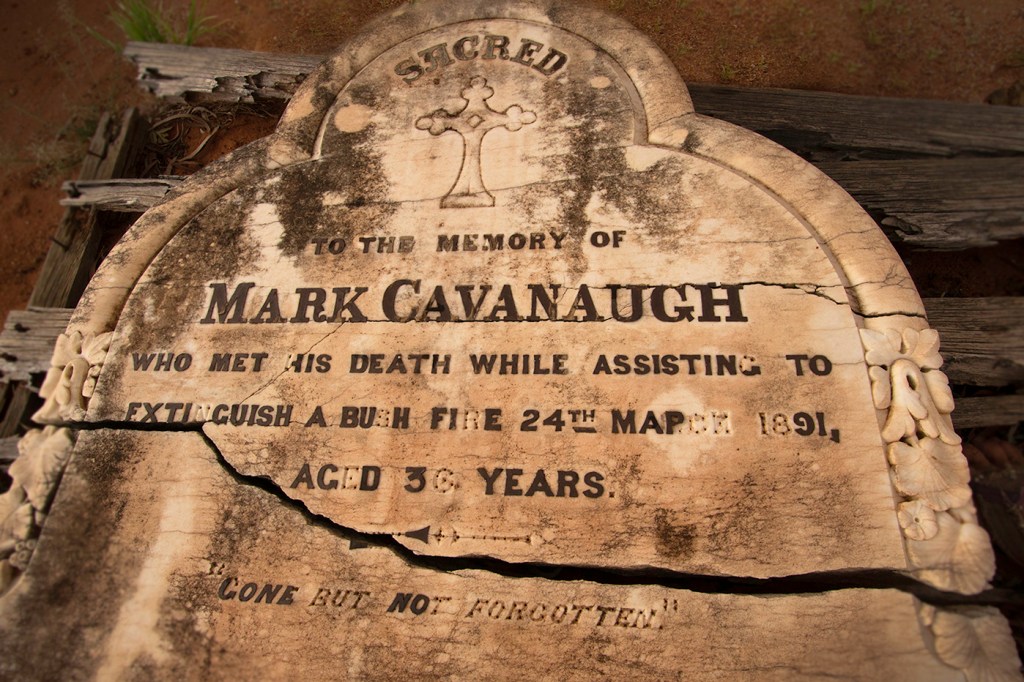
Tambo cemetery, Queensland: Sacred to the memory of Mark Cavanaugh, who met his death while assisting to extinguish a bush fire 24 March 1891, aged 36.Image: Sharyn Moodie
As the shearer’s dispute of 1891 raged around him, a union carrier named Mark Cavanaugh was burned to death helping to put out a bushfire.
The strike, which sparked the development of the Australian Labor Party, was over the use of non-unionised shearers. From February until May that year, central Queensland was on the brink of civil war.
Striking shearers gathered in armed camps outside of towns and the government sent in soldiers to protect non-union labour.
The unionists fought back by “raiding shearing sheds, harassing non-union labour and committing sabotage although the incidents of actual violence or arson were few, ” according to Wikipaedia.
Although the fire which Cavanaugh was fighting was not deliberately lit, unrelated stories claim unionists had been lighting fires in the general district.This fire started at a nearby grazing property, and was attributed to sparks from a travelling sheep camp getting away.
Rain soon put out the fire Cavanagh was fighting, but it was too late. It was presumed that he had been thrown from his horse and stunned.
He was badly burned and taken from Tambo Station to hospital by a four-in-hand team (four horses, one carriage) from Tambo Station and died in hospital within a few hours.
The poor fellow was roasted from his head to below his knees, and his clothes were burnt completely off, except a little portion of the legs of his trousers.
newspaper report
Tambo Hospital in 1900, nine years after Mark Cavanaugh died there. State Library of Queensland.
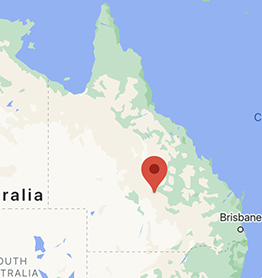
Tambo, Queensland.
SOURCES:
Queensland Times, Ipswich Herald and General Advertiser, Wednesday 25 March 1891 p 5
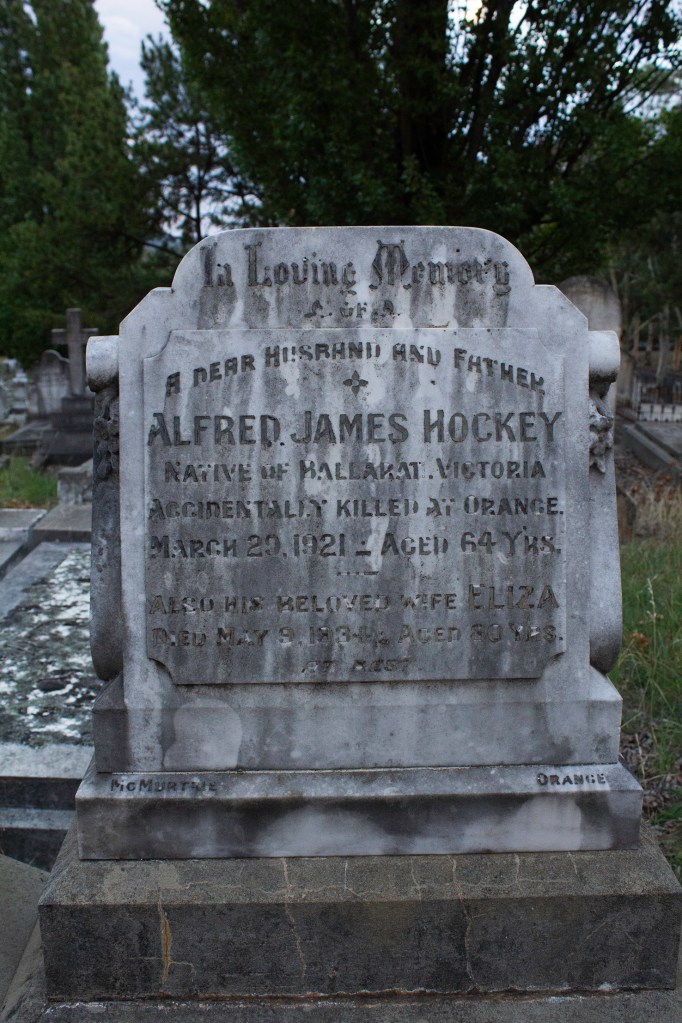
Orange cemetery: Alfred James Hockey, native of Ballarat, Victoria, accidentally killed at Orange, aged 64 yrs. Image: Sharyn Moodie
It was 64-year-old Alfred James Hockey’s habit to meet the Forbes mail train by taking a short cut across the tracks at Orange Railway Station.
He had “rheumatism’’ and so avoided the longer route via an overhead footbridge, half a mile away.
His mangled remains were found near the station by two railway shunters on March 29, 1921.
He had been dragged about 25 metres by the train.
“The back had been broken about the middle, and a mark and bruises traversed it. Some of the organs, particularly the lungs, had been forced out of the thorax.’
reported the local newspaper
His left arm was nearly severed above the wrist. Death had been instantaneous.
It is thought he had verbal permission to take the short cut, although no one at the inquest admitted to that.
There were signs posted at the station declaring the route Hockey took was forbidden.
Sources: Leader (Orange, NSW : 1899 – 1945)Monday 3 April 1922 p 1
The Sydney Morning Herald (NSW : 1842 – 1954)Friday 31 March 1922 p 10
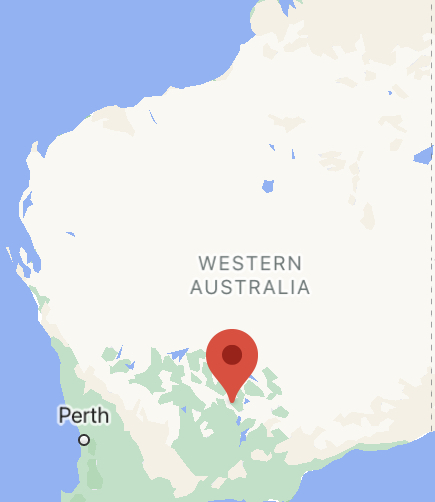
Kalgoorlie cemetery: Edwin Davis Tindall (late constable WAPF, died of fever 23rd March 1900 aged 26 years.
The scourge of typhoid ripped through mining camps across Western Australia, but it was not only miners who caught the disease.
The disease peaked over the 1890s and 1900s.
The Western Australia gold fields boasted the” largest episode of epidemic typhoid in Australia’s history”, according to the Western Australia museum.
“In the early years of the epidemic, up to twenty percent of – mostly – healthy young men, died.
Nearly 2000 people in Western Australia were officially recorded as dying of the disease, though the actual number was far greater. Most deaths occurred on the goldfields. An estimated ten times more people suffered from the disease.
Kalgoorlie policeman Edwin Tindall found that his ‘fine physique’ could not resist typhoid, and he died in the Kalgoorlie Government Hospital after a brief but severe illness. He is buried in the Kalgoorlie cemetery.
The existence of such terrible diseases resulted in the development of equally awful quackeries. One, which was available all around the world, was Dr. Williams’ Pink Pills.
Clever advertising, including the use of local testimonies, shored up its popularity.
‘’They actually make new blood-and by filling the veins with this vital fluid they fight off the deadly typhoid.
Kalgoorie Miner
“They have saved dozens of people in W.A. from contracting the fever, and they have cured its weakening after effects in scores of cases.
“Here is an instance:-“I was laid up in the Kalgoorlie Hospital for four months with typhoid,” says Mr. P. W. Hammond, contractor, Broad Arrow.
“I was so terribly weak that I was hardly fit for anything. I had entirely lost my appetite,and the food I forced down didn’t strengthen me.
“”The fever had seriously affected my heart. Palpitation was so acute that it was difficult to breath. Month after month I continued weak and sickly.
“”Then a pamphlet I got in Broad Arrow about Dr Williams’ Pink Pills, persuaded me that by building up the blood they went the right way about curing disease.
“”I tried them – and a few doses made a wonderful difference in me. Four boxes gave me back my health, and another box or two made me as strong as ever.”“
Kalgoorie, Western Australia
SOURCES: Kalgoorlie Miner Monday 26 March 1900 p 4, Saturday 24 March 1900 p 4
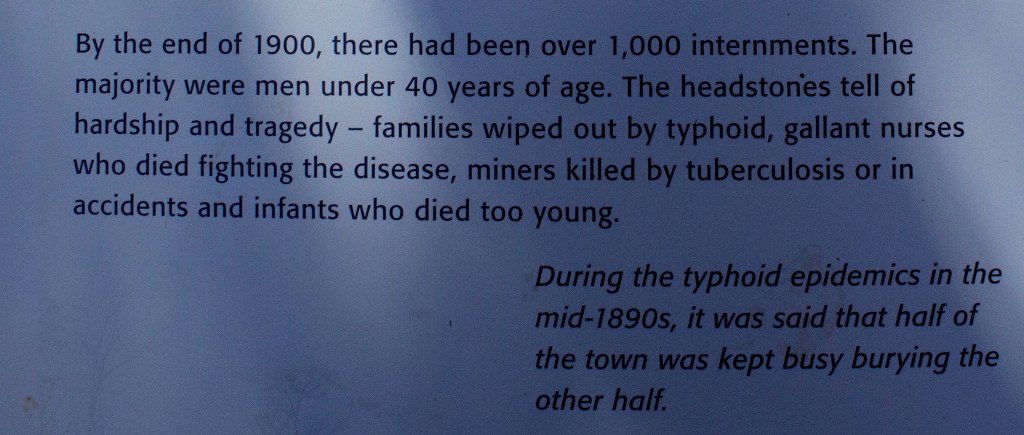
Epidemics of infectious diseases came and went in early Australian history – smallpox, measles, the plague, Asiatic and Spanish flu – but typhoid was considered endemic. Outbreaks in the goldfields were inevitable, with overcrowding, no sanitation, a limited water supply and co-existing gold fever.
It tended to occur in healthy young men and showed no respect for position or wealth. The main difference was the rich were more likely to end up with a gravestone in a cemetery, rather than buried on the goldfields, with no markers or records.
Those gravestones often gave cause-of-death as fever, although typhoid had many names, including gastric fever, enteric fever, abdominal typhus, slow fever, nervous fever, and pythogenic fever.
In memory of John Scott, manager of the Great Western Undaunted Gold mining company who died at Hill End of typhoid fever April 5 1874. He is buried in the historical cemetery at Tambaroora near Hill End, NSW. Image: Sharyn Moodie
John Scott, mining manager of the Great Western Undaunted Company’s claim near Hill End, central New South Wales, was lucky enough to be buried and commemorated in 1874.
Mr Scott, of Cornish heritage, was…
“…received into the hospital in a very low and delirious state on Thursday, and after lingering until Sunday, he also succumbed to the disease.
EVening news, April 10
The newspaper also says Mr Scott was buried on Sunday, which must have been the same day he died given the publication date of the paper.
Two decades later, on the other side of Australia, the disease peaked over the 1890s and 1900s.
The Western Australia gold fields boasted the “largest episode of epidemic typhoid in Australia’s history, with an official death toll of 2000 but a much larger true number. An estimated ten times more people suffered from the disease but recovered.
A gradual decline in cases saw a return to ‘regular levels’ by 1910.
The mining town of Coolgardie felt the impact, which is still evident in its cemetery today, both on the welcoming sign and the epithaths within.
Mining spectator Colin Gibson was one of those lucky enough to get treatment at hospital, although not much hope was held for his survival.
The 27-year old was in Coolgardie Hospital when a sentence in the Western Mail newspaper stated his case rather bluntly.
In a paragraph describing the excellent new tank at the hospital were inserted these nine words
”Colin Gibson’s condition is now considered almost hopeless.
western mail
Indeed his case was hopeless, given that the vagaries of distance and the publication process meant he had died seven days earlier.
Colin GIbson, Coolgardie cemetery. Image: Sharyn Moodie
Tambaroora, NSW
Coolgardie, WA
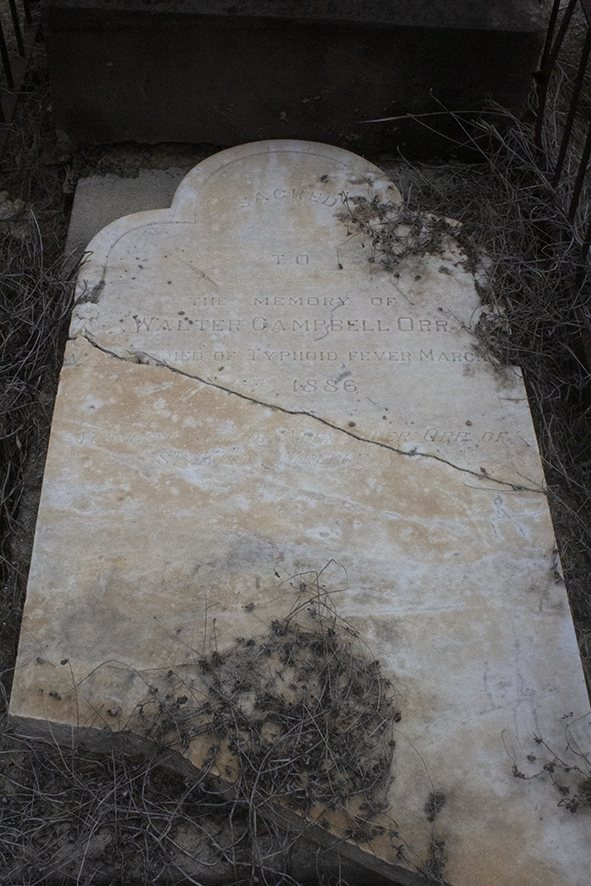
Walter Campbell Orr, who died of typhoid, is buried in the Charters Towers Pioneer cemetery. Image Sharyn Moodie 2021
Ilfracombe’s Railway Hotel licencee Bernard Muldoon sacked his yardman William Sheehan. The next day, Sheehan killed him.
How did it come to this? Muldoon was only 44, Sheehan “older than 60”, although his exact age is unknown.
Why Muldoon sacked him is lost to history, but details of an altercation the two had in the street, and the horrific aftermath, were well documented by newspapers across the state.
Muldoon managed the hotel and the adjoining butcher’s shop. The fight may have started because Sheehan was bad-mouthing the shop after losing his job.
Muldoon had knocked Sheehan down as they fought in the street in front of a crowd. Muldoon was pulled off Sheehan, who returned to his boarding room in a nearby hotel, the Wellshot, and got his tomahawk. It was either seven or eight o clock in the evening, depending on which witness account is being read.
Sheehan found Muldoon leaning over the counter of his butcher’s shop, serving a customer and hit him twice over the back of the head. Yet some reports say Muldoon was lying on the footpath when he dropped. Did he stagger outside or was the shop partially outside?
Muldoon, wherever he lay, had, “dropped like a felled ox,’ according to the Rockhampton Morning Bulletin.
newspaper report of Muldoon’s murder
Blood gushed onto the footpath from wounds in his head. He never regained consciousness before dying in hospital early the next morning.
Sheehan fled town, after first returning to the Wellshot and as he passed through the dining room, declaring to witnesses that he had hurt Muldoon.
“Now, I have settled him. If you don’t like to believe me, go and see.”
He was arrested two days later in a ram paddock 15 miles away, and claimed he was on his way to Longreach to give himself up. But he had clipped his long grey beard close, and initally gave a false name to the arresting policeman Dillon.
The tomahawk was never found.
A large crowd gathered in Longreach when Sheehan appeared for his preliminary hearing on September 17. He later appeared in the Supreme Court in Rockhampton.
He told the court:
“He was sideways on to me, and I intended to hit him here (placing his hand on the back of his neck low down).
I meant to hurt him and hurt him very much.
William Sheehan, on his murder of Bernard Muldoon
“I meant to hit him with the back or the flat of the axe, but I must have hit him with the edge.
Muldoon had recently been involved in a long legal dispute with his brother-in-law Hubert O’Kane over the management of the Railway Hotel and the butcher’s shop, following his sister Helen’s death in 1989. She had left one-third of the property to Muldoon and the other two-thirds to her children when they came of age. O’Kane had been assigned the position of butchery manager, but had to hand over all moneys to Muldoon. This arrangement apparently worked well until Muldoon married and brought a wife into the picture.
That civil case was finalised in the Supreme Court in Rockhampton in 1904 – the same court which two years later presided over the sentencing of his murderer.
Sheehan was to face death, but that sentence was soon commuted to “imprisonment with hard labour for the term of his natural life”.
Muldoon left a wife and two children.
Below is an image of the Railway Hotel, with the O’Kane family name still on the sign, taken in 1922.
It was 1883. The Wilsons lived in a weatherboard shack by the railway line between Epping station and Campbell Town in mid north-eastern Tasmania.
WIlson, a line repairer, was in bed with his wife on the night of April 9. He was about to lose his life as a drama said to be inspired by the Kelly gang unfolded.
And just like the demise of the Kelly gang just three years earlier, things were not going to go well for the perpetrators of this murder.
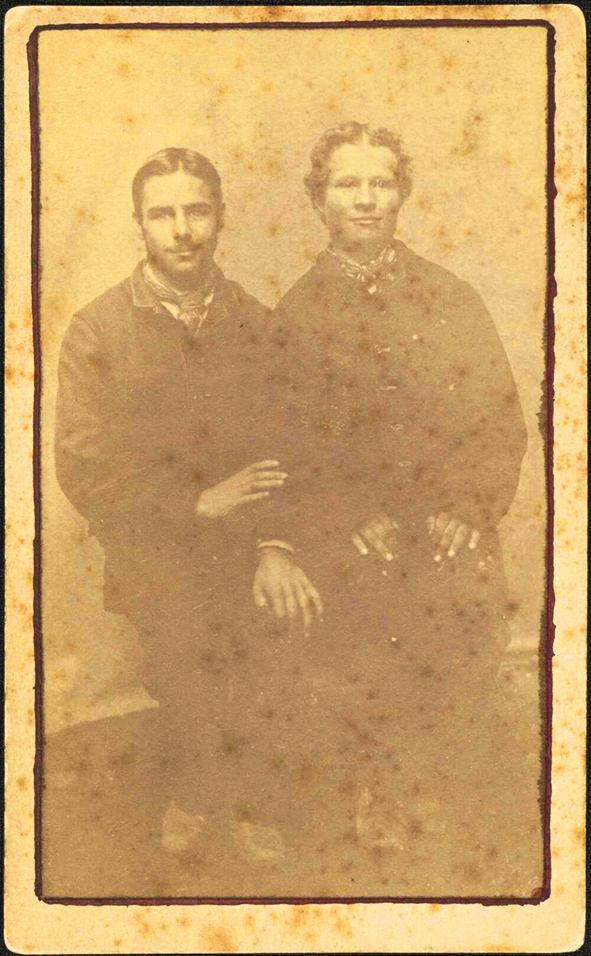
Source National library of Australia Gunson Collection file 203/7/54. This image was taken about 1878
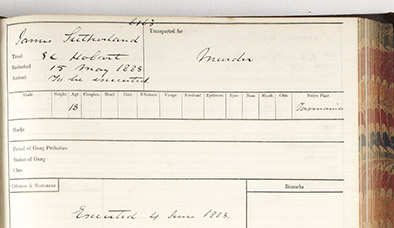
They were James (also known as Robert) Ogden, about 22 and James Sutherland (born Saunders, aka Maloney), 18.
William Wilson’s wife, Theresa, told the court that on that Monday night, the 9th, she and her husband were in bed before 9pm. Also in the house were an overnight boarder, Mary Boram and the four Wilson children, three boys and a girl.
After a while they heard a noise like gravel being thrown on the roof.
Wilson said it was probably rats in the palings, but when a second stone was thrown on the roof, Wilson got up to see where the dogs were. They were outside, but had not barked.
After a third stone came, Wilson went outside. Theresa heard a word spoken, then heard a shot.
She went to the door, and Wilson reeled by, saying to his wife “I’m shot.
She heard the perpetrators threaten that if she didn’t come out they would set fire to the home.
The voice outside said “Come on, Kelly, we’ll get sticks and set fire to the place, and burn them out.’
Flames consuming the weatherboard home soon compelled the household members to run outside.
As the boarder Mrs Boram came out, dragging a box full of clothes, she also was shot.
Sutherland, realising Wilson’s daughter recognised Ogden, grabbed her and started to take her towards nearby forest. A desperate Mrs Wilson followed, until Sutherland put the gun against her breast, threatening to shoot her if she didn’t go back.
Mrs Wilson headed for their neighbour Barker’s property, about a quarter of a mile away, for help, but the three men there would not go outside – but Mr Barker did contact the police the next morning. After daylight Mrs Wilson headed out and found all four of her children unharmed. She had not seen her husband since he was shot the night before. The next time she saw him, it was to identify his body with the coroner.
Mrs Boram, meanwhile, had pleaded with Sutherland to not shoot her again and given him four half crowns. Weak and bleeding, she had crawled away to safety.
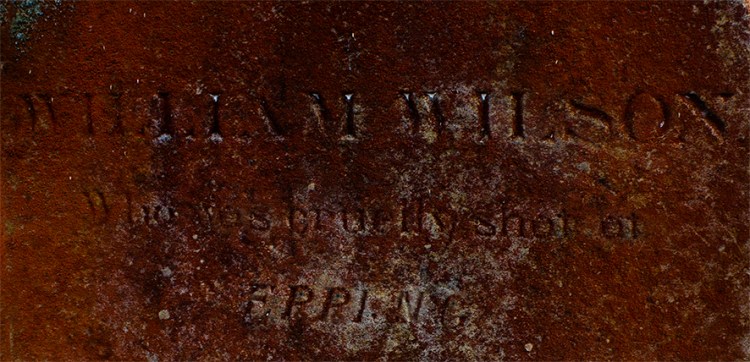
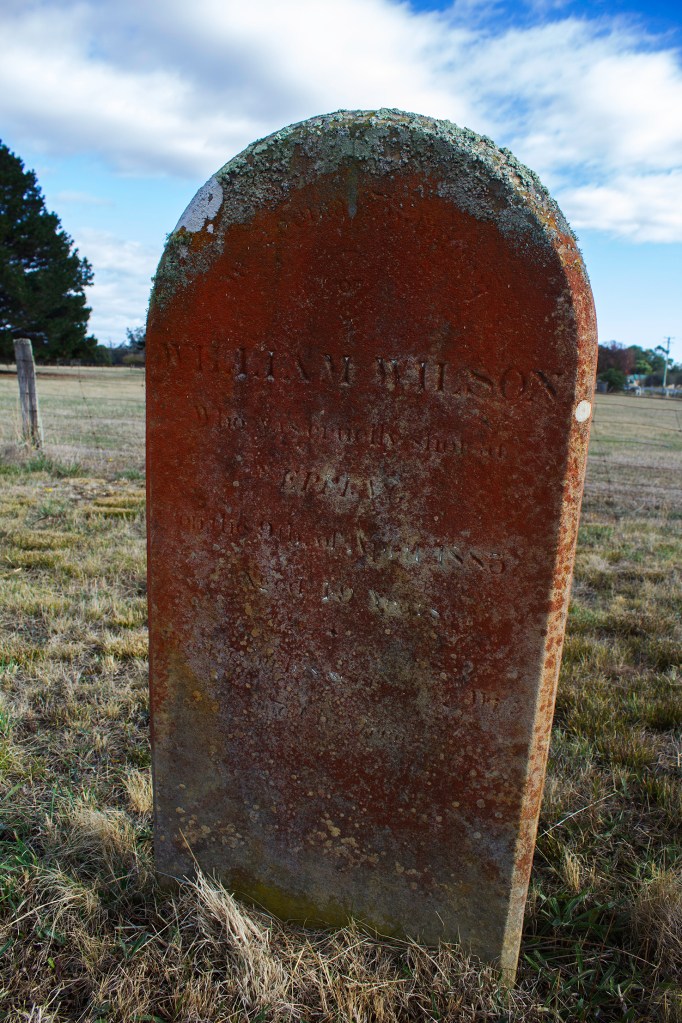
William Wilson, who was cruelly shot at Epping. The words are slowly being lost to nature.
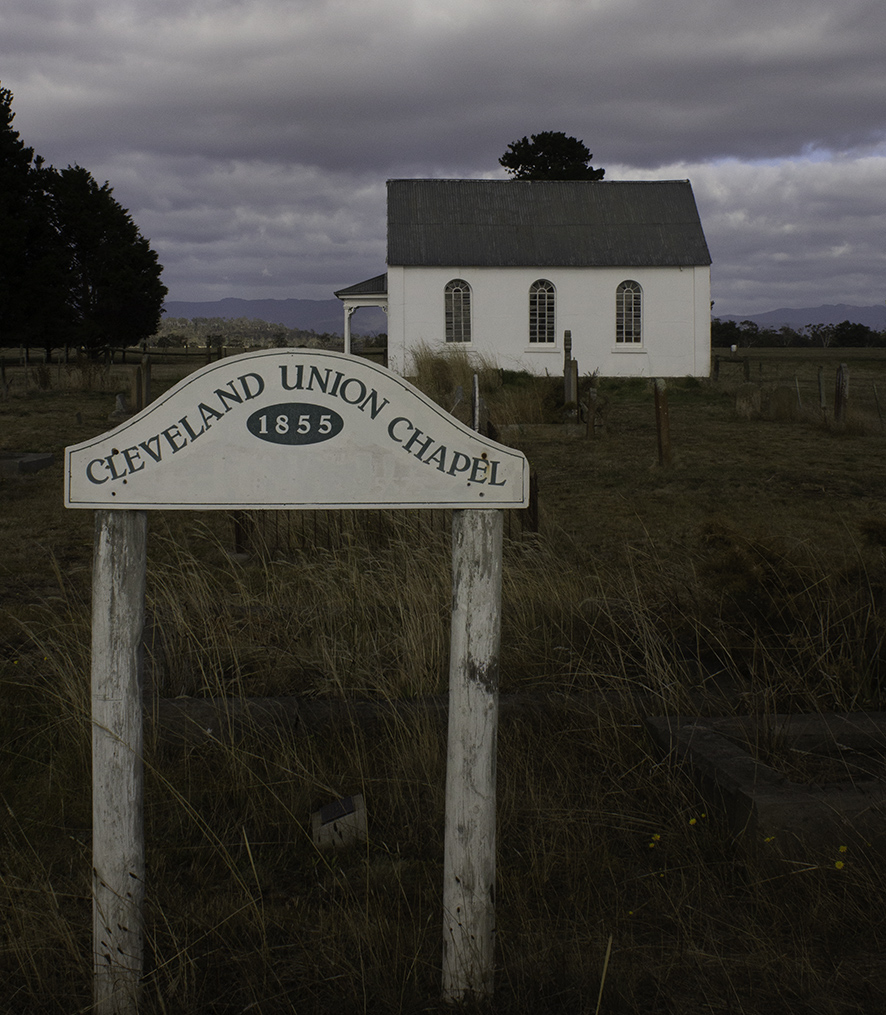
Wilson’s grave is one of a handful which can be seen from the highway in the grounds of the Cleveland Union Chapel.
Within two days, Ogden and Sutherland were in custody. But it was not soon enough. They had already struck again.
Cordial delivery cart driver Alfred Holman, 40ish, had been found dead two miles from Epping.
He had been dragged off the main road and hidden behind a log.
His head had been “smashed about terribly, while a large portion of the scalp had been torn from the skull, and was banging loose about it
The face and upper portion of the body were covered with blood, and life was all but extinct. He died about 2 o clock that day.
This murder was exacerbated by the crime of robbery, as they had taken the cart, various items from it and Holman’s watch was removed from his dead body.
It was said that they coolly sat in the woods and played cards after the murder.
A search party followed the tracks of the cart, and the pair were soon found with it. After a short chase, they were caught.
From the time of their arrest, there was intense interest in the case.
As the newly arrested pair arrived under police watch at Epping, an angry crowd gathered trying to get a glimpse of the prisoners.
“Yells, shouts of detestation, and cries of “Lynch them” resounded upon all sides, and if those present had been allowed their way, the desperadoes would both, within the space of a few moments, have been hanging from the topmost branches of the nearest tree.”
“Ogden could be seen huddled up in a corner of the coach with his hat drawn over his eyes, and a sullen look upon his face, His mate, Mahoney, alias Sutherland, acted with a great amount of bravado, and stared at the crowd with a sneer on his face all the time the vehicle remained at Epping,
“Both seemed mere youths, Ogden being a fair-haired lad, while Sutherland was a dark complexioned young fellow of the “bush larrikin” type. Ogden was only four foot six.
“Upon being placed in the watch-house (in Campbell Town) they acted with great bravado, and during the evening were singing Kelly songs, and behaving altogether in a very rowdy manner.
The special reporter of the Hobart Mercury, writing from Campbell Town on Friday, said: – ‘The callous indifference and braggadocio of the prisoners has slightly changed since Thursday, Sutherland is not so noisy; he whistles and sings less, but his manner is much the same, Ogden, who appears the more reflective of the two, has become more stolid in his bearing, but has not yet made any signs of fear or remorse.
Two inquests and a trial later, the pair were still being reported as defiant, even as they were sentenced to death. The duo joked and laughed with the other prisoners on their removal from the dock.
There is a strong opinion abroad that Sutherland will maintain his brazen effrontery to the last moment, but this is doubtful.
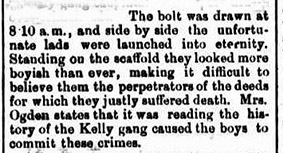
a newspaper report
Both had pleaded not guilty. The prisoners’ counsel pleaded that the crime was motiveless, evidencing insanity and an uncontrollable desire to emulate the notoriety of the Kelly gang. Ogdens’s mother claimed the reading of the Kelly’s history had incited the lads to commit the crime.
The day of their execution June 15, saw a more sombre pair.
Each prisoner stayed awake the night before, accompanied by a minister. They wished to see as much of the world as possible before they left it, said the newspapers.
“Sutherland requested his minister to ask the wives of the murdered men to forgive them.
“He complained bitterly of the treatment he had received from the world, which had not been a pleasant place to live in, as he had no parents to look after him, but had been kicked about by those who got all the work they could out of him without caring the least about him.”
Both walked calmly to the scaffold. Sutherland’s step was firm, but Ogden, who carried a bunch of flowers, trembled violently.
When the hangman placed the noose round Sutherland’s neck, he pulled him self together, not even flinching ; Ogden also keeping firm. Not a muscle moved as the caps were drawn over their heads.
On the bolt being drawn death was instantaneous.
SOURCES:
The Burrowa News Friday 15 June 1883 p 2
Border Watch (Mount Gambier, SA : 1861 – 1954)Saturday 21 April 1883 p 4
The TasmanianSaturday 9 June 1883, 21 April 1883, p 10
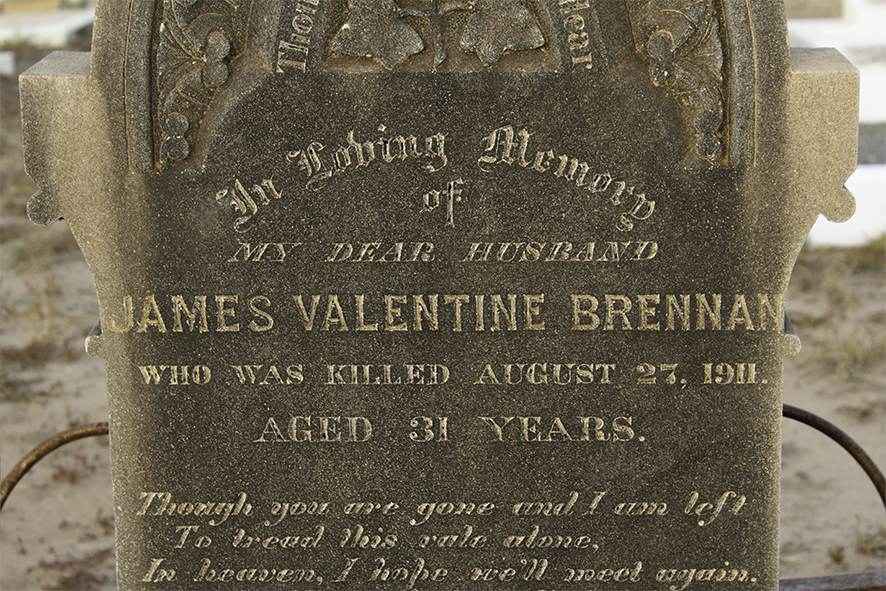
James Brennan was a drover who was killed in outback Queensland via the handy instrument of a shovel.
Or to use the eloquency of the Truth newspaper of the time, ” With a Shovel, Batters Out His Boss’s Brains.
The wielder of said shovel, William Shehan, also spelt Shean, but also known as Shannon, was found not guilty of murder though, as Brennan had just walked towards him with a gun in his hands and foul intent, and had also just thrown a pair of hobbles at him.
The two were part of a droving party taking cattle to New South Wales. They were camped at Shamrock Wells near Cunnamulla.
The men as captured by a court artist
The pair was arguing over whether Shannon had mistreated a mare in some way, and he had quit his job over breakfast. There was subsequent discussion over whether Brennan would pay Shannon his wages owing.
In the words of Shannon to the Brisbane court, as reported by The Brisbane Courier:
“I told him he would not hustle me out of his wages in the way he had done some other men.
Brennan then called him a —-, and threatened to shoot him.
Shannon said he had replied, “You had better not.” With that Brennan had thrown a pair of chain hobbles at him and said
“You —–, I will get the rifle and shoot you now. ‘
Brennan, in the last few minutes of his life
With that he made a rush towards the cart, where Shannon could see the rifle standing.
Shannon said he ducked as he saw the hobbles coming, and, seeing the shovel at his feet he picked it up, ran to Brennan and hit him.
Up to this, he said, he had been on friendly terms with Brennan.
The jury found the Shannon “not guilty,” and he was discharged.
Cunnamulla, Queensland, Australia
Sources: The Brisbane Courier Friday 17 November 1911
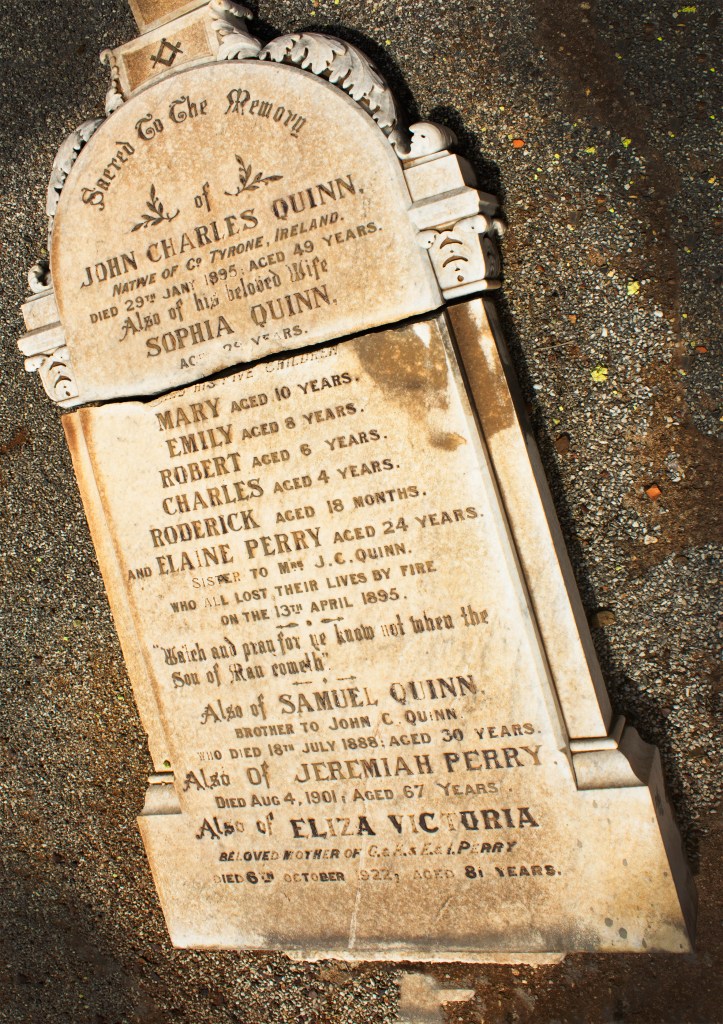
Lying on the ground in the Parkes Cemetery, NSW is this busy headstone, with more than one tale to tell. Image: Sharyn Moodie
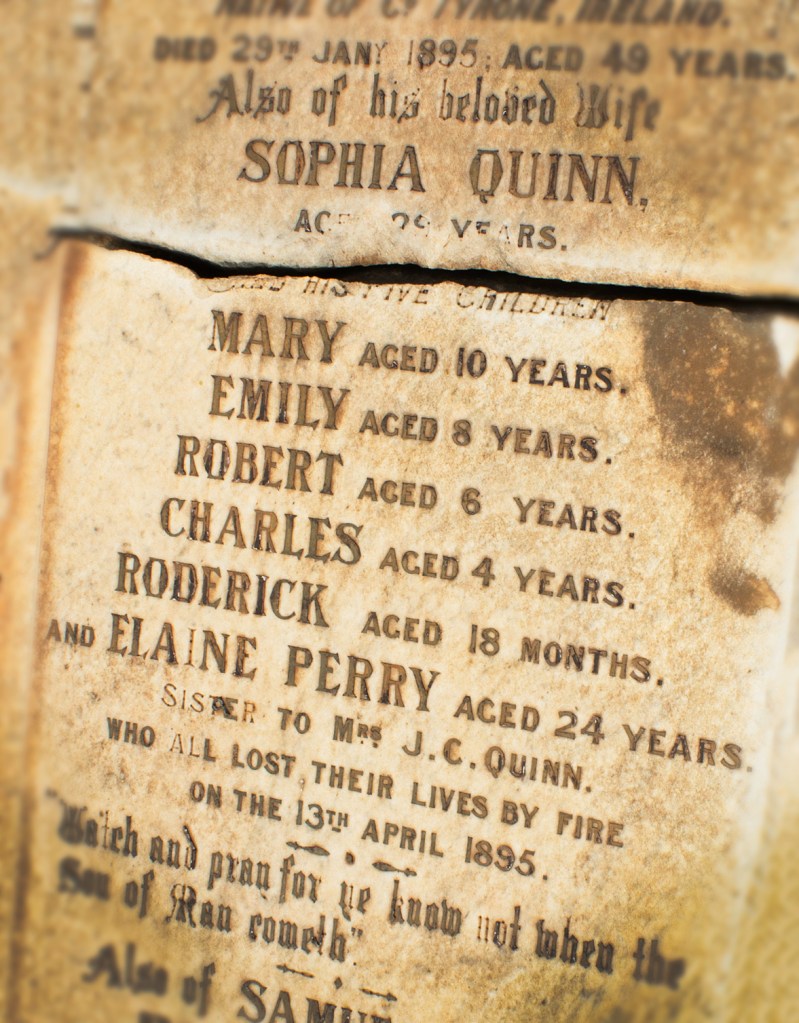
It was a tragedy when Sophia Quinn and her five children lost their father, a part owner of the Parkes flour mill, in January 1895.
So when Mrs Quinn, the children and her sister were burned alive in August, the newspapers’ elequent responses were heart-rending.
Mrs Quinn’s brother George Perry and a youth named Cook were sleeping in the wooden nine-bedroomed building close to McGee and Quinn’s flour mill, on Billabong Creek a few miles from town.
“George Perry was aroused from his slumbers between 2.30 and 3 this (Saturday) morning by hearing what he believes to have been the crackling noise of fire.
“ He jumped up, rushed out of his room (which was situated at the rear of those occupied by the others) to find the latter rooms a mass of flames. He endeavored to burst open the glass door in front, but the remorseless flames beat him back.
“No sound reached his ears from those within, and it is surmised the whole of the occupants of these rooms were stifled by the smoke and then beyond all human aid.
“He then went and roused up Cook, and also communicated with his parents, who lived nearby. By this time the whole place was a seething mass of flames.
“The writer was amongst those earliest on the scene — a few minutes after 3 o’clock — and the terrible scene will not readily fade from memory.
“The grief-stricken mother, brother, and sister were standing hard by powerless to do anything, as they watched the licking flames, that had robbed them of those near and dear, rushing onward.’’
The reporter goes on to describe seeing the gaze of the youngest child through the debris. ‘burnt to a cinder’ , and details the positions of the bodies in the house. A map was also produced detailing where in the house each body was found.
It was ascertained that one of the children had been unwell and that the fire started in a bedroom.
Beyond that, no-one ever found out what happened.
Mr Quinn had died after returning home from an operation in Sydney to treat some type of internal pain.
POVERTY BAY HERALD, VOLUME XXII, ISSUE 7257, 17 APRIL 1895
Parkes, NSW, Australia
Source: National Advocate (Bathurst, NSW : 1889 – 1954)Tuesday 16 April 1895 p 2
Poverty Bay Herald, Volume XXII, Issue 7257, 17 April 1895
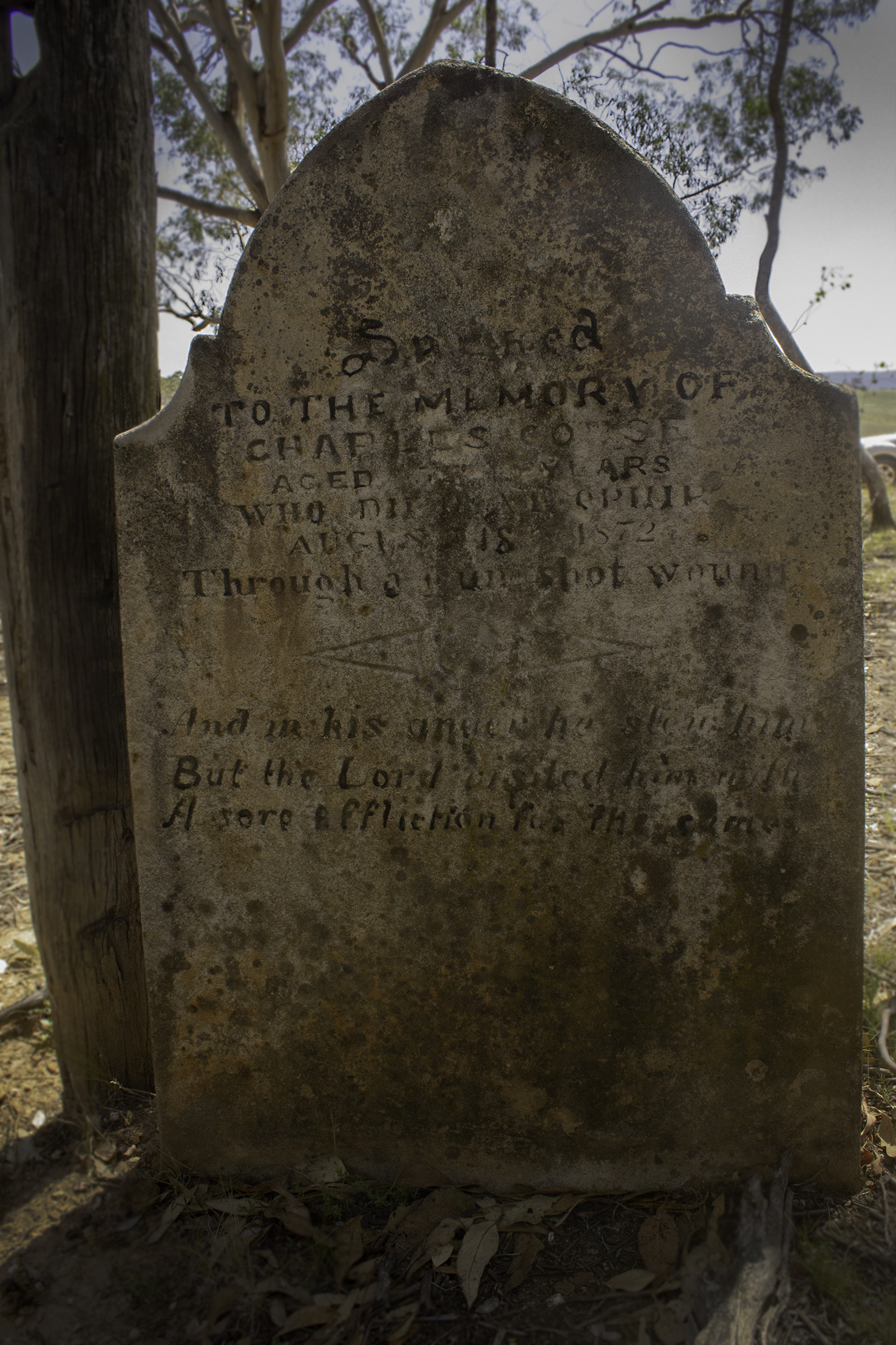
To the memory of Charles Corse, aged (unreadable, but he was about 45) , who died at Ophir August 3, 1872 through a gunshot wound, Ophir cemetery. Image Sharyn Moodie
Shoot, you bastard, shoot.
These were the last words Charles Corse said to his murderer. He had just put his head between his legs – assumedly to present his rear – as he made ‘a disgusting noise with his mouth.”
There is more to the story of his death at the hands of mine manager Richard Spencer than his lonely gravestone intimates.
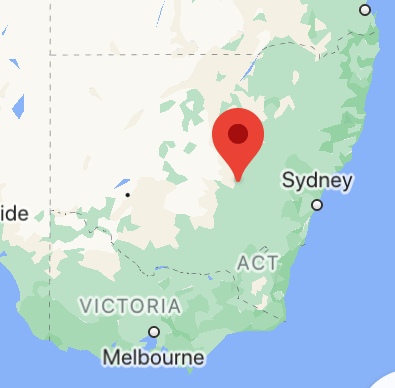
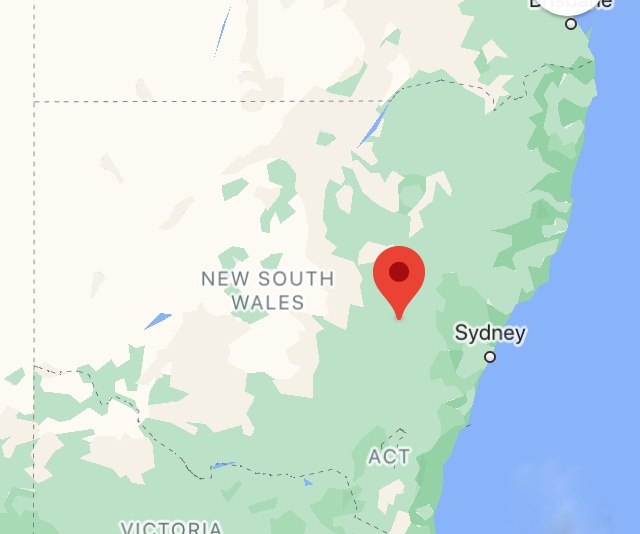
It is one of a handful of stones at the little fenced cemetery on New Church Hill, at Ophir, the site of gold’s discovery in New South Wales.
Murderer Richard Spencer, in newspaper reports of the death was …
…variously described as kind and upright, gentlemanly, unselfish, good natured, of unimpeachable moral character and singularly devoid of any violence.
A mine blacksmith, Corse was reported as a
violent, quarrelsome drunken bully.
It was all over a saddle found on a lost horse, and Corse’s subsequent harassment over the saddle. Corse claimed he had bought the saddle from the owner.
Spencer was suffering from rheumatoid arthritis, and described himself as a cripple. Corse was a powerful man, with a medal for his achievements in Cornish wrestling.
So how did Spencer come to shoot Corse through the back of the head, in Spencer’s kitchen, about 6pm on Saturday, August 3, 1872.
An inquiry in Orange found Spencer guilty of the wilful murder of Charles Corse and he was committed to trial on the capital charge at the Bathurst Circuit Court in October.
Before Sir Alfred Stephen, Chief Justice, and a jury of twelve, Richard Spencer pleaded not guilty.
Between his statements and that of various witnesses, the story unfolded.
The following details are from contemporary newspaper reports of the case.
Spencer told the local sergeant Bush:
“This fellow Corse has been in the habit of annoying me for the last six weeks about a saddle; he came to my house this afternoon about 4 o’clock, and commenced to abuse me.
Spencer said he told Corse to take his concerns to the court in Orange.
“I was walking up and down in the verandah in front of the house, and be called me a — rotten-legged old—; he called me a son of a — (or ——), and challenged me out to fight; I said to him
“Corse, you must be a cowardly dog to ask me to fight; you know I have not been able to lift my hands to my head for the last twelve months — why don’t you go and get someone that’s able to fight; if you don’t leave my place I’ll shoot you.”
Corse left, but while he was away, Spencer had ‘sent a boy for a gun’ from his neighbour Harris. He claimed later that roo shooting was his intention in borrowing the gun.
The gun was not loaded when the boy gave it to Spencer, but by the time Corse returned about 6 o’clock, it was.
The pair was not alone. Spencer’s housekeeper Martha Wright had made Corse a cup of tea and her husband Cornelius Wright was in the kitchen when the deadly confrontation took place. Other workers were nearby.
Wright claimed to have tried to take hold of the the gun as Spencer pointed it at Corse. However, he didn’t see the actual shot fired.
Spencer said when he saw Corse again in his kitchen and Corse had started to abuse him once more, he had repeated his warning – “Corse, if you don’t leave my place, I’ll shoot you;”
“Corse then put his head between his legs, made a disgusting noise with his mouth, and said Shoot, you b-—, shoot
” I fired, and shot him; this man has been in the habit of annoying me, and worked me up to such a pitch of excitement that I scarcely knew what I did,” he said.
Spencer fled to his friend Dr Warren at Orange, who had already heard the news from Wright by the time Spencer arrived.
Spencer gave himself up, and the local Sergeant Bush soon arrived. Dr Warren headed to inspect Corse’s body, while Bush immediately arrested Spencer for murder, not realising Corse was still alive.
On the way to the lock-up, Bush asked Spencer if he had been drinking; he said, ” Dear me, no, I never drink,” and he also stated that Corse was not drunk. However, other witnesses said Corse was drunk.
Having sat through the court proceedings, the jury returned in two or three minutes with a verdict of guilty. The judge directed that the sentence of death be recorded – but not passed. Spencer was committed to three years in jail, but only served 18 months.
This dirt-dusted gravestone in Cunnamulla cemetery only caught my eyes because I have a thing for 1888. And the stone was so covered in debris it was difficult to make out more details.
But when I cleaned it off, this is what was below.
Parents Richard and Alice had married in 1887, and it appears Charles was their firstborn, coming into the world on June 7, 1888. His cause of death is lost to history.
By October the next year, Alice had given birth to the first of three sisters for the short-lived Charles. The three lived into old age.















 Way to go Australia