1880 – Young Parkes flour mill worker Joseph Sim was riding his horse over a hurdle at a Boxing Day event, when it caught on the post and fell on him.
“He was immediately removed in an impossible condition to the hospital for medical attendance’’, where he died without recovering consciousness.
While newspaper reports say the event happened on Boxing Day, his headstone records December 28 as his date of death, so he may have lingered in hospital for a few days before succumbing.
The Parkes flour mill. Image: State Library of New South Wales. Date unknown
Parkes, NSW
SOURCE: The Sydney Morning Herald Thursday 30 December 1880 p 5
‘Such is life’ has long been a quintessentially Australian saying, grounded firmly in its supposed last-minute utterance by famous bushranger Ned Kelly.
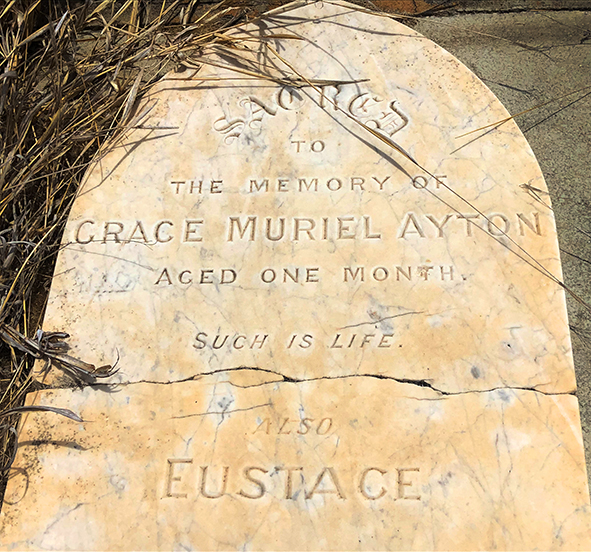
And it so neatly rounded up people’s forebearance of the tragedies of life that it appeared on the headstone of a one-month-old girl in Charters Towers in Queensland, Australia about 1888.
The stone is stark, and simply says Sacred to the memory of Grace Muriel Ayton one month, such is life. She is buried with Eustace Ayton, but no other people of that family name are in the cemetery.
Even today the Charters Towers Pioneer cemetery is a harsh place, roughly slashed and searingly hot in the summer sun. To see the phrase staring up from the fallen headstone evokes thoughts of the struggles of those in the town in an era of gold-rush endowed richness.
Who knows whether her parents were among those who benefited from the thriving boom taking place, or were simply battlers hoping to strike it rich – although obviously someone in the family could afford a headstone.
The discovery that these in fact were not Kelly’s last words have done little to dampen the Aussie enthusiasm for the motto, which appears on car stickers, merchandise (including facemasks) and countless tattoos on bronzed chests.
Kelly was hanged on November 11, 1880, before an enthusiastic audience. There was intense public interest.
The myth that “such is life’’ were his last word was taken up with gusto by the general populace. Though the phrases is not uniquely Australian – the Italians have ‘cosi v’al mondo’ used as early as 1762 and the French ‘c’est la vie’.
Charles Dickens used the phrase in Great Expectations published in 1860-61, and it was already a popular Australian phrase by the time little Grace died, hence its use as an epitaph for a life not lived.
The Afghan cameleers of early Australia are an iconic part of our pioneering history.
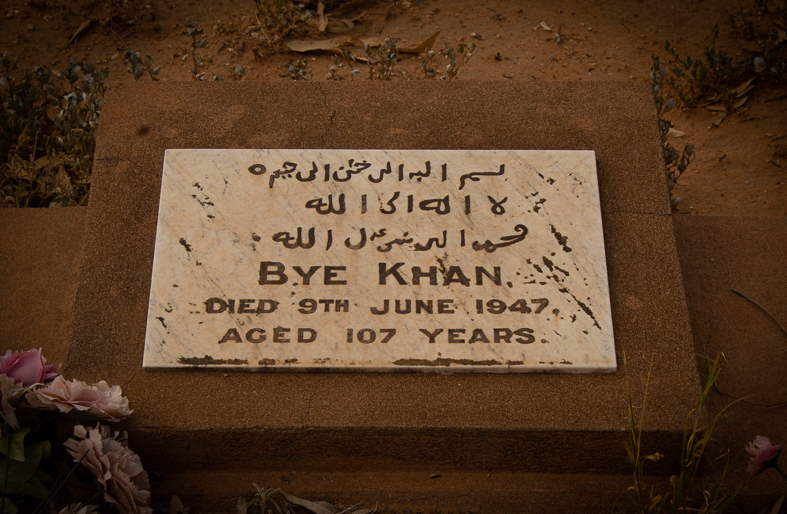
Bye Khan, who died in Bourke, NSW, aged 107, deserves a starring role in that history, not only for his longevity.
Khan’s gravestone in the Bourke Cemetery. Image: Sharyn Moodie
Like most “Afghan’’ cameleers, he would have come to Australia from the north-west regions of India, to train and handle camels to carry goods into the harsh interior of the country.
By 1885, Bourke had a rail service from Dubbo, and two years later the town had its own camel transport company, the Bourke Carrying Company. Abdul Wade was its initial owner, Bye Khan is thought to have come to Australia to take up the position of manager.
His obituary reported that his wife had died before he came to Australia, although another article said she was alive when he left but he later found out she had died. If Khan was indeed 107 when he passed away, he was 45 when he came to Bourke.
“He was a big man, about six foot one inch and 16 stone, and used to look even larger in his turban and loose robes.
“In the last nine years he had worn Australian suits,’’ said an article in The Sun.
Up to 2000 camels were based in a yard just south of the railway station, and from here camel trains of 20-30 beasts with their cameleers would distribute goods and bring wool to the railhead. They were also used at times by Cobb and Co to pull carriages, and distribute mail.
A camel caravan at Bourke in the era of Bye Khan. Image: National Museum of Australia.
Bourke’s Muslim community, known then as Mohammeden, was thought to have initially worshipped in a room at Bye Khan’s home. Later, a small tin mosque was constructed in Hope Street, Bourke. It was removed to the Bourke cemetery in 1988 for safekeeping and there it sits, still oriented towards Mecca, and close to the graves of those who used it.
The mosque in the dusty Bourke cemetery
The replacement of camels by motorized transport meant that by the time Khan died in 1949 there were only about four Afghans living in the Bourke region, working as gardeners or on properties.
A Mohammeden priest flew from Sydney to conduct Khan’s burial. Khan owned considerable property in Bourke. Two brothers who had also come to Australia had pre-deceased him.
Bourke, NSW
SOURCES:
KORVIN, G. 2003a ‘Afghan and South-Asian Pioneers of Australia (1830–1930): a Biographical Study (Part 1)’, Journal of the Pakistan Historical Society, vol. 51(1):49–90.
Western Herald (Bourke, NSW : 1887 – 1970) Friday 13 June 1947
1921 – Seventeen-year-old Eileen Flynn’s “splendid physique’ (as described by the newspapers) wasn’t enough to save her life when she went horse riding.
She and her mother had been living apart from their father/husband for two years, while he was at their home in Broken Hill.
This arrangement was a result of industrial unrest at that mining town, which, after decades of strikes and violent protests at inhumane working conditions, was in the midst of its final major unrest.
Dubbed the Big Strike, it ran from May 1919 to November 1920.
The fight led by the Amalgamated Miners Association (AMA), was for reduced hours, workers’ compensation schemes and safer conditions.
The conflict saw families surviving on limited rations of potatoes and onions for months on end. With malnutrition rife, many families send children and women away.
But the strike did manage to achieve the first 35-hour week in Australian history, full compensation for work-related injuries, and ventilation in underground mine shafts.
Was Mr Flynn one of those hard-done-by workers or one of those on strike? Either way, his wife and daughter had been living in Adelaide, and were heading to Broken Hill to see him for Christmas.
The couple stopped at Booborowie, where Mrs Flynn left Eileen with relatives while continuing north to Petersborough to see her sister.
Young Eileen was a keen horse rider, and on that sad Saturday morning a week before Christmas, mounted up to bring in the cattle. But the horse returned home riderless within an hour.
The property owner’s son, meanwhile, had already come across Eileen’s body lying on a rough back track.
An inquiry proved inconclusively that the horse had bolted, put its feet in a hole, thrown the rider and fractured her skull. She had also been dragged for a short while.
“The deceased, who was only 17 years of age. was of splendid physique.”
newspaper reports
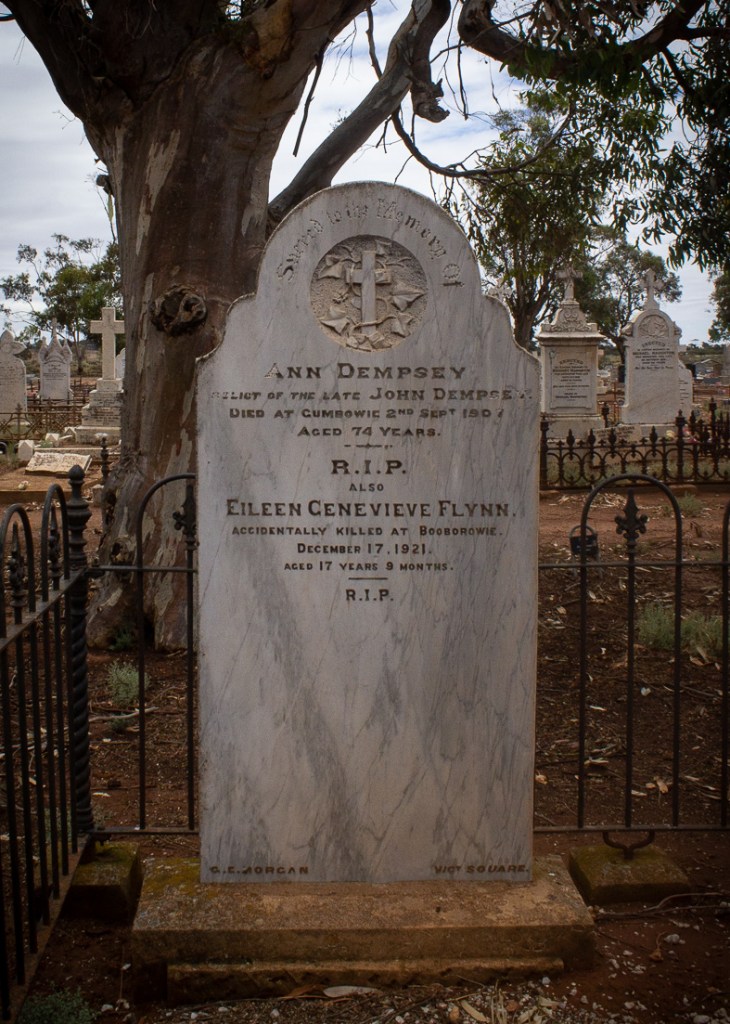
Eileen’s headstone in the Peterborough cemetery, South Australia.
Peterborough, SA
SOURCES: Barrier Miner (Broken Hill, NSW : 1888 – 1954)Friday 23 December 1921 p 1 Article
Burra Record (SA : 1878 – 1954)Wednesday 21 December 1921 p 3 Article
August 15, 1888 – Almost all of the children of Bourke, country New South Wales, were in the back of horse-drawn vehicles heading to the country town’s picnic ground by the Darling River.
The Annual Children’s Picnic procession would have been full of laughter and expectation, as the annual event brought the town together. There were games and races and food to anticipate.
Annie McCarthy’s gravestone in the Bourke cemetery. Photo: Sharyn Moodie
The children had assembled and marched to Billabong Bridge, where horse-drawn lorries, carts, vans, waggonettes and buggies were assembled to take them to the picnic ground only three miles down the river.
But the following events would have had town movers and shakers regretting their decision to build railings on the back of lorries and treat the children to a special ride to the picnic.
A flag or banner spooked one of the horses pulling one of the largest lorries. This caused the children to surge to one side of the vehicle.
“The extra strain broke away the timber frame fixed around the vehicle, and precipitated a large number of occupants on to the road,” reported the Gouldburn Evening Penny Post.
“The wheels passed over four children, killing three outright, and severely injuring others, and altogether about twelve children were hurt more or less.
Gouldburn evening penny post.
The Sydney Morning Herald went as far as to describe which wheels killed how many children. “They then rolled out in a heap, the front wheel killing two and badly injuring another; the hind wheel killing one.’’
The Penny Post listed the most serious injuries: F Short, a girl, broken arm; Clancy, girl, broken thigh; Barlow and Dowling, girls, badly bruised; Groves, boy, broken collar bone.
A public meeting held the next night, chaired by the Bourke Mayor, resulted in about £90 being donated to those affected.
An inquest was held two days after the incident, on the bodies of Arthur C Paine, 3½ years of age; Annie McCarthy, 6 years (stat, her gravestone says 4 1/2); and Ada Lilian Wharton, 6 years.
The driver of the lorry involved, Henry Harvey, deposed that there were about 40 children in the vehicle.
“After going nearly a mile, one of the horses swerved to the near side, being a little frightened at a flag in front, which was on another lorry.
“The children were all standing, with the exception of two or three; all were swayed to the near side of the lorry; the rail there broke, and all but three of the children fell or jumped out of the lorry.
“It was rather an extra hard jerk, and as much as would be caused by going over a brick; the horses were walking at the time.
“The broken timber of the frame and some nails caught some of the dresses, and seemed to drag the children under the lorry, which was pulled up in about 10 yards.
The driver said he had full command over the horses.
None of the picnic committee was riding on the lorry.
The driver explained that all the children were standing, as they would not have fitted sitting,
An adult who was standing in front of the lorry when the incident happened said it was very difficult, even for an adult, to stand on a lorry in motion without holding on to something.
Member of the Picnic Committee, Mr TW Hardwick, deposed that it had been unanimously decided by the committee to drive the children down to the park in lorries.
He had instructed a carpenter to make some frames for the lorries, and told him to go to a sawmill and get suitable timber, and to be sure and make them strong enough and to fix them securely on.
Mr Hardwick had inspected the frames, and even braced them together with rope to make them stronger. He had felt that they were quite strong enough.
He also said that the children had been told to furl the banners and lower the flags.
Another Picnic Committee member, GH Snowdon, said he had personally tried all the frames and had fully believed that they were all strong enough.
Dr Sides, who attended the children at the scene said Paine and McCarthy had fractured skulls, and Wharton had suffered injuries to the chest. He believed these injuries were caused by the wheels of a lorry going over the children.
The verdict returned by the jury was that the children were accidentally killed, and that no blame was attachable to anyone.
All three children were buried in the Bourke cemetery the next day.
The funeral procession was thus described – “four girls dressed in white, with black sashes walked on either side of the hearse, and held the weepers.”
Many of the little girls in the procession were dressed in half-mourning, that is, dark clothing, but not black.
“The procession having reached the cemetery the first coffin was taken off the hearse, that of Annie, and a Roman Catholic service read in English rather than the usual Latin in a sign of inclusion of the varied mourners,
“Mourners then moved on to the Church of England section to lay Alfred Payne to rest, and then to the Wesleyan section for Ada.”
“Thus has passed away from us, in the bud of life, amidst scenes of enjoyment and every prospect pleasant, three little innocent ones, cut off as by the lightning’s flash. This sad end will long find a place in the hearts of the people of Bourke.
Annie’s headstone still stands proud in the desolate Bourke cemetery.
The 1880 Bourke Children’s Picnic, held eight years before the tragic event. PIcture courtesy of Library of New South Wales.
Bourke, NSW
SOURCES:
SouthAustralian Register,Thursday 16 August 1888 p 5
Goulburn Evening Penny Post , Thursday 16 August 1888 p 2
The Sydney Morning Herald , Friday 17 August 1888 p 5
Western Herald, Saturday 18 August 1888 p 4
Children’s annual picnic, on bank of Darling River. Some boys in cadet uniform. Paddle steamer in background (identified in another photograph as the ‘Florence Annie’) – Bourke, NSW Online State Library Digital Collection viewed at https://collection.sl.nsw.gov.au/record/nGm3Gg0Y
1896 – There was great suspicion about Kalgoorlie when James Moore went missing for a day.
He had acted as accountant/confidential clerk for local auctioneer J Miller and Co for two months and had gained the confidence of his employers.
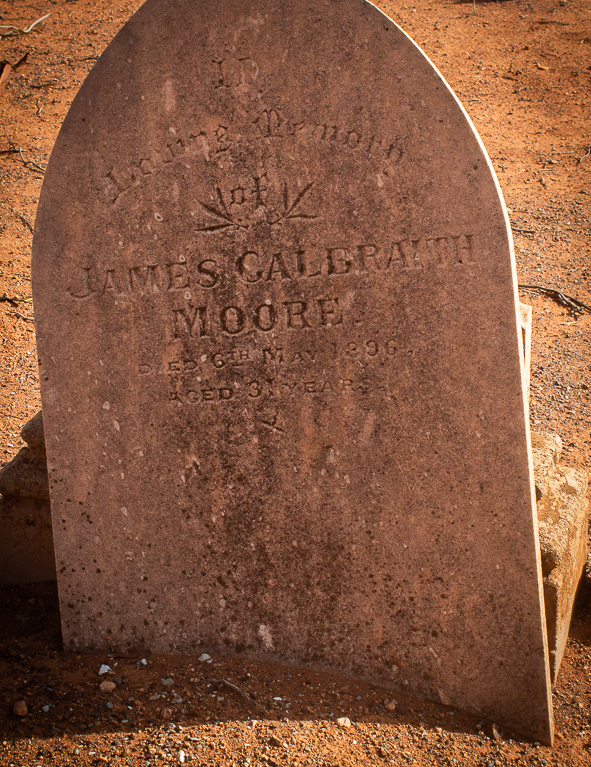
James Moore’s headstone in the Kalgoorlie cemetery is still legible. Image: Sharyn Moodie
However, he was missing, and so were the keys to the business safe. Moreover, he was known to be in depressed spirits.
Moore had told a friend at 7am that he was going for a walk, as was his custom.
But when he had not returned with the keys by the opening of business, unease arose.
Mr Miller reported his absence to the police, and a search began.
Four o’clock that afternoon their questions received a sad answer.
Moore was at the bottom of the shaft of the Hidden Treasure mine, “quite dead”, in the words of the Kalgoorlie Miner the next day.
“He had fallen a depth of 100 feet, and there were indications that he had been killed almost instantaneously.
“The body was frightfully mangled, the legs being broken and the skull fractured.
And to add to the horror of his discovery, a long whipsnake emerged from Moore’s shirt as his body was prepared for retrieval.
Later that night Mr Miller was able to open his safe, having retrieved the key from the dead man’s pocket.
“We are assured that everything was correct to a penny-piece. To the relatives and friends of the late Mr Moore, this fact will be of some consolation,” it was announced in the Kalgoorlie Miner
Moore, a Victorian barrister and solicitor, had come to Kalgoorlie 18 months ago to join his brother Robert. The pair worked together at the Hidden Treasure lease, and James had helped sink the shift in which he lost his life.
The brothers had since sold the Hidden Treasure and were working another mine, the Treasure Trove.
The successful sale of that property was due to be completed the next day, and it was said Mr Moore was a good deal worried over the sale, and had lately seemed rather despondent.
The inquest held soon after considered Moore’s state of mind and his drinking habits.
He was said to be a little upset by a mistake he had made at work, having lost some paperwork worth about 21 pounds.
The jury heard he was not a heavy drinker and was not known to be ‘excitable’ after alcohol.
Furthermore, a man who met and talked to Moore as he walked out to the mine swore he was perfectly sober.
Moore’s brother Robert said James was prone to dizziness, and he thought his brother must have fallen down the shaft in that state. He felt his brother was the last man he would have thought of to commit suicide.
No-one will ever know what really happened.
Moore, 31, left a wife and child, who were living in Melbourne.
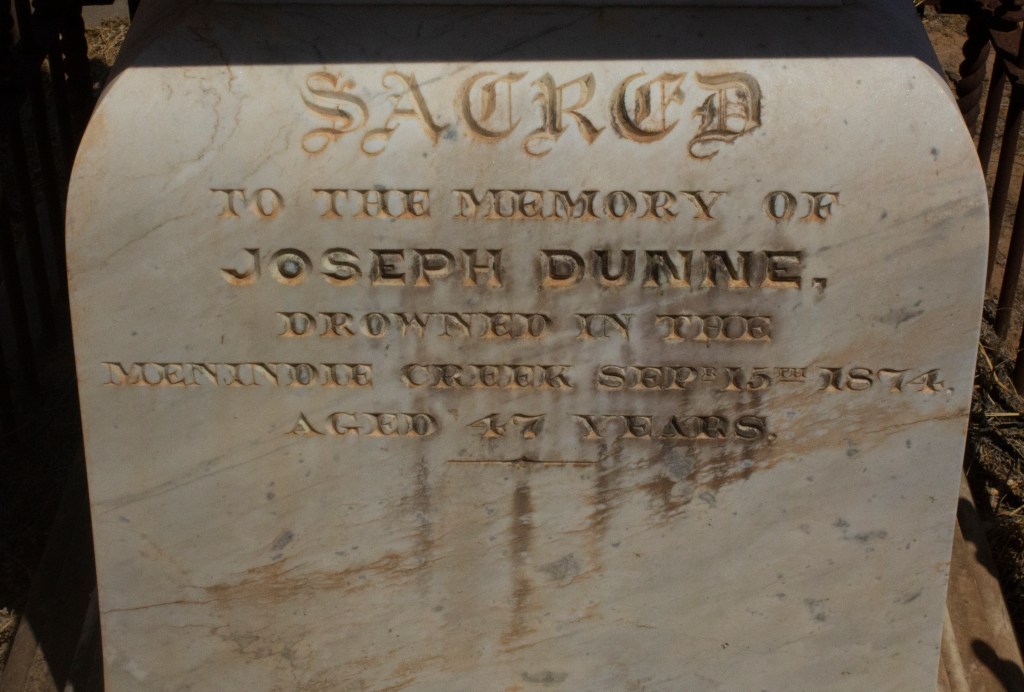
While a river-side plaque tells the story of a sad drowning in Menindee’s Darling River, the nearby cemetery reinforces just how dangerous it was to early settlers.
Robert and Elizabeth Scobie, aged 9 and 7, had only been in Australia for six months when they drowned in 1883.
They had emigrated from Scotland, and their father had set up in the tiny outback New South Wales town as a saddler and storekeeper.
The children had been sent to the river to fetch water at the end of the day. When they did not return before dark, the river was dragged and the bodies found.
Their parents, named Robert and Elizabeth, named their next two children Robert and Elizabeth.
A paddle-steamer engine driver from the Maggie was found dead in the nearby stoke-hole on the same day.
Another to meet an undeserved ignominious end in the Menindee waters was puntsman Fred Brewer, who fell off his punt and drowned in 1897. While one paper described him as well-known and well-respected, he apparently wasn’t well known enough, as another paper described him as a brewer, mixing up his name and his occupation.
Puntsmen were vital workers in that age, before the advent of bridges across the river.
Below are two more gravestones in the Menindee cemetery which ascribe deaths to drowning. Who knows how many more there were over those harsh early years.
Photos by Sharyn Moodie.
Menindee, NSW
SOURCES: The Riverine Grazier, Wednesday 7 May 1879 p 2
The Australasian,Saturday 20 January 1883 p 20
Australian Town and Country Journal, Saturday 10 May 1879 p 9
This story has been written as a snapshot of media attitudes and language regarding First Nations people in the 1940s. It highlights how much things have changed, and how much they haven’t. None of the attitudes reported in any way reflect my personal views.
Ruby Jackson’s final resting place lies at the end of a long line of unmarked graves in the indigenous burials section of the Southern Cross cemetery, WA.
The fact that there was a separate sections for indigenous internments already says something about attitudes of the day. But this grave is one of only two to have headstones, making it unusual. It turns out Ruby’s death was also far from usual.
Reportage of the events leading to her death was most likely standard for the times, but through the lens of seventy-odd years, is derogatory and racist.
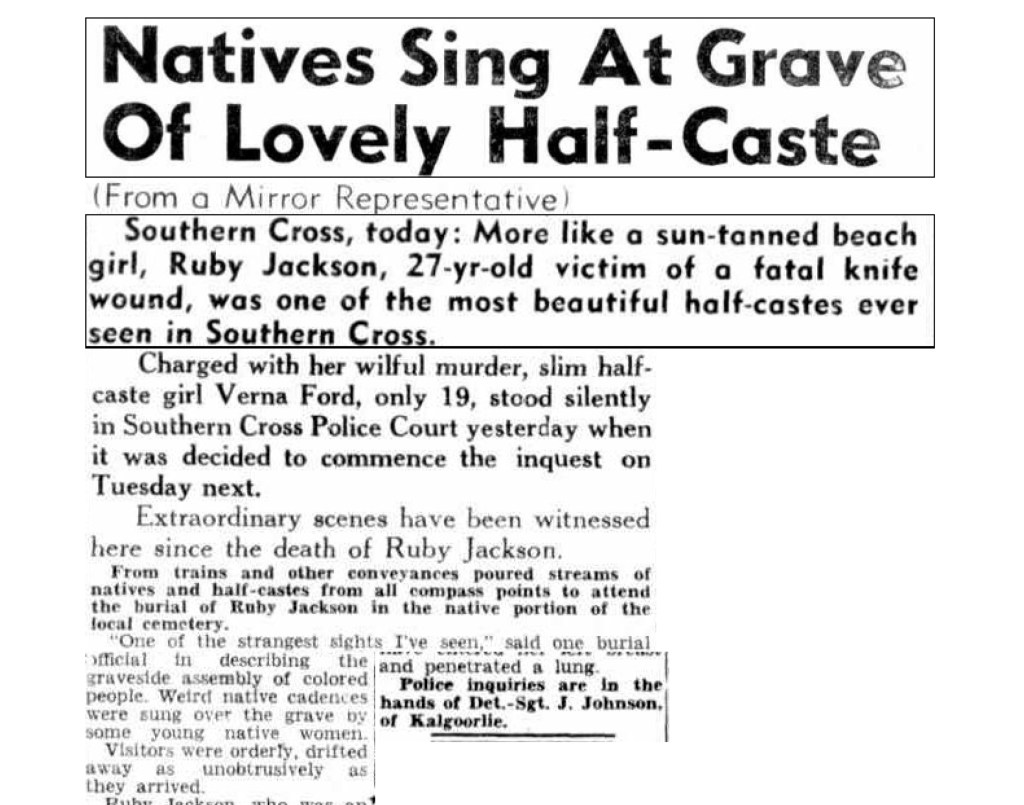
Article image from the National Library of Australia’s Newspaper Digitisation Program
The article above continues:
‘’Peculiarly she met her death after not being long out of hospital following a spider bite.
“Her brother is ace Southern Cross footballer Perry Jackson, a shearer (who paid for her gravestone).
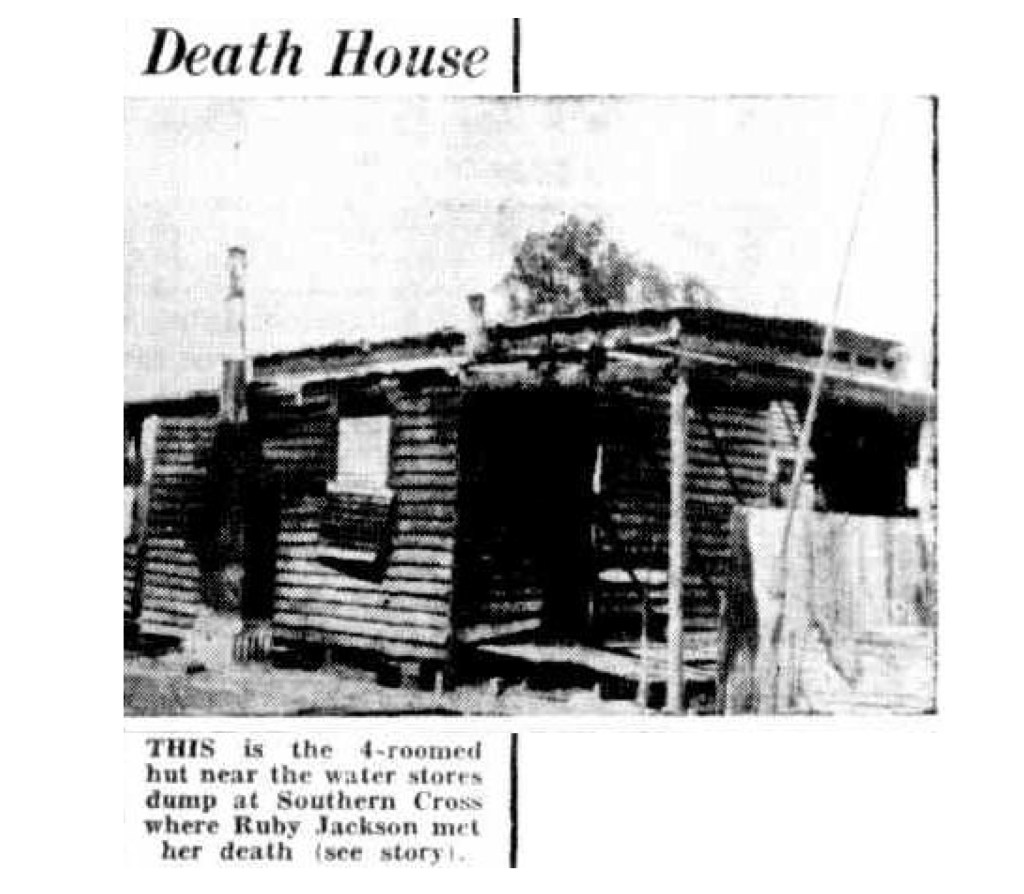
“Ruby Jackson collapsed and died on the front verandah of a ramshackle house adjacent to the railway station and to the aboriginal compound in which there were a large number of natives.”
Article image from the National Library of Australia’s Newspaper Digitisation Program
“A large sheath knife in possession of police is stated to have entered her left breast and penetrated a lung.
The Coroner’s Court, meeting on April 20/21, heard that a group had been drinking since early on the morning of April 7.
Neil Champion, Ruby Jackson and Verna Ford, and later Perry Jackson and an Alec Ellis were present.
About 1pm Champion went to sleep in an adjoining room. About two hours later he was awakened by Perry Jackson, who wanted to fight, said Champion. Champion refused.
Jackson then picked on Ellis, who ran, chased by Perry Jackson and his sister Ruby. Ruby Jackson carried a stick, about 18 inches long and the thickness of a broom handle.
But the fight was called off and they returned to the vicinity of the house. Ruby Jackson, said Champion, got a mug of water, threw it in Verna Ford’s face.
Champion went outside to shake hands with Perry Jackson, he said. While outside he heard a scream. And again.
He turned and saw Ruby and Verna in trouble. ‘Ruby hit Verna with a stick,’ he testified.
“Verna moved away and I got in between them. Verna had a knife in her hand. Perry Jackson knocked me down, told me to let the women go.
‘Ruby went towards Verna. Verna put her foot in a hole in the verandah and fell backwards. Ruby fell on top of her. I lifted Ruby up, took the stick off her, I helped Verna up. She still had the knife. I threw it into the hole in the verandah.’
The women went inside, said Champion. He heard someone say: ‘Ruby has fainted.’
He rushed to her, found her lying face down on the verandah, saw blood on the floor. When he turned her over he saw a stab wound in her breast. He told the coroner he thought Ruby had fallen on the knife.
Ruby died within 20 minutes.
Speaking to the inquest, Dr M Little said the wound, only about an inch long, was several inches deep, and penetrated the left lung by about two inches.
He said the wound slanted up and was caused by a stab from lower down. As considerable force would have been needed he doubted it was caused by falling on the knife.
Stationmaster Robinson was one of the first to reach the scene.
The Coroner’s court heard Verna said to him…
“ Every time they drink they fight …Why do they drink? It was an accident. I didn’t mean to do it … I couldn’t help it… ‘
accused murderer Verna ford
“Verna Ford, her dusky features paled to a chalky hue under the strain of the past week, her lips trembling with nervous, suppressed emotion, was committed for trial at a date and place to be fixed, charged with the murder of Ruby Jackson’
However, after a two-day trail by the Court of Native Affairs in June that year, Ford was found guilty of the lesser charge of manslaughter, placed on a personal bond of £25 to be of good behavior for 12 months and to come up for sentence if required.
There were some interesting sidebars to come from the story.
Tribal law broken
“If, as the police alleged, Verna Ford, 20, stabbed Ruby Jackson, 16*. then it was said she not only broke the white man’s law, but tribal law.
When fighting it is against tribal law to spear or stab above the legs.
In evidence, Police Sergeant Tully said he had had experience with hundreds of natives and always found that native women, when settling differences, fought with sticks.
”He knew of no instance of women fighting with sharp-edged weapons. Although the women in the present case were half- castes, they were classed as natives.”
*Several articles gave Ruby’s age as 16, others as 26, or “about 27’. Her gravestone says she was 27.
Alcohol providers charged
Meanwhile, one April Leeman (male), was charged on two counts of selling intoxicating liquor to natives – once to Neil Champion and again to Alec Ellis. Leeman lives close to the native reserve adjoining the house where Ruby died.
Neil Champion claimed to have bought a bottle of wine and three bottles of beer from the accused on April 6, taken them to the house and hidden them under the bed. Ellis later bought more alcohol with money Jackson had given him.
Leeman had been drunk for several days at the time, and claimed the alcohol was stolen from his home.
He said liquor had been stolen several times previously from house, but did not report it to the police, because he got no co-operation from them.
Cross examined by the Sergeant, he said he was too drunk to remember whether he drank the liquor or gave it away, but knew he didn’t sell it to anyone.
Leeman was later overheard at the reserve telling Ellis he would shoot him if he told anyone what he had done.
Hotel employees gave evidence Leeman had bought wine and beer several time over the Monday and Tuesday (April 5 and 6). Leeman was found guilty on both counts, and as he had no money to pay fines, was sentenced to three months on each charge.
Southern Cross, Western Australia
SOURCES: Mirror, Saturday 19 June 1948, p1, Saturday 17 April 1948, p1
Headstones are an effort to leave a permanent reminder of our demise. But they too, return to dust.
There are countless gravestones like this over our big country, decaying, decayed, destroyed.
I shall tell the sad story of two of them now, and revive their memory, if only for a short time.
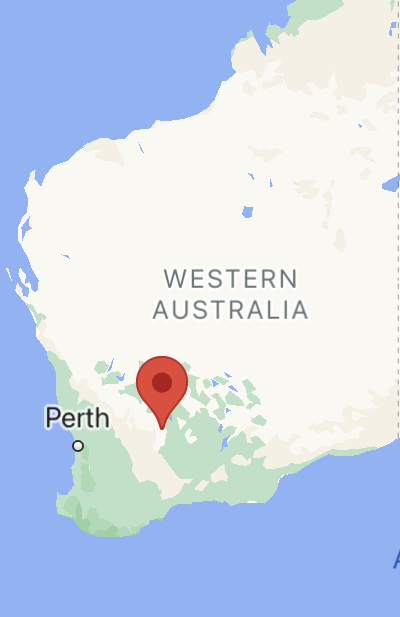
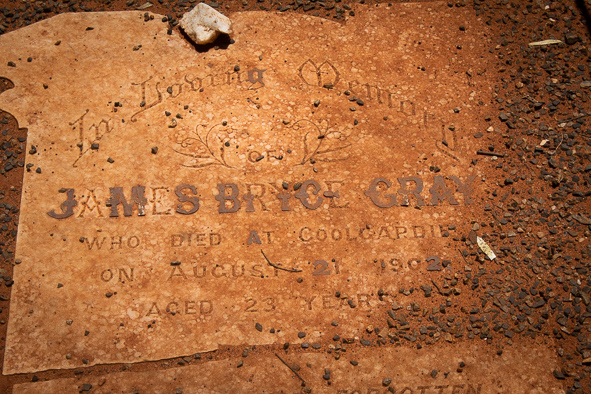
James Gray’s cracked headstone (above) lies partially obscured by red dirt at the Coolgardie cemetery, Western Australia.
And although the words below his name say “gone but not forgotten’’, he certainly appears abandoned.
The 23 year old, whose age was given as 22 by the local paper, died a simple death due to pneumonia after about three weeks of illness. He had only been married two months and a day when his final call came.
He was part of a large local family, and was involved in the Amalgamated Miners Union, so was most likely a miner, and the Coolgardie Football Club.
“A very largely attended funeral was that which conveyed the mortal remains of James Bryce Gray ‘over the border. ‘”
Image Sharyn Moodie
About 40 kilometres from Gray’s final resting place, is the Boulder historical cemetery. It is littered with cracked fallen stones, many long illegible.
It is difficult to make out the first name on Arthur Perkins’ cracked headstone, which has been partly jigsawed together, but his story can be eked out.
While the newspaper article tells the tale in the graphic yet matter-of-fact verbage of the day, reportage of the inquest was more detailed, if no less macabre.
An inquest was held in the Boulder Police Court on Friday into the cause of the death of Arthur Perkins, who was torn to pieces in the Horseshoe shaft on the previous day.
newspaper report
The inquest heard Perkins had complained of a headache before entering the cage to return to the surface after his shift, but after it went up about 200ft he fainted into a sitting position. Another man in the cage grabbed his coat to support him, but when the cage passed a plat (an enlarged shaft entry) he no longer had support behind him and fell backwards. His head was caught between the cage and the cap and he was pulled out and plunged downwards.
There was much discussion about dynamite fumes, whether they caused the man to faint and if they were worse than usual. Another man in the same cage also fainted.
The jury returned a verdict that the deceased was accidentally killed while ascending the shaft while unconscious from the effects of dynamite fumes.
They added a rider that there should be better ventilation.
A fallen angel? Possibly the gravestone of a little girl, also buried in the Boulder Historic Cemetery. Image Sharyn Moodie
Coolgardie, Western Australia
Sources : Kalgoorlie MinerMonday 25 August 1902 p 4, Friday 21 March 1902 , p 4
Kalgoorlie Western Argus (WA : 1896 – 1916)Tuesday 25 March 1902, p 1
1906, Kalgoorlie – Lilian Harcourt, 34, died a barmaid, but she had packed some excitement into her short life.
When pain and anguish hit the brow, a ministering angel thou, erected by one whom she tenderly nursed during a severe illness
She ‘breathed her last’ at the Shamrock Hotel, one of two hotels she had worked in for the majority of the past five years.
“Rheumatic gout, upon which supervened a wasting complaint, was the cause of death”.
Despite her lowly role as a saloon barmaid, newspapers made much of her role in society, pointing out that she was the daughter of one Captain Harcourt of Birmingham, England.
One newspaper said she had come to Australia as a member of the chorus of the first London Gaiety Burlesque Company, while another said she became involved with the professional as a vocalist, at WH Jude’s organ recitals in Sydney, in 1892, and afterwards a chorister in JC Williamson’s Opera Company.
The Burlesque company was famous for its music-hall derived shows, including musical burlesque, pantomime and operetta.
The women of the dancing chorus, in particular were seen as “a symbol of ideal womenhood’’, as fashionable, elegant polite young ladies.
The Hobart Mercury claimed Lilian was a member of the chorus of the Burlesque Company when eight of its women invaded a suburban printing office while on tour in Dunedin, NZ, after a newspaper report cast aspersions on their morals.
They horsewhipped the editor (with prop whips), but the situation took a turn for the worse when a brawl ensure between office staff and company stagehands who accompanied the women.
There is no evidence that Lillian was one of the women who was present at the brawl – but none that she was not.
Either way, she obviously was part of an exciting profession for a young woman of that era. And as respectable as that profession may have been touted, she died unmarried, living in the hotel she worked in.
The late Miss Harcourt was of a most genial and kindly disposition; not a few “battlers among the pioneer prospectors … having experienced practical proof of her kindness of heart.
said the Coolgardie miner
And one of those paid for Ms Harcourt to have a quite impressive stone erected at her grave, to perpetuate her memory.
Kalgoorlie, WA
SOURCES: Coolgardie Miner, Wednesday 31 January 1906 p3














 Way to go Australia