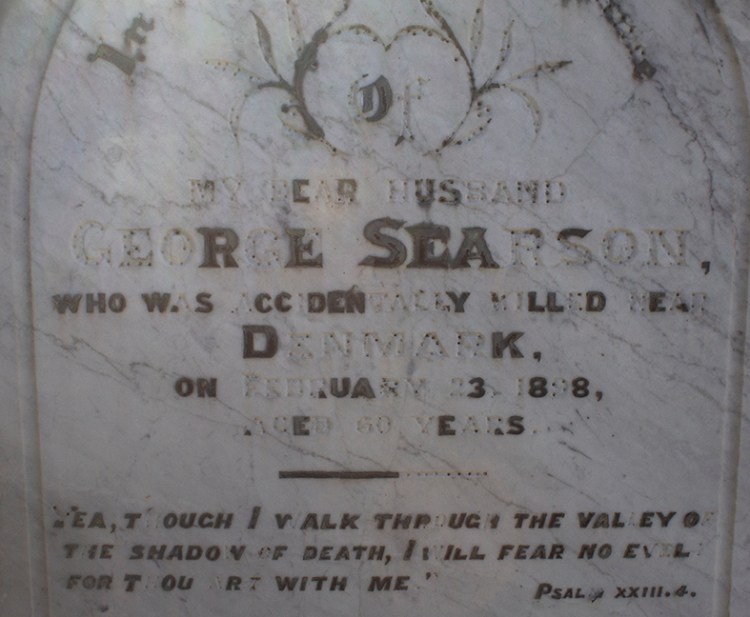
1898 – Veteran railway workers appear to become callous of danger, the coroner said as he closed the inquiry into George Searson’s unnecessary death.
Image Sharyn Moodie 2020
Searson had been a ganger in Victoria for nearly 40 years but had been run over by a railway trolley and killed.
The incident occurred after two train trucks had been derailed, about seven miles towards Albany from Denmark.
The guard and engine driver Thomas Clark couldn’t right the trucks so took the train engine to get help.
Meanwhile, Searson and his team had been told they were needed to help right the trucks. They put sleepers on two trolleys and headed towards the train.
When they met the engine and began to head back to the derailed trucks, Searson wanted to draw the trolleys behind the engine.
He said he could hold on to the tender chain, so the trolley was dragged behind. The trolleys were not designed to be pulled, they were separate small units to allow railway workers to move along the tracks. The tender was a unit behind the engine, the chain was a back-up to its usual coupling, to help it stop becoming derailed.
Engine driver Clark later told the inquiry he objected to the trolleys behing pulled behind the train. The grade was up to 1 in 50 , making the procedure dangerous.
Searson said he had travelled hundreds of miles other times doing this, so eventually Clark relented.
Pearson also wanted fellow line repairer John Washington to hold onto the chain, but Washington thought they should also attach a rope. He didn’t think he would be able to hold the chain once the engine was moving.
Searson reassured him it would be all right. The tram started off, reaching only five miles an hour
As they were going up an incline, Washington let go of the chain, causing both men to somehow fall forward off the trolley onto the track.
Washington was slightly stunned, but the trolley struck Searson as it passed over him. This caused the trolley to leave the track and the other men on it to be thrown off.
Searson appeared badly injured, so he was put on the trolley and taken back to Washington’s camp.
Clark returned on the engine to Denmark for the postmaster, Mr Doyle, who must have had some first aid knowledge, as he attended to Searson – until he died.
The coroner showed little sympathy for Searson, saying he “must have known that it was prohibited on all railway lines to attach trolleys to engines in such a manner.’’
The jury decided that “death was due to an accident and that no blame was attachable to anyone except deceased.”
Searson’s gravestone in the Albany cemetery. Image Sharyn Moodie 2020
Albany, WA
Source:The Albany Advertiser, Saturday 26 February 1898, p3
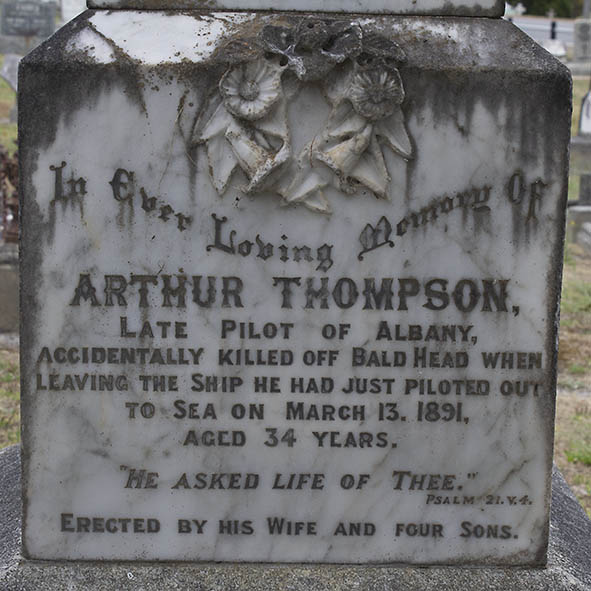
1891 – Ship’s pilot Arthur Thompson was crushed between two boats as he attempted to move from one to the other.
Image: Sharyn Moodie
He had just piloted the barque Mary Stewart through King George’s Sound as it was towed by the launch Escort.
They were two miles beyond Bald Head – near Maud Reef in a line with Eclipse Island – when he attempted to board the towboat.
The Mary Stewart had prepared its sails, no longer needing the tow boat.
The tow line was taken in, the Escort dropped astern, and then steamed up towards the Mary Stewart.
The sea was heavy with a southerly swell, and it was apparent it would be a difficult transfer.
Having brought the launch alongside, Escort Captain Sipple called to Thompson, asking if he was ready to leave the Mary Stewart.
Thompson replied that he was, and stood holding a rope, reading to drop over the side.
Captain Sipple called, ” As soon as you can, for there is a big sea running.”
Sipple told the ensuing inquest he looked up and said “Jump sir, jump”.
“I turned my face forward from the vessel to see that the launch was going right.”
Stipple turned again and saw Thompson “in the act of falling”.
According to eye witnesses he seemed to slip and then hang for a few seconds.
I then shrieked ” Let go and go down,” but before I could get to the vessel’s side he was gone.
The roll of the sea smashed the two vessels together, just as Thompson came between them.
No-one knew whether he slipped and fell, or whether he expected to land on the launch.
“As he fell he cried out as if he saw the peril he was in but he never again uttered a sound,’’ one witness said
“His body was crushed in an indescribable manner when the two vessels came together with a snap.
southern times
The watch that he wore was crushed and stopped at 9.14, but according to Captain Sipple the sad accident happened after 9.30 and before 9.43.
Image: Sharyn Moodie 2020
It took the towboat five minutes to retrieve the body.
“There was no life in him,’’ Sipple said.
“It appeared as if the vessel had caught him just under the shoulder blades.’’
They placed a Union Jack over the body and the launch then steamed away for the town.
An inquest was held before a three-man jury.
Its verdict was that “no-one one was to blame in the matter, though the accident might have been avoided by a Jacob’s ladder being used on the ship’s side, or a boat being lowered from the ship to take the pilot to the launch.
Sources: Southern Times, Monday 23 March 1891, p5
The Australian Advertiser, Monday 16 March 1891, p3
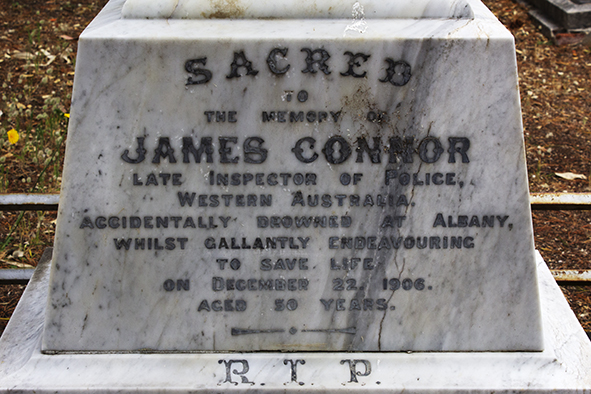
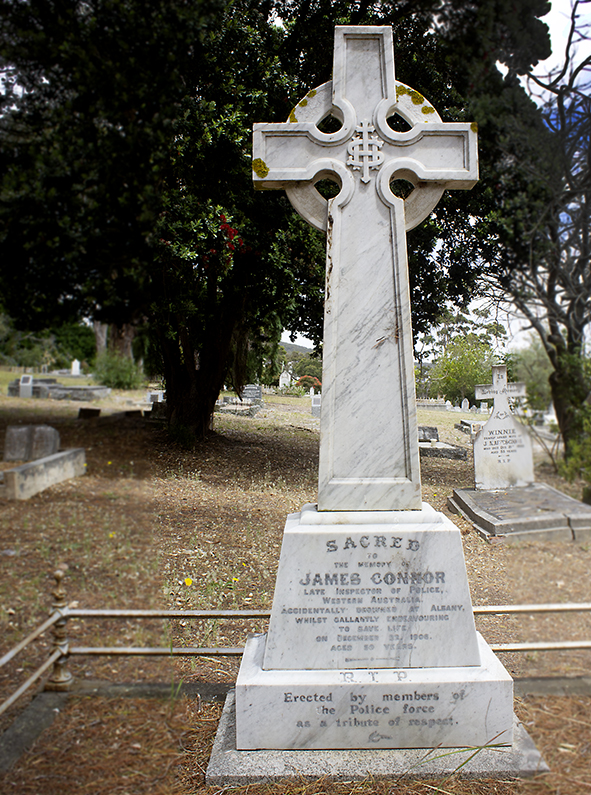
This is how his police colleagues remembered Inspector Connor, but some of the contemporary newspapers reports were less effusive, claiming Connor was overcome with excitement and fell in the water. Image Sharyn Moodie
1906 – Albany Police’s Inspector James Connor came to a sad end in the most innocuous way – on a Saturday afternoon fishing excursion with his son and nephew.
But did he die in a gallant effort to rescue a boy who could swim well, or did he simply fall in?
James had finished work for the day, and as he often did, headed to the east side of the town’s deep-water jetty with his son John (either 9 or 12, depending on the newspaper article), and his nephew Austin, 14, to try their luck.
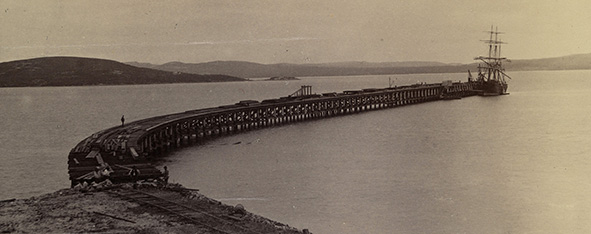
The Albany Jetty in 1881, several years before James Connor, a poor swimmer, drowned.
Austin fell into the water. He wasn’t concerned – he was a strong swimmer, and he soon climbed up a post back onto the jetty.
But James, 50, either went in straight after him to help or, as some reports said, became “excited’’ and fell in.
Poor James could not swim, but made it to the other side of the jetty, where he clung onto a rope. He also seems to not have had the strength of young Austin to clamber up a piling. However it seems he still had his pipe in his mouth, as his son told the inquest he took his pipe from his father.
James told his son to get help, and the boy beckoned a nearby man called James Mitchell and asked him for help.
Connor apparently told Mitchell he was nearly done, but he would try to hang on.
Mitchell hailed down a passing launch, the Dunskey, and when it arrived, it took O’Connor’s now-lifeless body to the HSM Encounter. which was in the harbour, for medical assistance. Dr Holyoake of The Encounter, told the inquest that death was due to drowning.
However, no post mortem was held, and earlier reports said death was due to heart failure caused by shock ‘through immersion’’ and excitement.
It should be noted that the water around Albany is usually pretty cold.
The jury returned a verdict that deceased came to his death by drowning in attempting to save his nephew.
They also pointed out James Mitchell did not “render the assistance he might have done”, and that one lifebuoy on the jetty was inadequate. Mitchell had told the jury that he had tried unsuccessfully to haul Connor up.
State police banded together to raise money for a monument to remember O’Connor, lauding his gallant effort. He left a widow and six children.
Albany, WA
Sources:
Royal Trust Collection: View of jetty, Albany, W. Australia, c.1881. (The Cruise of H.M.S. Bacchante 1879-1882. Volume III, Bermuda, South America, Cape Town, Australia).
The Evening Star, Wednesday 16 January 1907, p3
The Pilbarra Goldfield News, Saturday 29 December 1906, p3
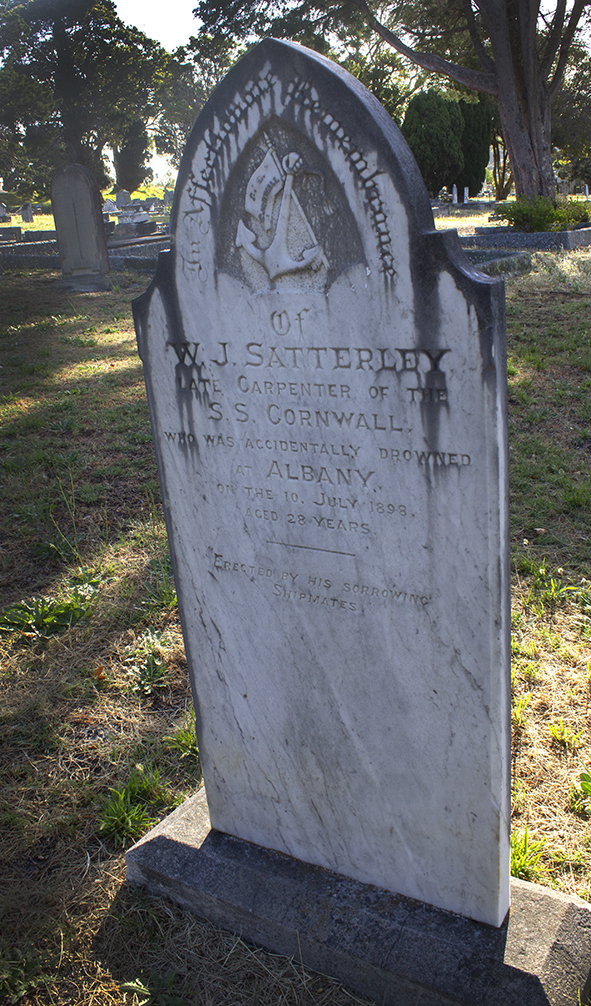
1898 – W Satterley died for the sake of a pair of pyjamas.
He was a carpenter on the cargo ship Cornwall, which was moored at the Albany wharf. It was on its way to London with frozen goods including beef.
As he shook a quilt over the side of the boat in the early hours of the evening a pair of pyjamas fell on to a beam between the wharf and the ship.
He tried to retrieved them from the boat, but couldn’t. So he went ashore, stepped down from the whart and lowered himself around a post towards the beam where the wanted nightwear lay.
But before he got low enough he slipped, fell on his back onto the beam, and then into the water.
He was alive though, as he cried out to the Cornwall’s boatswain, who answered and fetched a rope.
But by the time he got there, Satterley had sunk. His body was found the next morning.
The inquest which followed heard that he was ‘perfectly sober, but could not swim’.
Medical evidence proved Satterley had drowned.
An advertisement for Satterley’s job, two days after he died. Iimage from the National Library of Australia’s Newspaper Digitisation Program
The SS Cornwall, published a few days after Satterley’s death. Image from the National Library of Australia’s Newspaper Digitisation Program
Albany, WA
Sources:
For more stores from Albany’s Memorial cemetery, click here.
1903 – Grazier Andrew Muir was unable to save his son when he got caught in the surf off the south western Australian coast. In fact, he had to be rescued himself.
. Albany cemetery. Image Sharyn Moodie 2020
Mr Muir, his third son Melville and another man George Arber, all of Mt Barker had gone to visit his cattle run at Quarramup Boat Harbor, about 25 miles from Denmark.
It was a Tuesday morning, and after attending to their business, they fished, lunched and then went for a swim.
Melville went about 15 yards away from the adults, where the waves were breaking on a sandy stretch of beach.
A little later the men lost sight of Melville, until Arber saw him struggling in the water.
They rushed to him. Muir was unable to swim and Arber was “little better qualified to go to the rescue’’.
The newspapers reported that Melville’s father
“in his anxiety, rushed into the sea, and being caught by the backwash he would have been carried away but for the assistance his companion was able to render him’’
– in other words Arber had to rescue the rescuer.
The men could see the body about 50 or 60 yards away floating in shallow water. Muir and Arber went in and carried the body to the shore.
The bereaved father spent more than an hour carrying out artificial respiration “but all efforts in that direction proved futile”.
When the duo accepted that Melville was gone, they put him on a packhorse and started out for Denmark. It was about 3 o’clock by then.
But progress was slow, and they were forced to spend the night in the thick scrub.
They reached Denmark about 9 o’clock the next morning. Melville’s body was put on to a train to Albany, where an inquest was duly held at the Court House.
Melville’s father told the inquest he could not swim, but that he considered the area safe for bathing.
Detail from Melvile’s gravestone in the Albany cemetery
Sources: The Albany Advertiser, Saturday 17 January 1903, p4
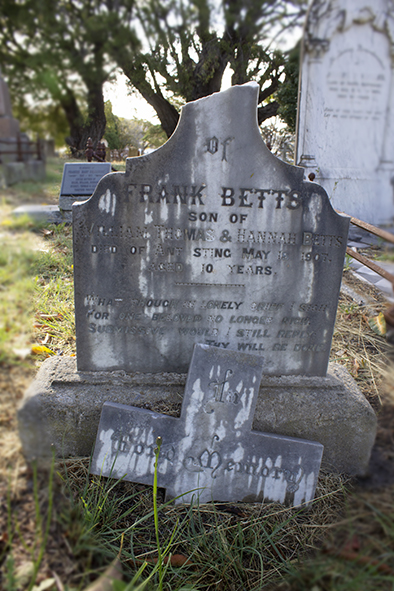
The gravestones of the children in the Albany Pioneer cemetery tell some fascinating tales of the dangers of childhood.
“Died of convulsions”, “died of ant sting” and “accidentally injured while playing” … read some of the more obvious stones.
Frank Betts’ poignantly worded gravestone at Albany Memorial Cemetery. Image Sharyn Moodie
There was no story to be found on Catherine Runciman, who died convulsing aged two in 1914, or Frank Betts, whose demise by ant occurred at age 10 in 1907.
But five-year-old Charles Leslie Hynam’s story made the newspapers.
Known as Leslie (his father was also Charles), the boy had only been playing outside with four friends for a short while when one of them rushed back into the house, crying out to Charles senior that Leslie and another boy, Willie, were “under the sand and couldn’t breathe”.
The boy, John McLeod, pointed out where the children had been, and the frantic father picked up an old shovel lying nearby, but was afraid to use it for fear of hurting the children.
He began to dig with his hands and came across Willie Kay, who was lying “insensible”, face down in the sand.
He handed the boy to a bystander and kept digging until he got out his son, also unconscious.
He carried the child in his arms to the hospital, and although the doctor arrived in a matter of minutes and attended him for three or four hours as the boy convulsed, the child died the next day.
Image Sharyn Moodie 2022
John McLeod, who lived with the family in Festing street, told the subsequent inquiry that the boys had gone to play in the sand bank, which was the result of some recent road works.
When it began to rain they took shelter under the sand bank.
“He removed about a shovel full of sand from the bottom of the bank and Johnnie Edwards removed the same quantity,” a newspaper report of the inquiry stated.
“They sat down with their back to the bank and about two minutes later it gave way”.
Leslie had been sitting in the centre of the boys.
McLeod scrambled out and pulled two other boys out. Unable to see Leslie and Willie he ran for help.
The jury’s determination after a ten-minute deliberation was that the death was an accident.
They added a rider: That the Albany Municipal Council in future, when taking away sand, should have the excavation slope and cut left with a vertical or upright face, so as to avoid the possibility of future accidents occurring.”
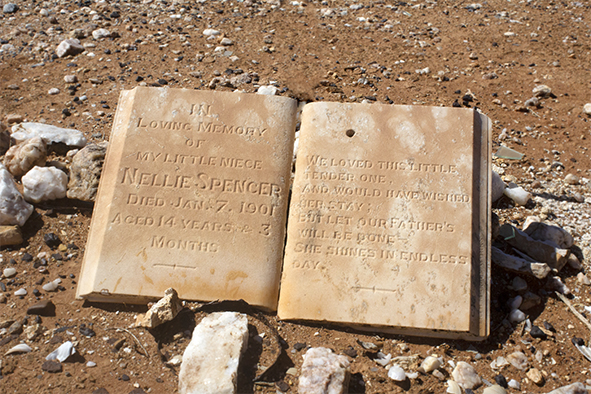
For the story of young Nellie Spencer, who died from the extreme heat at Cue, click here.
Source: The Albany Advertiser, Friday 30 May 1902, p4
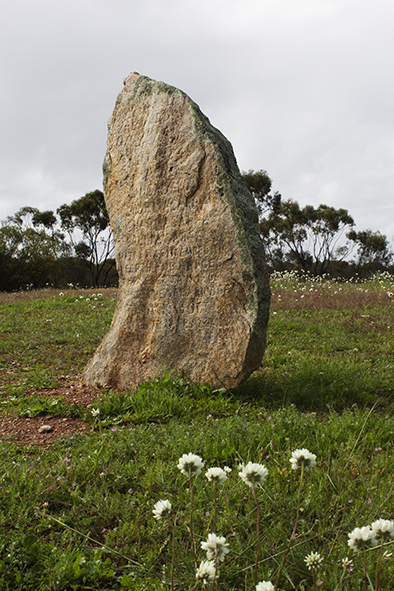
Wildflowers dot the ground around the solid stone memorial, a delicate visual lacework.
The daisies are part of Western Australia’s famous annual display, each floral renewal marking one more year since several horrific events took place at this site.
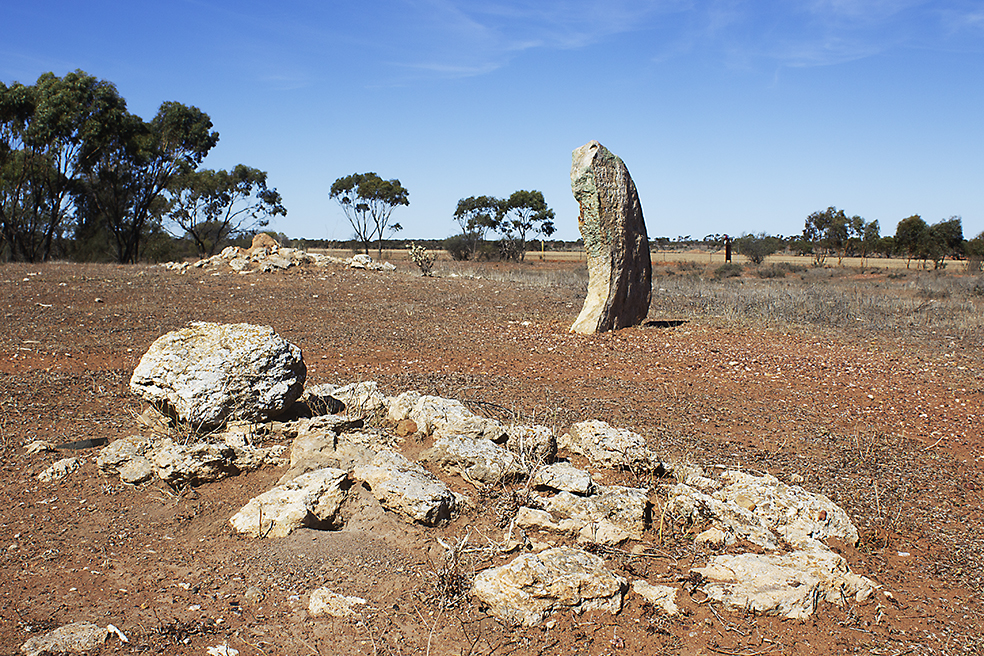
And they cover the mounds of rock which are hard to make out among the boulder-strewn ground.
These are the Butterabby Graves, a site of murder and retributive execution 16km south of the mid-West Australian town of Mullewa.
Not too many kilometres away, swathes of canola and wheat fields patchwork the vast kilometres.
It was sheep which brought white men to the region in the 1850s and 60s, starting the deadly clashes which occurred over the entire nation as the original inhabitants protected their world against the settlers expanding theirs.
This land was part of the country occupied by the Wajarri people.
“Inevitably there were clashes between the cultures at the Wajarri tried to protect their women and the resources that sustained them and the settlers sought to expand their holdings,’’ says an information sign at the site.
When a shepherd, John Lewis, was speared at Kockatea Spring on 17 February 1864, the man responsible was sentenced to life imprisonment at Rottnest Gaol. The Champion bay resident magistrate noted that a strong deterrent would be for death sentences to be carried out on the spot the murder was committed.
“Pause awhile, reflect on what took place here and why, and pay your respects to all caught up in this tragic clash of cultures.”
sign at butterabby gravesite
The next year 1865 James Rudd and Thomas Bott began to develop an outstation at Butterabby, digging a well, clearing land and building a hut.
“On August 22 Bott was grubbing out a tree about 90 m away when he was attacked and speared. He died four weeks later in the hospital in Champion Bay (Geraldton). Three policemen were set out to find and arrest those responsible.”
Five Wajarri men were arrested – Wangayakoo, Yourmacarra, Garder, Charlacarra and Williacarra
Impressions of the men hanged at Butterabby are incorporated in a shelter shed at the site. Images Sharyn Moodie 2020
When the arresting party called at Butterabby a few days later, as they took the men to Perth for trial, they found Rudd’ s body laying just outside the hut.
He had died from a blow to the back of the head and was buried at the site that day.
A Wajarri man Mumbleby, his wife Belo and a 14-year-old girl Beeja Beeja were subsequently arrested, about 160 kilometres away, with flour and some of Rudd’s clothing in their possession. They said there had been a struggle over Rudd’s gun.
Mumbleby and Belo were charged with Rudd’s murder. Belo was acquitted, but Mumbleby was sentenced to life imprisonment.
The trial of Bott’s killers did not record their motivation – whether there had been provocations or whether they were simply acting against the invaders.
They all pleaded not guilty, though they admitted to “spearing the white man’’. All were convicted and sentenced to death.
The resident magistate got to carry out his plan to use a hanging as a deterrent. The men were brought back to Butterabby.
At daylight on Saturday, January 28, 1865, the men were hanged from a tree that stood not far from where they were buried.
To make sure the message was received they forcibly brought in 12 more Wajarri to watch the hangings.
The Perth Gazette and West Australian Times had this to say about the forced horror.
“Although there were not many aborigines of the district present on the occasion, it seems probable that the late ceremony was witnessed by a sufficient number to communicate what took place to those who were away ; and the superstitions which the detailed account of such a scene would be likely to inspire into their minds, added to their natural dislike of death and the localities where the dead are deposited, will so far have the desired effect, as at all events to deter the natives from their murderous attacks for a time, if they do not go far to produce a decided change in the feelings of these barbarous and benighted beings.
The graves are more clearly discernable during the dryer times of the year. Image Sharyn Moodie 2020
The hand-carved words in the memorial read:
In these graves lie James Rudd speared here at Butterabby 23 Sept 1864.
Also Garder, Wangayakoo, Yourmacarra, Charlacarra, Williacarra, natives sentenced in Perth and hanged.
The stone memorial was erected in 1973 by a descendant of the family which bought the land 50 years after the murders and hangings.
Blayney Cemetery, NSW John James Donahee, who was accidentally killed 16 September 1909. Image Sharyn Moodie 2019
1909 – Railway fettler John Donahee was instantly killed when he was run down by a passenger train from Cowra.
Donahee and another fettler, Mackay, were on a railway tricycle, about a quarter of a mile west of the Blayney station.
The passenger train from Orange was due, and the men were cautioned to watch for it.
But it was windy and raining heavily, and the men did not hear the approach of the train until it was 30 or 40 yards behind them.
The men were not in any danger on the line they were on. The train was on an adjacent line and would have run past them safely. But Donahee was apparently under the impression the train was on the main line.
The above is a manual railway tricycle made for use in the New South Wales rails system in 1945, and is similar to the one Donahee would have been using. According to the Railways’ 1945 Book of Rules and Regulations “An employee must not use a tricycle unless he can read and write, and has in his possession a watch which shows the correct railway time, a copy of the last issue of the Working Timetable corrected to date and applying to the District in which the tricycle is being used” and “when a tricycle is used on a double line, it must be taken in the opposite direction to the ordinary trains, and always facing trains on the same line”. Perhaps these rules were put in place after too many accidents like Donahee’s.
He jumped off the tricycle and stepped right in front of the arriving train.
Its entire length passed over him before the driver could stop, dismembering him completely.
The 40-year-old left behind a widow and family of young children.
Blayney, NSW, where Donahee is buried.
SOURCES: Albury Banner and Wodonga Express Friday 24 September 1909 p 32
NSW Government Railway tricycle made at Per Way Workshops, Goulburn, NSW, c.1945 2021, Museum of Applied Arts & Sciences, accessed 21 February 2021, <https://ma.as/36773>
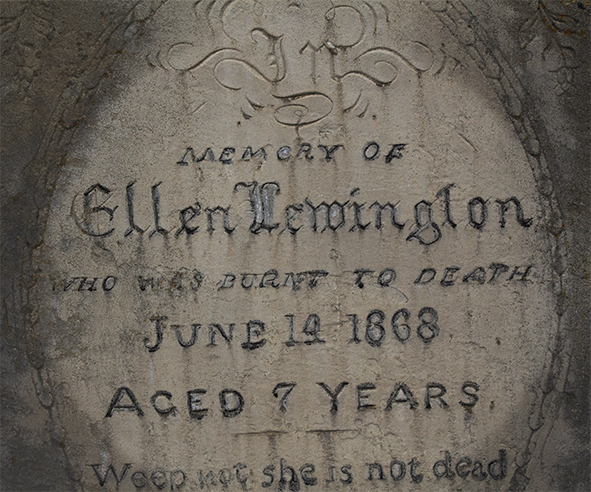
She was sitting, alone, on a stool with her back to the fireplace. The stool canted and she fell backwards into the fire.
Few other details are known, except that a woman nearby went to Ellen’s grandfather’s place and a doctor was called. Why she was, presumably, alone at home is not known.
The doctor arrived very quickly, but young Ellen died.
She is buried in Fremantle cemetery, amidst a score of movers and shakers whose graves are marked with stories of their lives and deaths.
This is her ode.
Ellen’s grave in the Fremantle cemetery.
Source: The Herald, Saturday 20 June 1868 – Page 3
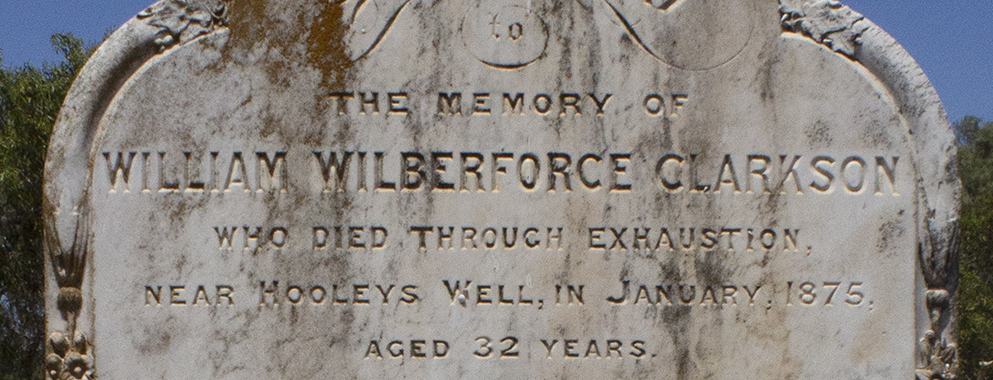
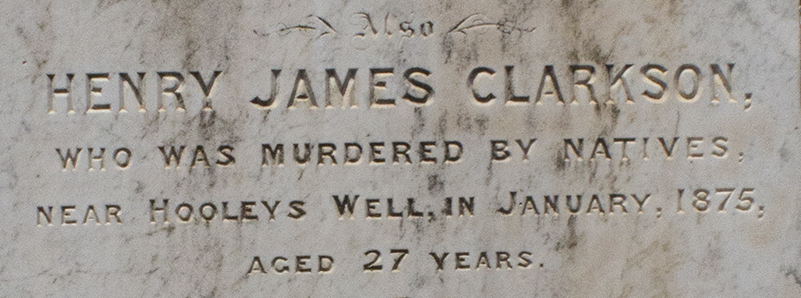
William Wilberforce Clarkson, who died through exhaustion near Hooleys Well, in January 1875, aged 32 years Henry James Clarkson, who was murdered by native at Hooleys Well in January 1875 aged 27 years. Greenough Pioneer Cemetery. Images Sharyn Moodie
It was a real wild west story – the Clarkson brothers planned the greatest cattle drive ever in Western Australia’s short colonial history.
In early 1874 Henry, with his older brother William, two half-brothers and other proven outback men bought up cattle from around Albany and drove them via Augusta, through the Margaret River region and eventually up to Geraldton and another 500 kilometres north on to the Murchison region.
The Clarkson brothers. Cemetery Walk Trail brochure.
Henry, a drover and livestock dealer, was commissioned to take a mob of cattle from Albany in the very south of the state to Nichol Bay in its north-west.
Along the way they bought more cattle and recruited extra hands, so when they reached the Murchison in December they had more than 1500 cattle and 173 horses.
But the Australian summer heat was relentless, they were struggling for water and in serious trouble.
On December 28, William and Henry set out to find water. They gathered four days of provisions, a revolver each, one single-barrel gun and a pack horse.
When they were not back nine days later, the remaining men put together a search party, which made a “hurried, unsuccessful journey” – mostly due to lack of water.
But another search party quickly set out with a pack-horse loaded with water. Two days and 52 miles later they reached a place called Hooleys Well.
Here they found Henry’s compass hanging on a tree, and tracks to the north. Following them they eventually found a girth hanging on a tree, and about four miles away, the punnel of Henry Clarkson’s saddle.
Yet further on they found a tree where a horse had been tied up for some hours, and a note written in pencil.
“I could not get her any further without giving her a spell, I will try to get to the well and will return if I can.”
Note left by William Clarkson
The words “If I can” and “try to” were underlined.
On the other side of the note were the words “you will find the watch, it is now half-past 5 o’clock”.
Also found scratched on the tree were the words “Try and bring the mare with you’’.
Why the search party did not continue from there is unknown – perhaps lack of water – but the men decided to call in the authorities.
This necessitated a return to Geraldton to report the situation to the Resident Magistrate.
By the time a new search party set out, almost a month had passed since the brothers left their droving party.
The new search party included two more Clarkson brothers, Edward and Robert.
It took them until February 5 to reach a place close enough to start the search.
Edward said in a letter that even the trip to the search point was fraught with hardship “in consequence of the want of water for ourselves and food and water for our horses.’’
He said they reached Hooleys Well on the sixth – finding it perfectly dry, but after a little digging managed to obtain a couple of quarts of water for each horse.
While looking for more water, they found a “native spring”.
“Concealed in some native shades we found portions of Henry’s bridle, a gun-stock and stirrup-irons. This was evidently a regular camping-place of the natives, for we found a number of spears and other articles recently in use, and many fresh tracks in all directions’’, he wrote.
The search party moved their camp to the spring.
The next day they went north again, coming across the saddle the initial search party had found.
Half a mile east of there they found the carcass of the horse.
It had a spear mark in the neck and one in the hip.
“I have no doubt the natives killed her,’’ Edward said.
Up the road they found the remains of his brother William under a small tree. He had died lying on his side, his boots under his head for a pillow, his partly lowered trousers unbuttoned and his shirt partly pulled up.
There were no signs of violence on the body, and a pannican nearby appeared to have contained urine. A gun barrel, still loaded with shot, was present.
Edward said
“He appeared to have laid down and died in his sleep — nothing whatever had disturbed him after his death. It would however be difficult to say whether he died of wounds or not (due to decomposition).
The next day, (the ninth) one of their trackers found Henry’s body – in a very different condition to William’s.
“The remains were partly covered with earth and bushes, the face feet and hands were exposed.’’
“The body appeared to have been opened and the inside taken out, the whole of the abdomen was gone. I am quite satisfied the flesh had been removed from the bones, on the feet and hands the skin was whole. A small piece of a spear was found nearby, but there was no blood on it.
Police Corporal William Laurence was satisfied the remains were those of white men.
It seemed to me that the flesh had been cut off from the thigh. William Clarkson’s bowels were still in him, but Henry Clarkson’s seemed to have been taken out.
Corporal William Lawrence
The bodies were brought back to Greenough, just south of Geraldton.
An inquest was held at the Greenough Court House on March 2, where a three-man jury viewed the remains of William and Henry.
Coroner Fairbairn, in summing up, pointed out that there was no evidence to show that murder had been committed, and advised them to bring in an open verdict.
Yet this was their judgement.
“We find that Henry Clarkson was wilfully and deliberately murdered in the beginning of January last, at spot about 7 miles north of Hooley’s Well, on the Nicol Bay road, by some person or persons unknown.
“We find that William Clarkson died from exhaustion the beginning of January last, at a spot about sixteen miles north from Hooleys Well on the Nicol Bay Road.
This was not quite the end of the matter.
For a start, the cattle still needed to be taken north. Johnnie Brockmann took on the task of leading the large contingent, and succeeded.
And an arrest warrant was made out for an Aborigine who was suspected of being involved in Henry’s death.
However, when they came upon him and another older man in the bush, the suspect fled.
The other man, Mingaberry, described as aged and decrepit, rolled on the ground in fear and despite being reassured that he was not their target, “seemed oppressed with a fear that they were going to shoot or otherwise kill him.’’
He blurted out a confession that he and his decamped mate had speared “whitefellow” in the neck.
But the case was let go when it became apparent the confession was not made to a legal authority and “it was evident that it had been elicited by catechising the accused when he was oppressed by a feeling of terror.
The jury was directed to find a verdict of not guilty and the prisoner, still appearing overwhelmed with fear, was discharged.


















 Way to go Australia