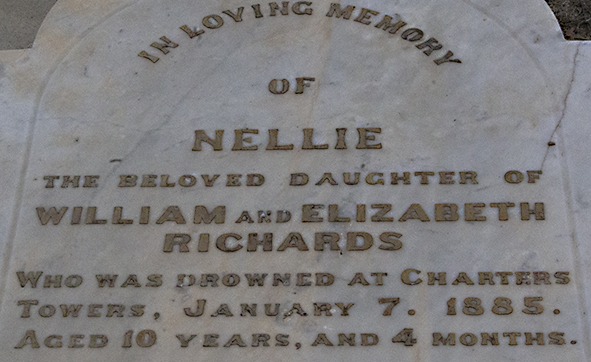
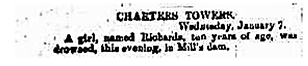
Charters Towers, 1885 – The drowning death of Nell Richards led for calls for the town’s dams to be fenced before any more children were lost.
…
Elizabeth Ellen, known as Nell, was watching her younger sister bathe with several other children at Mr Mill’s dam at the top end of Mosman Street. Nell was on the bank minding “the baby’’, gender unknown.
When her sister got into trouble, having gone beyond her depth, Nell rushed in and pulled her to shallower water.
But somehow she had gotten herself into difficulty, and was lost to view.
The turmoil of the other children attracted the attention of a man who lived nearby.
“He lost no time in hurrying down, and plunged in where the girl had disappeared.
Nelliel is buried in Charter’s Tower’s historical cemetery. Images Sharyn Moodie 2021
“The water was twelve feet deep at this point; he dived and found the child, but she was then quite dead, having been nearly a quarter of an hour in the water.
“The father of the child (William) arrived just as she was brought out of the water a corpse.
“Great sympathy is felt for poor Richards and his wife. They are not in good circumstances, and have had many troubles within the past few years,” said the Northern Miner.
The newpaper went on to say that there had been fear of such a drowning among the children bathing in the town’s two dams.
“There is a dam at the top and another at the bottom of Mosman Street, both traps for human life, and the Municipal Council is bound to see that they are properly fenced in by zinc fences, so that children cannot get at them.
The town’s other dam, Plants dam, was also unfenced. Mosman Street can be seen running through the image. Image courtesy of State Library of Queensland.
“It would be for the public safety that they were moved farther away, but, at any rate, there is no excuse for farther delay in fencing them, so as to protect the children of the town from drowning.
Sources: Queensland Times, Ipswich Herald and General Advertiser, Saturday 10 January 1885, p5
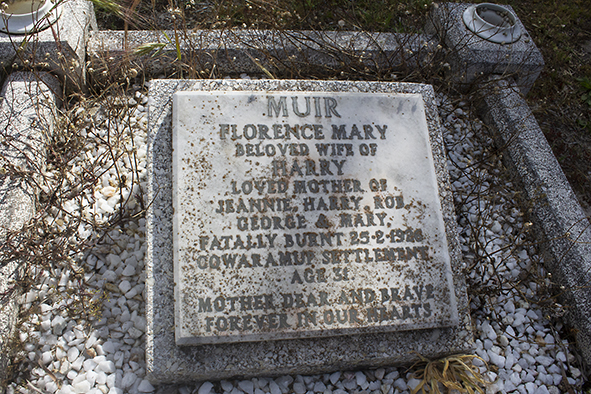
1926 – “Harry, I am in flames,” Florence Muir cried.
She had just put a pot of apples on the stove, and while walking to the table smelt something burning.
She looked down and saw her dress on fire, the flames quickly growing.
Her husband, Harry was having a rest as he waited for his dinner. It was about 1.30 on a Sunday afternoon.
He grabbed a blanket and rushed into the kitchen to find her clothes alight, and her body collapsed to the floor.
He immediately used the blanket to partly extinguish the flames, and his bare hands to tear away burning clothing not covered by the blanket.
Their daughter, 11, ran to the neighbours for help.
They discovered Florence badly burnt on the body, legs and arms, and in too much pain to be moved.
Neighbour Mr Richies immediately set off on horseback for Cowaramup, which was only recently gazetted as a town, to report the matter to Dr Rigby at Margaret River.
However, they could not contact the district medical officer, and Dr Yates from Busselton, finally arrived at 10pm.
Poor Florence was given first aid and taken to the Busselton Hospital, where she died on Thursday.
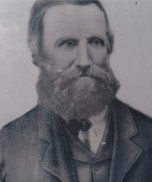
1880 – Henry Yelverton was considered the most experienced timber merchant in the colony of Western Australia.
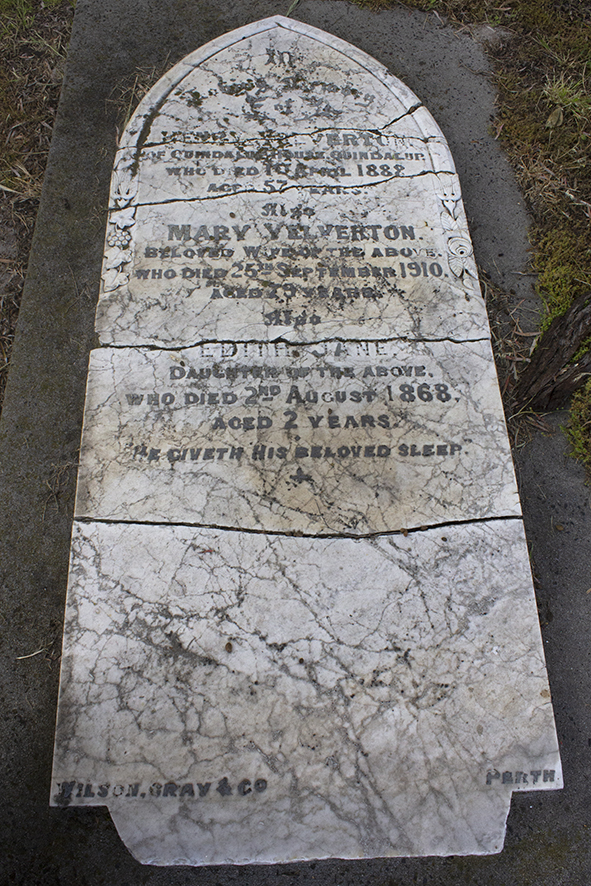
Henry Yelverton’s gravestone is almost illegible and some of the information on it is incorrect.
Yelverton was the man responsible for supplying timber for and constructing the Busselton jetty, the 1.8k heritage-listed landmark and major tourist attraction.
He was certainly one of the richest men in the region. As well as his timber mills, he had interests in a whaling station, an inn, a flour mill and smuggled tobacco. He was bankrupt twice, but recovered.
He also initially recovered when a large log crushed him in January 1880.
He was supervising his timber operations at Quindalup when a log weighing many tons was being moved up skids into position for being sawn.
But the chains pulling it snapped and the log rolled back over Yelverton’s body.
According to an information sign at Yelverton’s grave in Busselton’s historic cemetery, he instructed his foreman on how to amputate his leg. A hut was then built over him, as he was too unwell to be moved.
It is not known how long he stayed there, but by the day of his death on April he had moved the several miles to his own house and was up and about using crutches.
He had performed his toiletry duties and gone outside, where he was talking to a man sharpening a saw.
His daughter, who was making his breakfast, saw him stumble.
When she went up to him he was in the agonies of death. He attempted to speak, but the words died on his lips, and in a few seconds, life was extinct.
west australian
It was April 1, 1880 and he was aged about 59 – his headstone says his date of death was April 1, 1888, aged 57. Contemporaneous newspaper reports prove that year wrong however.
His wife Mary was laid to rest alongside him, as well as one of their 11 children.
Yelverton’s cracked headstone lies above his grave in Busselton’s historic cemetery. Image Sharyn Moodie 2020.The timbers of the Busselton jetty. Images Sharyn Moodie 2020.
For more stories from Busselton’s historic cemetery, follow this link.
The Old Busselton cemetery lies within cooee of the famed Busselton Jetty, the southern hemisphere’s longest timber jetty.
The famous Busselton jetty. Image Sharyn Moodie 2021
The man who was responsible for the supply of that timber lies in the cemetery. Henry Yelverton died in a timber industry accident that led to an in-the-field leg amputation. Read how he died here.
Burials were carried out there from the mid 1800s to the 1930s.
The cemetery was built on slightly undulating ground, giving it a sense of instability.
Many of the region’s founding fathers are within its fences. It is described as a non-indigeneous cemetery.
Wandering around the burial ground on an overcast day revealed some stories of interest.
Old Busselton Cemetery. Image Sharyn Moodie 2021
Florence Muir received life-taking burns as she was cooking dinner and now rests among the she-oaks at the cemetery. Her story is here.
My favourite gravestone was this below – an incongruous meeting of the old and new.
Elmo oversees Hugh Michael Browne, died 6th Feb 1918, aged 5 years.
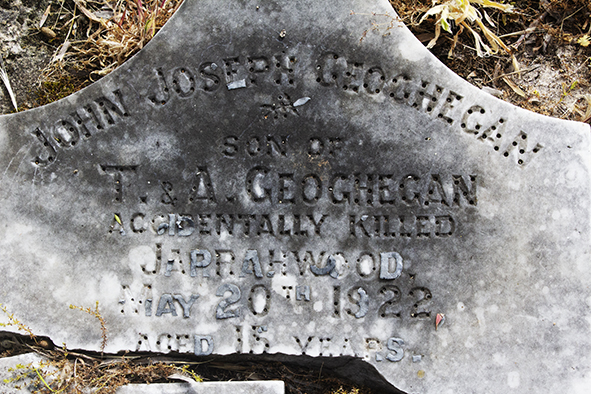
In another tale, 14-year-old John Geoghegan was driving home in a sulky with his sister when it hit a stump and overturned. His story is here.
And then there was schoolteacher John Bowler, whose life was going so well, until, suddenly, on a day when he took a simple horse ride, it wasn’t. His story is here.
This information sign at the entrance to the Wills graves does nothing to aid reconciliation.
As astounding as it is today to read the words above, they are understandable given the context in which they were written. Image Sharyn Moodie 2021
It was commonly known as the Wills massacre, but the history of the battle which took place at Cullin-la-ringo near Springsure in Central Queensland is being slowly reshaped.
The 1861 attack, in which 19 European men, women and children were killed, was the single largest massacre of colonists by Aboriginal people in Australian history.
But those numbers are nothing compared to the extermination of up to 370 members of the Gayiri tribe in the following weeks. It was also the start of many more battles in the Frontier War.
There have been many words written about the event, easily accessible on line.
But with the hindsight of history, surely the information sign at the entry to the site could acknowledge the full story. It gives no context to the attack being a reprisal, or the much larger magnitude of the new settlers’ response.
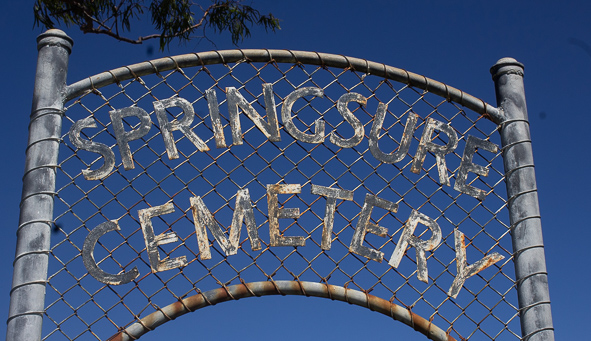
You can follow well-marked signs to find the graves about 30 kilometres from Springsure.
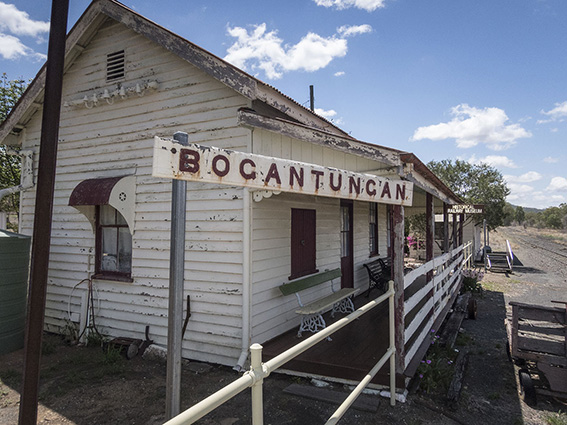
George Kembery (also called Kimbery by the newspapers) was an off-duty engine driver who fell asleep on the railway tracks at the Bogantungan Railway station.
Image Sharyn Moodie 2022
This obviously wasn’t a clever place to sleep, especially at 3am on a Sunday morning when the goods train from Emerald was due.
The first anyone knew of his presence was when the driver, shunting into the station, heard a shriek. Kembery had been caught by the train’s cowcatcher.
Although he was able to crawl out himself, his injuries were serious enough that he was taken by special train to Springsure hospital (165k by road today but probably shorter by train in those days).
“Mortification set in” and he died several days later. Newpapers described his injured thus “He had the flesh literally torn from his bones…the wounds at present contain so much cinder and other matter.
Morning Bulletin
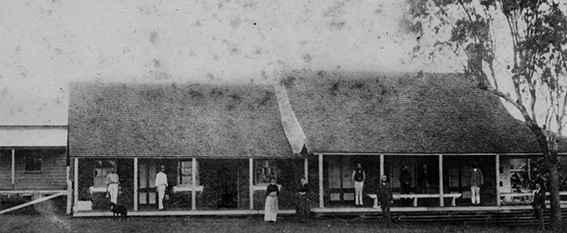
Springsure hospital circa 1875. Image State Library of Queensland.
Kembery left a wife and children.
Bogantungan Railway Station today. Image Chris Ison.
In 1960 Bogantungan became the site of Queensland’s worst train disaster when the Midlander passenger service crossed the flooded Medway Creek. Water had weakened the pylons and the train came crashing down, killing seven and injuring 43. The accident happened at 2.30am, eerily close to the time Kembery was killed.
Kembery’s sinking headstone is found at the Springsure cemetery.
Sources: Morning Bulletin, Tuesday 29 April, 1890, p6
The Queenslander, Saturday 3 May 1890, p821
Toowoomba Chronicle and Darling Downs General Advertiser, Tuesday 29 April 1890 The Capricornian, Saturday 3 May 1890 – Page 15
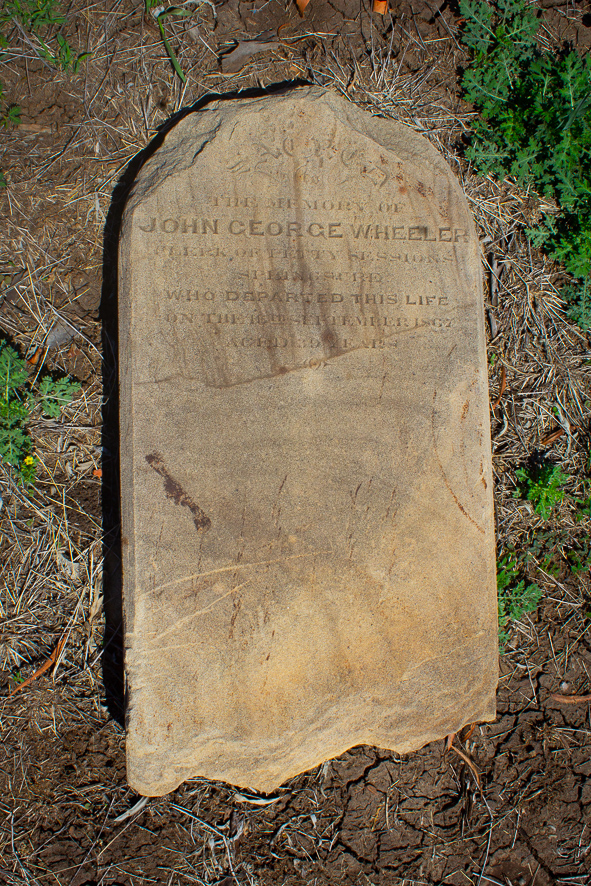
Springsure – Does this fallen, eroding gravestone honour the man after whom the Capricorn Coast’s controversial Mt Wheeler was named?
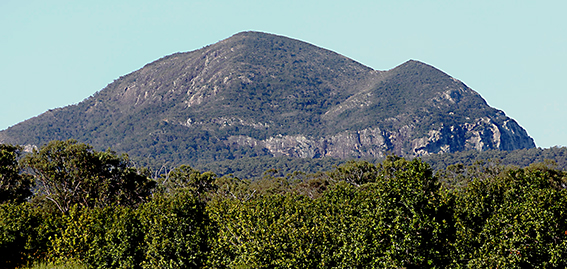
Now known as Gai-i, the popular narrative for a long time was that the mount was named after cruel Native Police inspector Frederick Wheeler, who was allegedly involved in a massacre of local Darumbul people.
It is now broadly accepted that it was named after John George Wheeler, a gold commissioner who worked in the area during the 1860s.
Historic gazettes show that the John George Wheeler who worked as the Peak Downs gold commissioner went on to become a magistrate of that territory.
The John Wheeler who lies buried underneath this gravestone at the Springsure cemetery was a journalist who went on to work in government service.
He was a Clerk of the Petty Sessions when he died in 1867, aged 40.
Either way, this John George Wheeler was instrumental in fundraising for the central Queensland town of Springsure’s first hospital.
Springsure’s hospital circa 1875. Image State LIbrary of Queensland.
Unfortunately, he died on the day the hospital work was completed, so never got to experience its life-saving benefits.
He inspected the new building on September 17, and then attended a funeral.
“On his return he partook of his dinner, after which he went to his room, and laid down upon his bed with his clothes on as if to have a nap,’’ reported the Queenslander.
He was found dead the next morning.
Image Sharyn Moodie
“From the position he was lying in it would appear that he must have breathed his last without a struggle and without the slightest warning, during sleep.’’
The Queenslander
An inquiry found he died of heart disease.
Earlier in his adult life, Wheeler had been a journalist, having covered the Ballarat riots while working as a special correspondent for a Geelong journal at the time.
He later worked for the Courier and then the North Australian.
Mount Wheeler, Capricorn Coast, Central Queensland. Photo CHRIS ISON.
He then entered government service, and, if he is the same John George Wheeler, perhaps had a mountain named after him.
While it is much nicer to think that is the case, it is also right that the volcanic plug which dominates the landscape has a First Nations name.
Sources: The Queenslander, Saturday, 12 October 1867, p 7
It is unlikely Sydney Constantine Tolley and Edwin Poyner knew each other in life, but they shared more history than their bones decaying together in the dry Norseman cemetery in WA.
They both came from Adelaide families, both were one of five sons and both died of bowel-related illnesses.
Tolley was a successful barrister in Adelaide, who had moved to Western Australia to gain his qualifications to practice there.
This required a period of residence, which had almost been served in the gold mining community of Norseman when he ‘suffered an attack of peritonitis’ (inflammation of the peritoneum) and died.
One of his five brother was his partner in the practice.
Edwin Poyner, who died two years later of “inflammation of the bowels”, was a miner.
More than 120 years later, their gravestones endure, giving little indication of the similarities or differences between these two men.
Norseman, Western Australia
Sources: Chronicle, Saturday 1 August 1896 p 9
The Advertiser, Wednesday, 19 January 1898, Page 3
Saturday night motorcycle racing at the Claremont Speedway was one of the most exciting things to do in Fremantle in the late 1920s.
Daring young men would fling their motorbikes around the dirt and cinder track, thrilling the spectators.
Motorcycle riders at the Claremont track the year that Mulligan died.
Percy Mulligan’s proud parents were there the night of March 2, 1929 when he became the second person to lose their life at the speedway, which had opened two years before. And following on only two months since the first death, it set off community debate about the safety of the popular sport and that particular track.
Percy fell at the grandstand corner during the third heat of the A Grade Handicap. The track had been graded before the event, with a steward saying it was in as good condition as possible.
As he started to crawl towards the fence, the following cycle hit his, throwing him back into he race, where the front wheel of the third rider, Hector Williams, struck him at the base of the skull, ripping off his crash helmet.
Williams said he had been close behind Mulligan. He estimated they were travelling about 50 miles/hour.
As they approached the grandstand corner in the third lap he saw Mulligan’s cycle “turn right around and skid sideways, before going down to be obscured in flying cinders.”
Mulligan had fallen to the inside of the track so Williams headed to the outside, as he pulled his goggles down in an attempt to see better.
He remembered nothing from then until when he woke up in the Perth Hospital.
Image Sharyn Moodie 2020
The two were carried off the track by ambulance officials and Mulligan died in the casualty room a few minutes later.
A post mortem found that death was due to fracture and dislocation of three vertebrae, with compression of the spinal cord.
“I’ve known him since he was so high. He was a bonzer chap.”
a childhood friend of percy pays a tribute
“Percy Mulligan was one of those healthy looking young Aussies whose ambition was to become a cinder track champion,’’ reported The Call.
“About twelve months ago he refused an offer of a car from his father in favor of a motor bike. When he found he could “show up’’ some of the speedway riders as he practiced laps at a track near his home, he sought permission from his father to race but was repeatedly refused.
“There’s no risk Dad” he used to say, and eventually his father gave in to him.
Percy was promoted to the A grade ranks on his second appearance, partly due to a strike by riders seeking better prize money.
On his third, he died.
“They picked him up from the track broken and dying. But the expression on his face through the muck and grime of the cinders was one of exultation in the thrill of sport.”
the call
Percy’s proud father was known as a Fremantle “sportsman’’, which seems to be a euphemism for gambler.
The Call News newspaper took it as a sign of Bill’s great sportsmanship that when his son died, he requested the night’s entertainment go ahead.
Image Sharyn Moodie 2020
Mulligan’s parents ordered one of the tallest monuments in the cemetery, a 2.5m polished granite base with a 2.1 metres marble angel from Italy. It cost the equivalent of an average house at that time.
Percy, 18, was by no means the last to die at the speedway. There were 19 deaths between 1928 and 1995, among motorcycle, sidecar, car and spectators.
Sources:
Call News-Pictorial, Friday 8 March 1929, p 17, Wednesday 27 March 1929, p7, Friday 8 March 1929, p22, Friday 1 March 1929,p21
Percy Mulligan, Fremantle Cemetery Heritage Walk Trail One mcb.wa.gov.au














 Way to go Australia