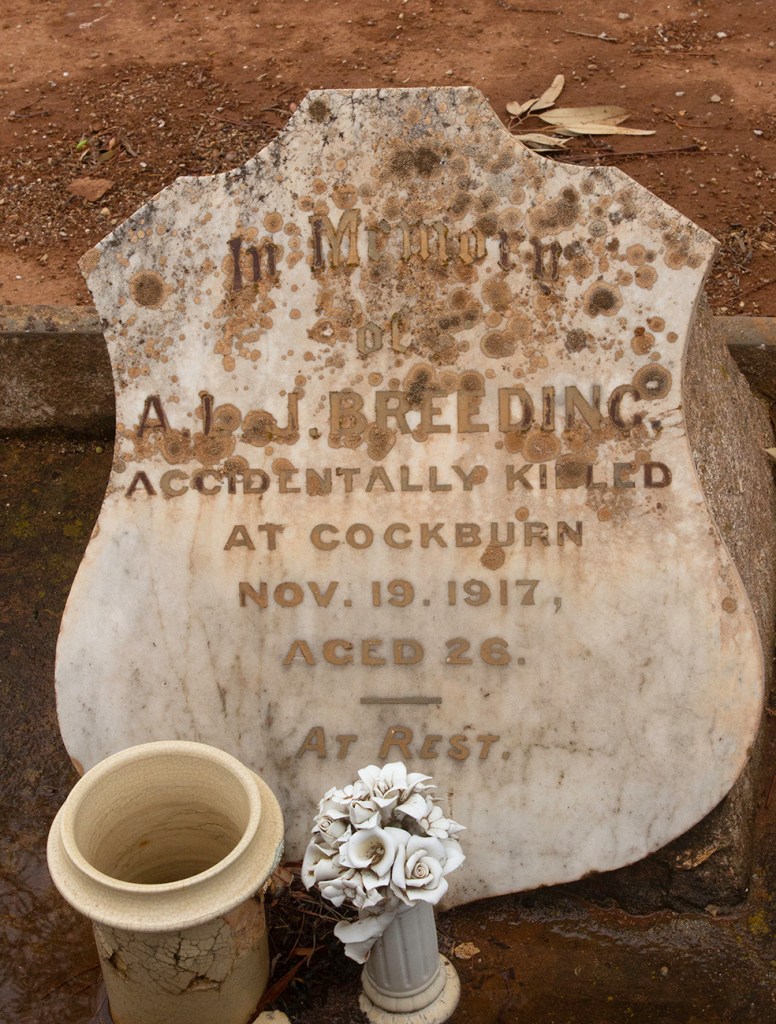
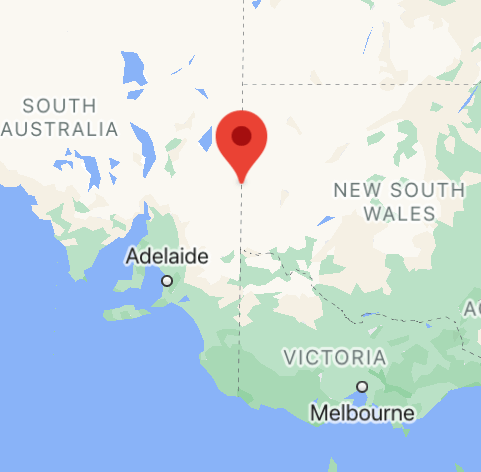
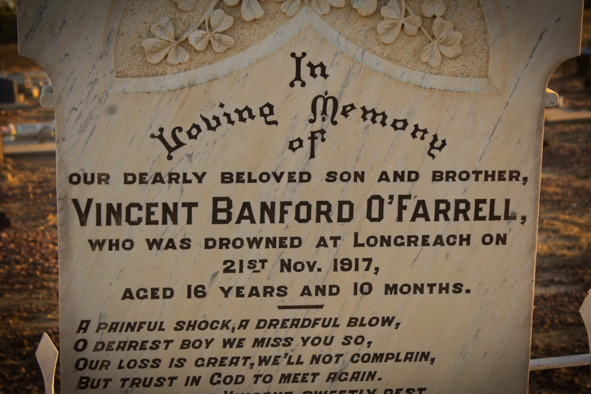
1917 – Shunting driver Alfred “Leonard” Breeding was working at Cockburn on the border of NSW and SA, when he got the heel of his boot stuck between two rails and was run over.
That is what initial newspaper reports of his death claimed. But there was no mention of his foot being stuck in the coronial inquiry which followed, where it was claimed his body was found well clear of the tracks.
It was 9.30ish in the evening and Breeding, 26, had not long started his evening shift as a shunting engine driver at the Burns yard on the New South Wales side of the border.
Breeding should have been safe doing his work in the engine. Although the inquiry into the incident heard that an engine driver should not have been uncoupling railway trucks, two witnesses had heard him say he was going to show the porter the best way to divide the train.
But no-one seems to have seen what happened. The porter said he heard a “bumping sound between the two pits of the level crossing” and ran to tell the men on the engine to pull up.
Breeding had died instantly – his body was found lying clear of the rails. His right arm and jaw were broken, as well as his left leg.
The coroner’s finding was one of “accidental death, no blame being attachable to anyone”.
Breeding left a widow and three children, aged four and two years, and three months. They lived at Petersborough, where Breeding was buried.
The Silverton Tramway which employed Breeding was a 58-kilometre-long railway line running from Cockburn on the South Australian border to Broken Hill in New South Wales.
It linked the differing line widths between the two states – South Australia using a narrow gauge and NSW government railways using “standard gauge”, thus allowing silver-lead-zinc ore to reach South Australian ports.
Cockburn, where Breeding died. He was buried at his hometown Peterborough, 226k south-west.
SOURCES: Barrier Miner, Tuesday 20 November 1917 p 2, Wednesday 21 November 1917, p 2
It must be immeasurably sad to learn of your only son’s death by letter, but in the early days of Australian history, it was the way it was sometimes done.
It’s hard to imagine in these days of instant telecommunications.
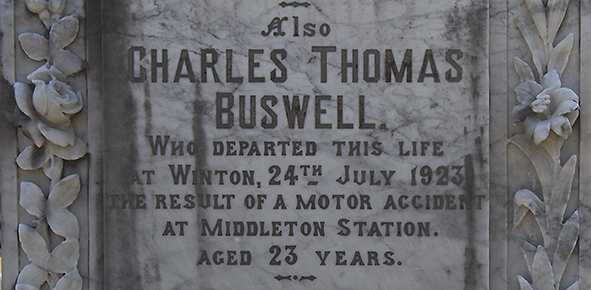
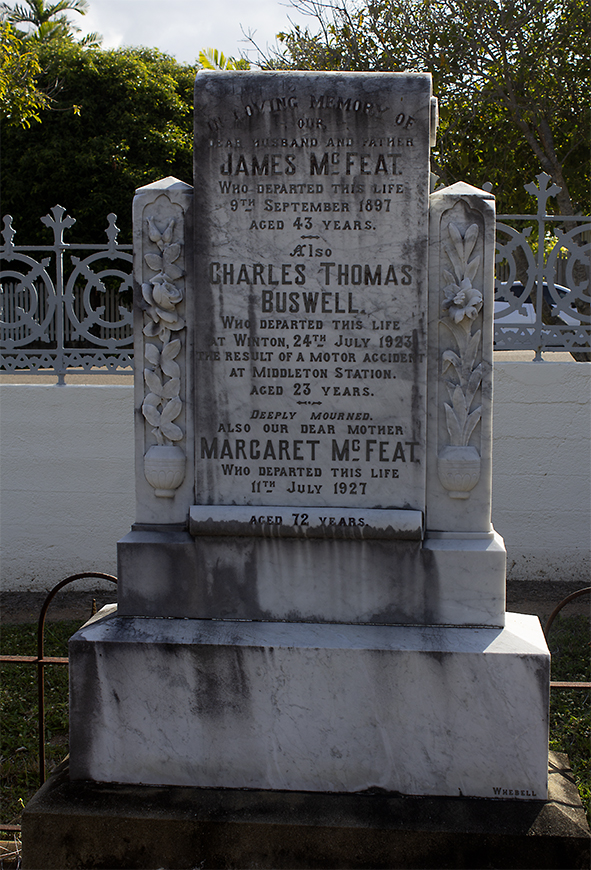
This is the only account I could find of Charlie Buswell’s death in the Queensland outback in 1923.
The information was contained in a letter received by his father, Charles senior, who was the officer-in-charge of the weighbridge at the Mulgrave sugar mill at Gordonvale, near Cairns.
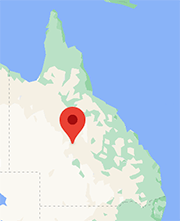
Charlie, 24, was the book-keeper on Llanrheidon station, a 673 square mile sheep station smack bang in the middle of outback Queensland, about 160 kilometres from Winton.
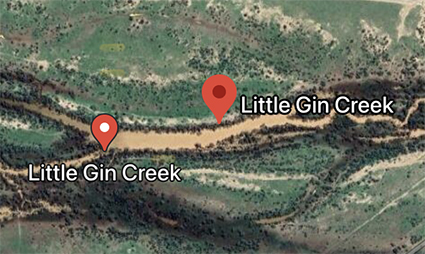
“Charlie and Mr. A. Durrach were going to a neighboring station, when, whilst driving along the Boulia road, something went wrong with the steering gear, and the car turned over,’’ said the letter, which was published in the Cairns Post.
Initially Charlie thought he had not been badly injured.
Durrach got up, and saw Charlie walking round the car, and asked him if he was hurt.
Charlie replied that he thought his jaw was broken.
Cairns post
The two started to walk to a neighboring place, and had gone about 200 yards when Charlie sat down, and said he felt sick.
Durrach left him, and went for assistance, and brought him into Winton (about 160 kilometres away).
He regained consciousness only for a short period in the hospital, and passed away quickly.
His body was brought to Townsville, where his family resided, for burial in the West End cemetery.
The Cairns Post said he had a large circle of friends and was a member of the South Townsville Tennis Club,and of the Independent Order of Rechabites.
The Order of Rechabites was a temperance society which promoted abstinence from alcohol and gave sickness and death benefits to its members.
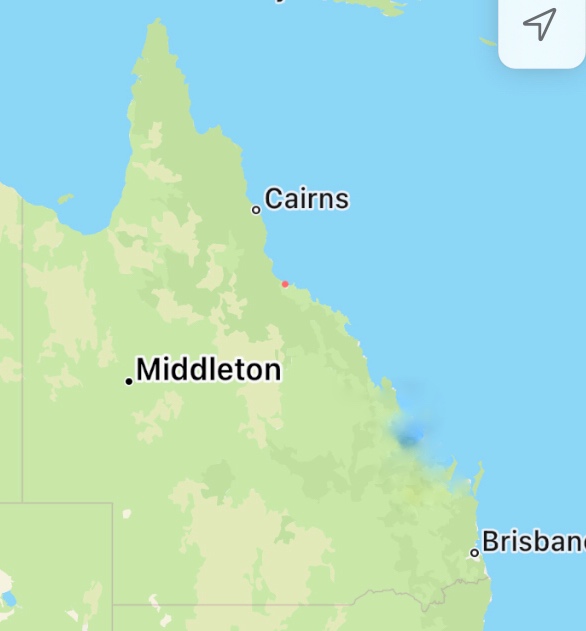
Middleton truly is in the middle of Queensland. Llanrheidon Station neighboured Middleton Station.
Digging out headstone history can be a real brain-teaser.
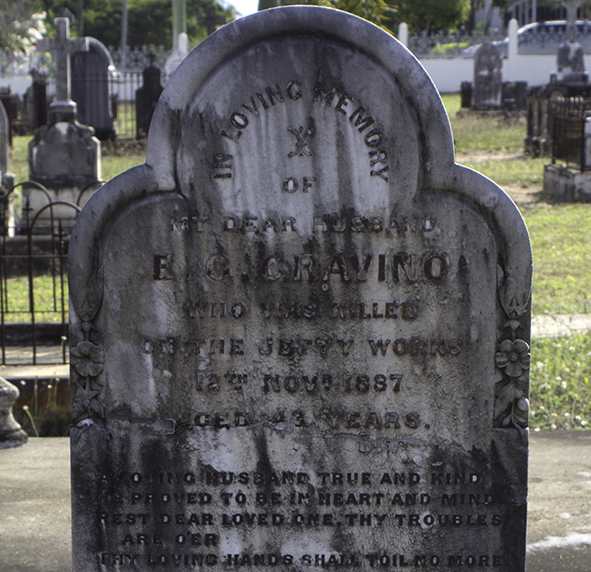
This West End, Townsville cemetery gravestone is for an Emile Gustav Cravino, whose headstone reads that he was killed on the jetty works, but there were no newspaper reports for such a death.
There were, however, reports for a man variously named “Carandist” and “Cavanagh”, with identical stories telling of a man crushed between two waggons (sic) after he “got on the wrong line’’.
The Mackay man died, leaving a wife and six children. And it seems that his brother Adolphe married the widow Eliza in 1888, but then committed suicide two years later.
The naming errors may have been due to attempts to Anglicise the name, or to vagaries of the use of telegraphs to spread news.
A newspaper story two years later makes it likely that the reports were about the Cravino whose headstone is pictured above.
Another man with the last name Cravino committed suicide at the Crown Hotel, Townsville, and reports of his death said that his brother was killed while working on the jetty two years ago. The following details make it most likely that this was Adolphe.
Reports of the second Cravino’s death in 1890 would certainly not be written today as it was then, seeming to take delight in the drama of the event and speculating on the cause.
Cravino, described as “a traveller”, committed suicide at the Crown Hotel by taking poison.
The groans of the man roused the house, but before the doctor arrived he had expired, after suffering great agony
the telegraph
“The deceased’s brother was killed while working on the jetty two years ago, and his first wife died from sunstroke at Rockhampton.
“He then married his brother’s widow.
Rockhampton’s Morning Bulletin provided more detail, saying he had arrived at the hotel in a despondent mood ten days beforehand.
He had borrowed two shillings, and it was assumed he used that to buy the strychnine which took his life.
“On Friday he had two or three drinks, and shortly before eleven o’clock, took a final drink of brandy.
“He complained of an internal disease, and was given a moderate dose of laudanum earlier the same evening.”
When his groans roused the house he was given emetics. He died before a doctor could arrive.
Shortly before he died Cravino took off two rings he was wearing and handed them to another man?
Cravino had been living in Charters Towers and had worked as a clerk.
“It is thought that ill health and financial troubles so prayed on Cravino’s mind that he sought refuge from the cares of this world, and hesitated not to choose perhaps the most painful way out of it.”
the telegraph
Those financial troubles would not have been helped by the addition of six children to his family. Eliza moved on from the death of her second husband, marrying again in 1891 (this husband died in 1897) and again in 1903.
Townsville, Queensland.
Sources : The Telegraph, Tuesday 25 March 1890, p2
Queensland Times, Ipswich Herald and General Advertiser, Tuesday 15 November 1887, p7
1907 – There is a sad irony in a man named Drain breaking his neck in a swimming bath.
Drain’s fallen-over headstone lies in the Gladstone cemetery, Queensland.
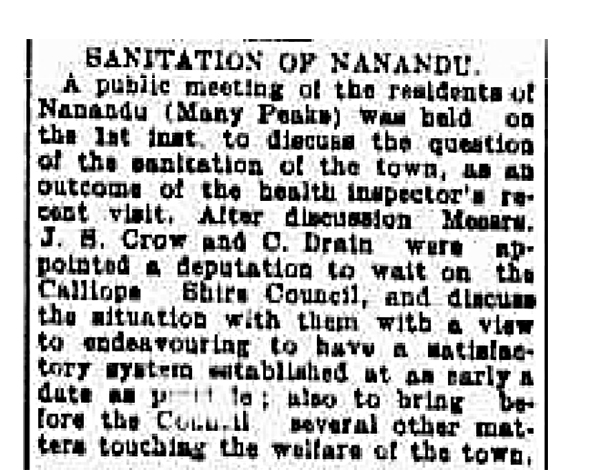
Thirty- year-old Charles Drain was visiting Central Queensland’s Gladstone from the nearby copper mining region of Nanandu, now known as Many Peaks. The copper from the mine was used as a flux in the Mount Morgan gold mine smelters 200 kilometres away.
Drain was employed by the Mount Morgan Mining Company as a shift supervisor.
He and another man, Mr Crow, were in town to seek an improved sanitary service at their rapidly growing township. They had made their presentation to the Calliope Shire Council the day before, after the 100-kilometre trip.
One newspaper article reported that no-one saw the incident, which happened at the Auckland Creek seawater baths, described as “of an open character, with staging raised about 3ft above the water running round the interior.
“Drain, after undressing, went to the shallow end where the depth is not more than about two feet, and dived into the water.
“….it is believed that in his plunge the young fellow’s head, came into violent contact with the bottom of the baths, the impact dislocating his neck.
“When the attendant entered the baths he found the body of the unfortunate man floating in the water.
Another article, presumably more informed, said Drain was at the baths with a friend. When his friend had said he was getting out, Drain said “one more dive.’’
As the friend headed for the change rooms Drain went out on a plank and dove off.
“He took a header and struck shallow water, rolling over without a word or a groan”.
The capricornian.
Another lad in the water gave the alarm and Drain quickly had medical assistance, but his spine was fractured and he died within the hour.
Crow informed the Mount Morgan company of the incident and they arranged for his body to be taken to Nanandu for burial, the newspaper reported. However, he was buried in the Gladstone cemetery on the Sunday afternoon.
Crow also arranged for a “special messenger” to proceed from Miriam Vale to inform the company’s manager there “so that he might break the sad intelligence to the widow, who, with four children, is thus bereft of her bread-winner.’’
The Bundaberg Mail and Burnett Advertiser, Tuesday 3 December 1907 , p2
Sources: The Bundaberg Mail and Burnett Advertiser Monday 9 December 1907, p2: Wednesday 11 December 1907, p2;
1874 – John Clerke died when he fell into the hold of the ship under his command, during the dark of night.
He was the chief officer of the steamer Lady Bowen, which had just arrived from Rockhampton to Gladstone, a settlement which was only about 20 years old.
The Commercial Whart in Auckland Creek in 1860. Photo courtesy State Library of Queensland.
It was a long slow trip, taking about eight hours, and the ship arrived in Gladstone’s Auckland Creek well after dark, after 8.30pm.
Some wool was loaded, and Captain Cottier left the ship, giving command to Clerke, who had the vessel shifted 40 yards to the Commercial Wharf.
The hatches were put back on while the ship was moved. However, mobile lights on the dock were not moved.
Clerke then ordered the hatches taken off, but as that was happening the boatswain ordered them put on again, to allow cargo in the horse stall to the taken out.
Clerke was leaving the area, when the carpenter called out “Mr Clerke, thc second mate is singing out for you.”
As Clerke replied “What does he want?” he lifted his leg to stand on the coaming of the main hatch – the vertical frame around the hatch.
At this stage two men were in the process of replacing that hatch cover.
Clerke stepped right into the open main hold hatch, brushing against the man holding the hatch.
Although the carpenter and another man shouted a warning, it was too late.
Medical aid was called to the unconscious chief officer, but he died two hours later, at midnight.
Clerke was from Tasmania, and had sent for his wife and four children to join him in Gladstone.
He had been there long enough to become a part of the community, as 30 sea-faring friends and tradespeople followed his Union Jack-draped coffin from the church to the Gladstone cemetery.
The flags of the vessels in port, and on all the wharves, stores and hotels were hoisted half mast, reported the Rockhampton Bulletin.
“Uninformed tattlers were busy, as is usual in these cases, with the cry of carelessness, not sufficient lights, etc.
rockhampton bulletin
An inquiry showed no such neglect, and it was pointed out that Clerke was in charge of the ship, which meant he was also in charge of the lights.
Sources: Northern Argus, Saturday 14 November 1874, p2
Rockhampton Bulletin, Wednesday 9 December 1874, p6
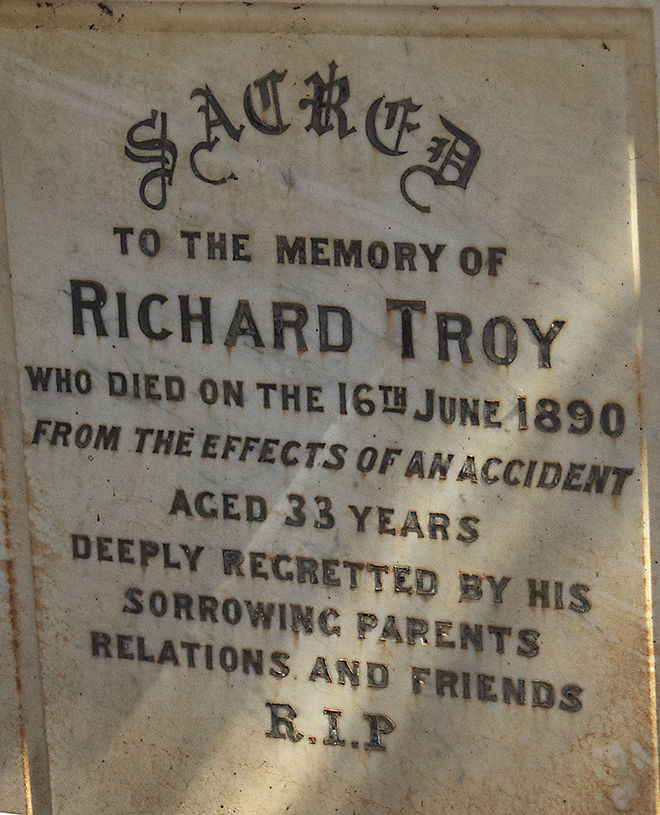
1890 – Police sergeant Richard Troy, 33, may have shot himself during a raid on an Aboriginal camp in remote north-western Australia.
York cemetery. Image Sharyn Moodie 2020
It was June 16, 100 miles east of the Kimberley town of Wyndham, when Troy and fellow policemen charged the camp. They were trying to catch men thought to have been cutting telegraph wire.
The camp inhabitants fled, but Troy was shot in his leg as his horse lunged forward.
There was conjecture about whether he had shot himself or whether another officer’s gun had caused the wound. It doesn’t really matter – the end result was that he took five long days to die, despite a doctor’s attention.
He was put under the red, rocky ground in the wilds of the Kimberley, but it was not to be his final resting place.
News of his death reached his family in York, 3000 kilometres south, via a telegram to Richard’s brother Patrick, also a policeman, at Derby.
This is what it read:
“Your brother was accidentally shot by one of the constables whilst rushing a native camp in the early morning of June 16th, over 100 miles from Wyndham. Everything appears to have been done that was possible, a trap was sent for, also the doctor, who attended him before he died, and who states that he could not possibly have recovered.’’
Patrick set off to organize his brother’s unburial, and then accompanied his body to York.
It wasn’t until November 21 – five months later, that the brothers arrived by train at the York railway station.
The funeral was held the next day, with a procession of more than 100 people, including many police officers.
Sources: Clack, A and Rae, J, 2006, York Cemetery Historical Walk Trail, published by the The York Historical Society Inc.
Marion Currie, aged 84, killed at Townsville, during cyclone March9, 1903. Image: Sharyn Moodie 2022.
Marion Currie, 84 years old, and her young grandson, age unknown, were pinned under a piece of timber in the midst of the worst cyclone Townsville had known.
It was March 9, 1903 and as Cyclone Leonta intensified, Marion had made two attempts to reach her daughter’s home near her Sturt Street home. But the weather was too bad and they returned.
The North Queensland Register reported what happened.
“Mrs King noticed about 12 o’clock that her mother’s house was in ruins and fearing that some injury might have come to Mrs Currie she got the assistance of a friend to battle the storm and he discovered Mrs Currie and the grandson pinned under the building.
“Mrs Currie was quite dead, but the boy was uninjured.
“The lad said his grandmother was not killed instantaneously; she spoke to him and asked him to lift a piece of timber that was crushing her.
“The poor boy replied that he could not move it, and the grandmother then replied, “I am afraid I am going. Good-bye.”
She was one of 12 people in Townsville to lose their lives that day.
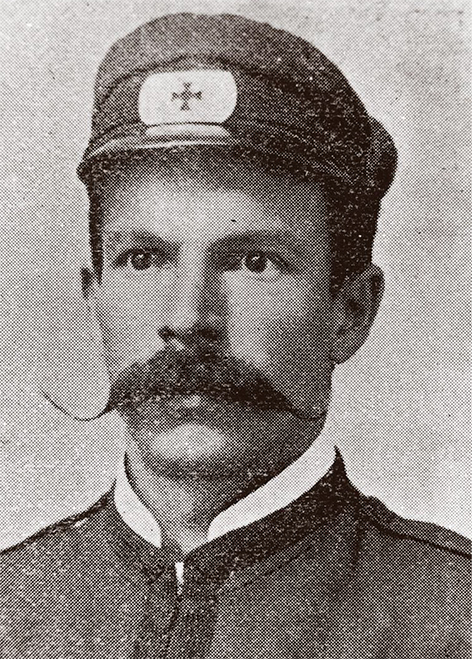
Mrs King was the wife of the local ambulance superintendent, Gus King, (pictured right) who was busily saving lives while his mother-in-law unfortunately lay dying. The town had only had an ambulance service since 1900.
While cyclones Althea and Yasi in the years since have surpassed the intensity of Leonta, the impact of the tempest was devastating to the town.
With telephone and telegraph services disrupted, at the time it was difficult to know the extent of the damage, or to call for help.
“ The appearance of the town — and Flinders-street suffered least — was extraordinary, sheets of iron, branches of trees, wooden frameworks, and sign boards floated about like leaves, but in the higher portions of the town the grim work of the gale was perceptible to an extent that would have been grotesque had it not been so terribly tragical (sic).
The view from the Townsville hospital, which was flattened with multiple loss of life. Picture courtesy State Library of Queensland.
Marion is buried in Townsville’s historic West End cemetery.
To wander through the Thursday Island cemetery is to take a 135-year time travel journey through the complex and fascinating history of the region.
With a population which from 1890 comprised Europeans, Chinese, Torres Strait Islanders and Aborigines, South Sea Islanders, Malays, Filipinos, Japanese, Singhalese, Indians and a few Thais, Arabs and Africans, visits to the cemetery are always going to be an interesting adventure.
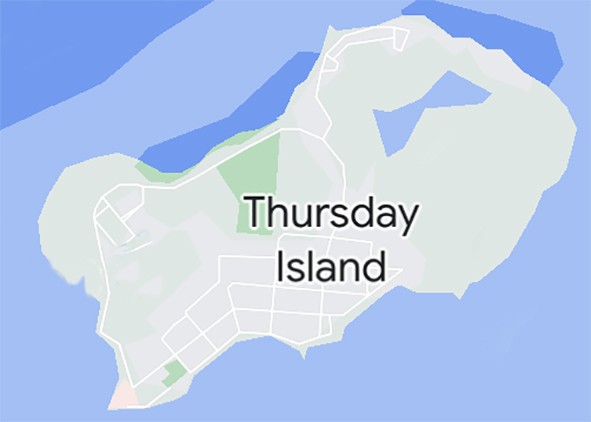
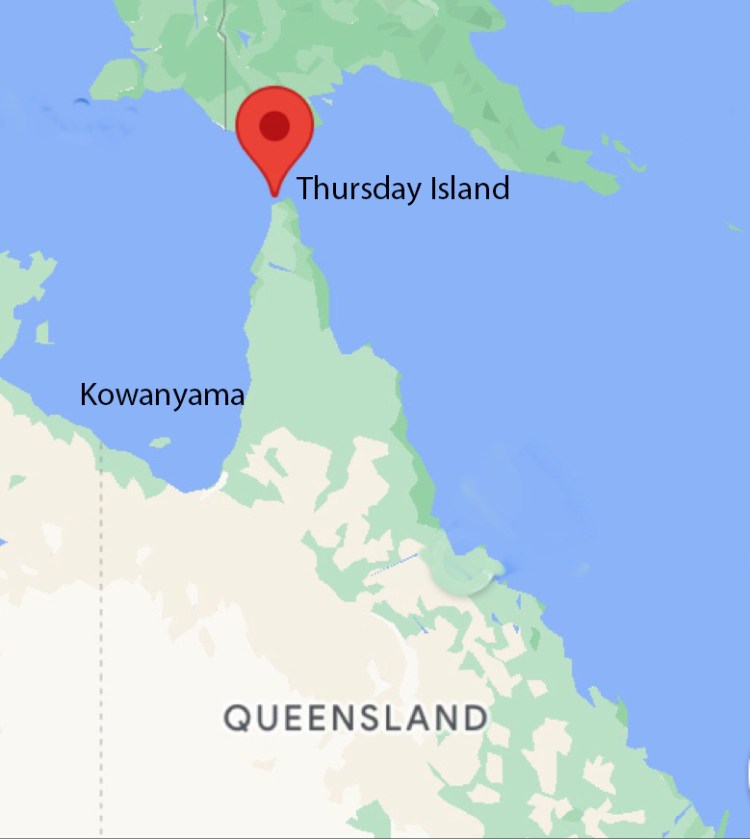
The cemetery itself is as inhomogeneous as the many ethnic and cultural communities that lie within. Some sections are mown and well-kept, while others are overgrown and inaccessible. Different parts of the cemetery are so unalike as to have their own ecosystems. Some parts are flat, others steep and rocky. The cemetery stretches from the ocean-side flats to a high rise in the centre of the island – the green rectangle in the map below.
The most high-set graves are in the cemetery’s earliest section, in the middle of the island, along Summer and Blackall Streets.
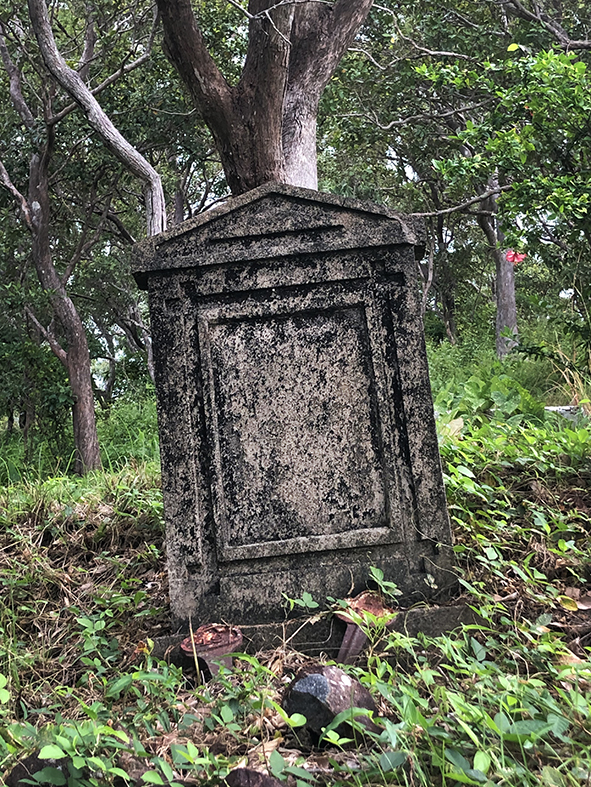
John Douglas’s grave in the Thursday Island cemetery. Behind, almost in the scrub, is the grave of Archibald Watson.
The proclamation of a permanent cemetery reserve of eight acres was made on July 8, 1887 and soon after, cemetery trustees were appointed. One of those was John Douglas, seventh premier of Queensland, who by then was the island’s Government Resident.
His blue granite grave is one of the most prominent in this upper section of the cemetery – but still requires some effort to get to, especially if it’s a while since the whipper snippers have been through during the wet season.
Click here to read about John Douglas‘s life and burial .
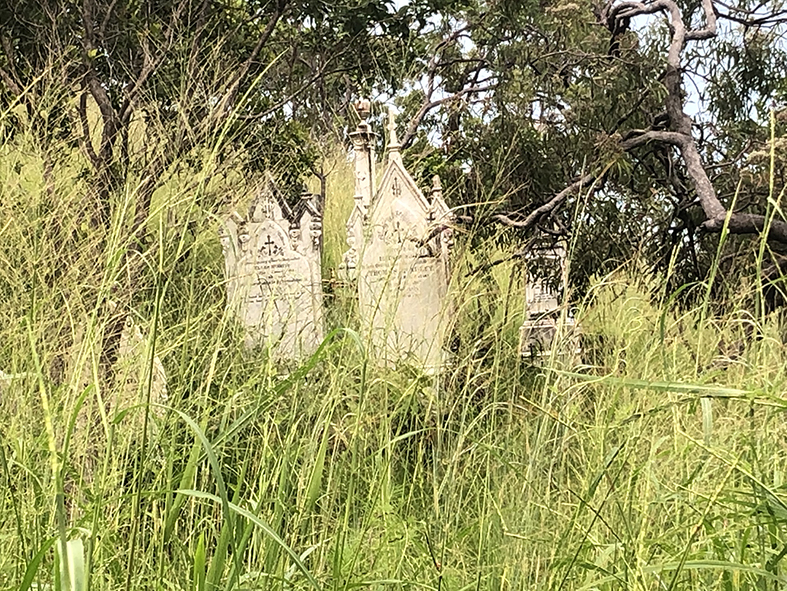
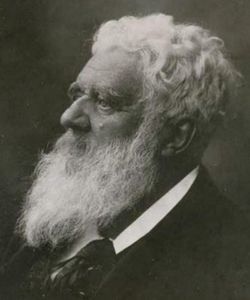
Also buried in this section is Archibald Watson (stone pictured below) who overcame early notoriety and fled the possibility of incarceration, to become a leading surgeon and academic.
The trustees soon found that much of the reserve was too steep and rocky for burials. The paths would become washed out during the wet season – even today there are numerous drains and gullies amidst the long grass, waiting for an unwary visitor to turn an ankle.
In 1894 the cemetery was doubled in size to 16 acres, towards the northern side of the island, and again in 1896, to take in what is now the Japanese Divers Cemetery.
It was pearl fishing in the Torres Strait in the early 1870s that kicked off the ethnic diversity of the region. An exemption from the White Australia Policy, which started in 1901, meant that diversity continued where in other parts of Australia, it was stymied.
Imported labour gangs from Pacific Islands in the early years were replaced, as technology changed, by Malay and Filipino divers and by the 1890s Japanese divers and tenders dominated.
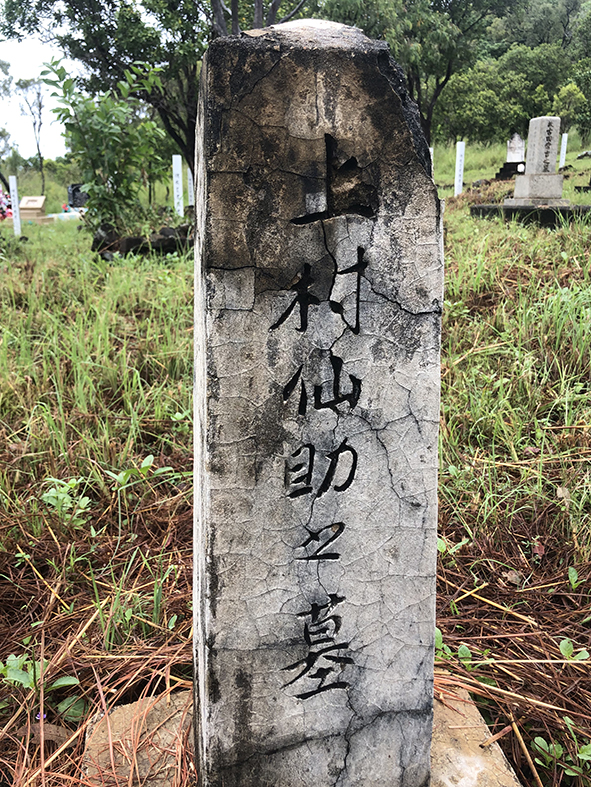
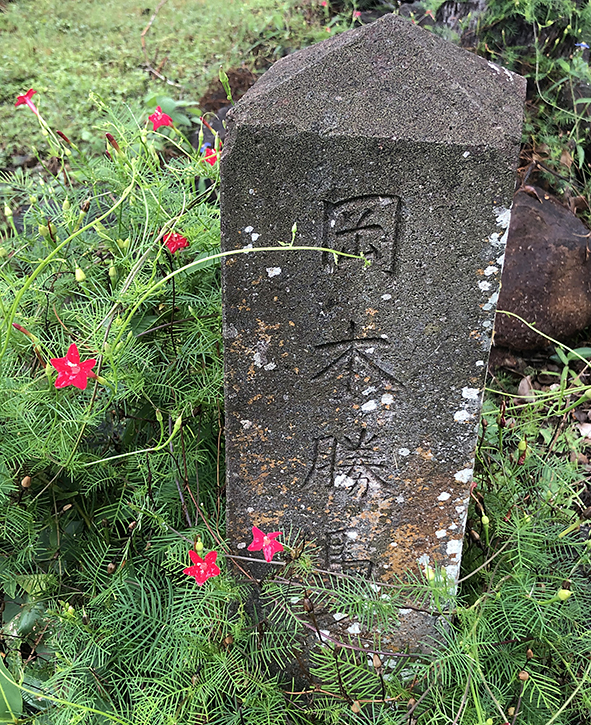
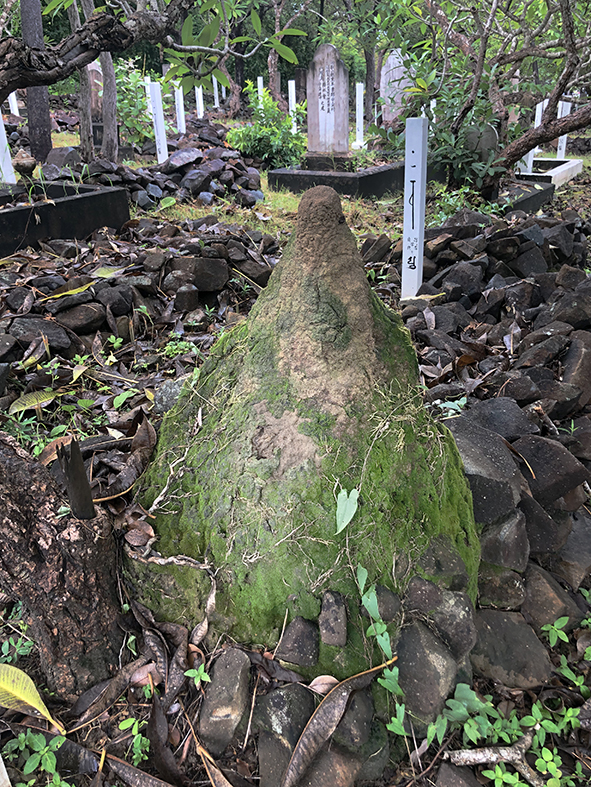
Japanese graves certainly dominate the cemetery. There are over 700, although more than 1200 Japanese workers are thought to have died during the 60 years they were in the industry – most were deported after World War II.
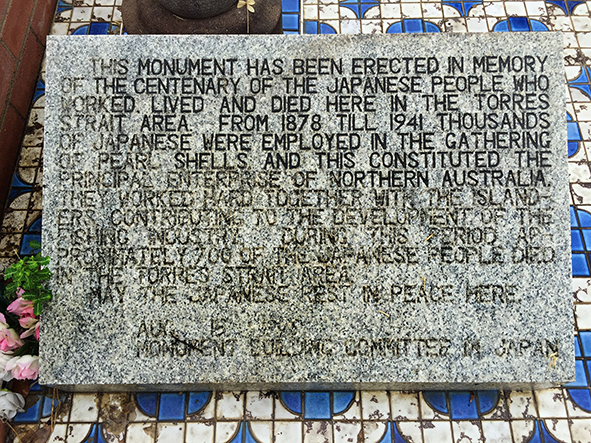
But Japan has not forgotten its fallen. Some of the post-like grave markers have been replaced by Japanese funding and a monument has been erected by the Monument Building Committee of Japan to “commemorate the Japanese who worked, lived and died in Torres Strait between 1878 and 1941”.
Memorial to the many Japanese pearl divers who died in the line of their work in Torres Strait, at the Thursday Island Cemetery.
And each year on August 15, the Japanese Day of the Dead, known as Obon, a Buddhist ceremony is held, where a recital and the name of the known dead are called out.
A Japanese resident has established a trust of about $100,000 to ensure future maintenance of the gravestones.
Torres Strait Islander’s burial cultures have changed since colonization, but still retain, or more accurately, have reintroduced, unique aspects.
In a two-part process, a funeral is held, then the grave/tombstone is covered with materials. About a year after the death, a ceremony is performed, known as an unveiling or opening. It is meant to be a joyous event, representing the release of the person’s spirit. It usually involves feasting and dancing.
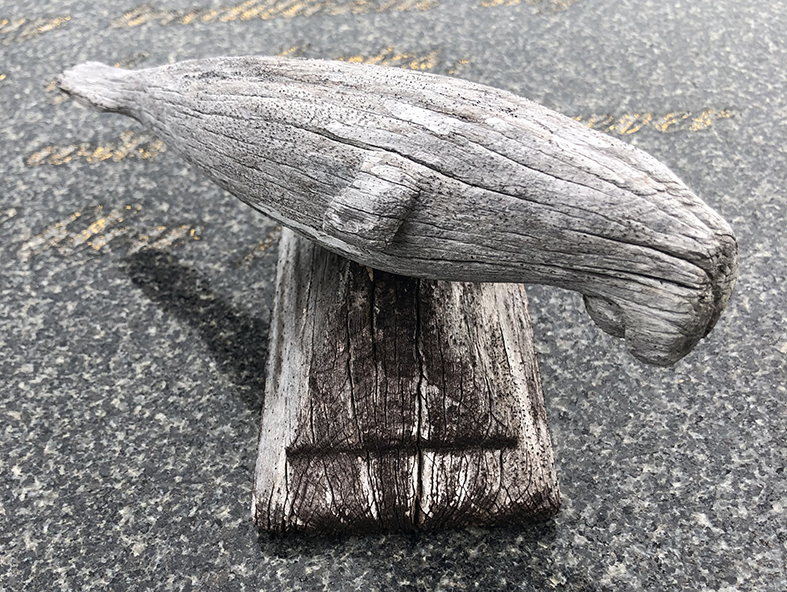
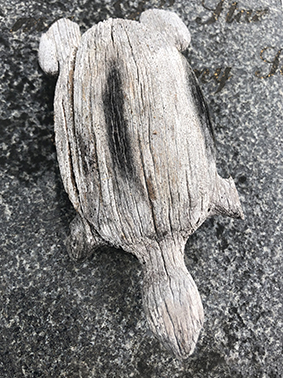
The hand-carved animals below were found on Torres Strait Islander’s graves.
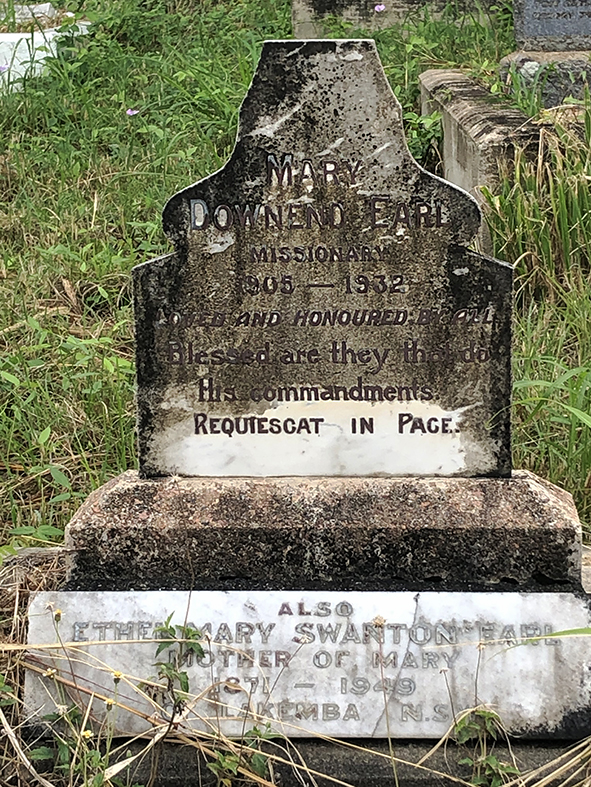
Other interesting graves in the cemetery include that of James Price, murdered in a pearl fishing venture gone wrong, and Mary Earl, a young missionary who met an unfortunate end while passing through. Click on their links to read their stories.
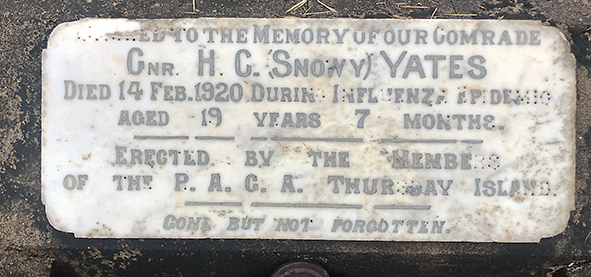
And there are graves which tell of events, like the influenza epidemic of 1919, which took the life of Snowy Yates.
It took several weeks to explore the cemetery, with different parts being exposed as the maintenance crews worked around the unsettled wet season weather. It was almost like a gift being slowly unwrapped.
















 Way to go Australia