The 1919 Spanish flu epidemic which had hit Queensland hard was all but over, when an outbreak raced through the Thursday Island population early in 2020.
Although some Islanders had been vaccinated the previous year, the original inhabitants still bore the brunt of the disease. Despite this, death tolls announcements focused on the number of white deaths.
Gunner Snowy Yates was reported on February 14 as being the third white person to succumb, while the total death toll was 27. His headstone can be seen in the Thursday Island cemetery today.
While initial cases were mild, the disease soon ramped up in severity.
At one stage it was estimated that 60 per cent of “the people are suffering, the general hospital being overcrowded, while a temporary hospital for the military has been established”.
When the medical superintendent fell ill, leaving only one doctor to treat the populace, military authorities were requested to send doctors, nurses, medicines, and milk.
“There is a serious shortage of medicine and the hospital staff is quite inadequate.
Help duly arrived, with the Queenslander newspaper reporting “ fortunately, the outbreak was not so serious as expected, and in several of the islands patients were found in a state of convalescence. Mortality was chiefly amongst the old people”.
Little consolation to the families of those who had died.
The Queenslander ran a photo page of the rescue effort, putting a positive spin on the health intervention.
Sources: The Brisbane Courier Monday 16 February 1920, p6
Maryborough Chronicle, Wide Bay and Burnett Advertiser Wednesday 11 February
Cairns Post Thursday 12 February 1920, p5
The Queenslander, Saturday 3 April 1920, p21 (image above), 36
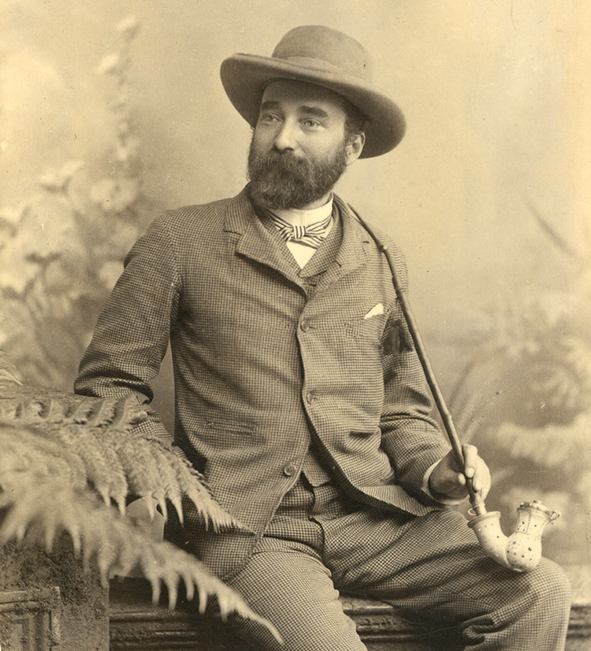
Archibald Watson’s life could have been so different.
The eminent Professor of Anatomy is well known for his contribution to the development of anatomy and surgery in Australia.
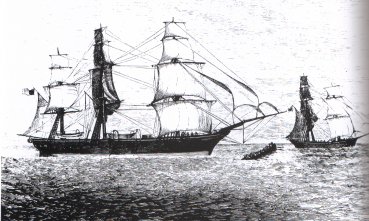
But the man described as an ‘’erratic, histrionic genius’’ was embroiled in controversy early on in his adult life when he took a trip on a blackbirding venture on the Carl in 1871-72. The murder of many Pacific Islanders during that trip resulted in a charge of piracy – while others on the boat were charged with murder.
.
.
The naval ship Rosario intercepting the Carl in the seas off Vanuatu. Image National Library of Australia.
While two of the men charged with murder were convicted and sentenced to death, Watson, having paid a recognizance of one thousand dollars, saw it conducive to his future to flee from Fiji to Melbourne and then on to Europe.
There, he studied medicine, returning to Australia as a professor of anatomy. There appeared to be no repercussions from his failure to take part in the due proess of law, a fact attributed to the prominence of his grazier family.
From here, his academic career flourished.
“He flouted convention and dressed in an old canvas coat. Short, bearded and bespectacled, he spoke six languages and had a firm voice, acid wit and racy vocabulary.’’
Australian Dictionary of Biography
“As a lecturer, using vivid language and rapid blackboard sketches, he taught with dramatic intensity.”
He compulsively recorded his professional life, leaving a rich legacy. He also compulsively recorded his personal life, but ordered those records destroyed.
“He had developed the habit of recording daily the details of patients seen and operations witnessed; his style was terse, his descriptions precise; his diagrams were finely drawn in pencil, black ink, crayons and water-colours.
“He also kept daily accounts of expenses. Most of his accounts and surgical notebooks have been preserved.
Despite having travelled the world, he is said to have been determined to end his days on Thursday Island, which he loved. He never married, had no known children, but “recorded details of his paramours in his personal diaries: he entered the names in Greek, his sexual experiences in Fijian and his actions often in variations of a coloured Maltese cross.’’
His life and legacy is much too complex to cover in this short blog, but more can be found about this incorrigible character in the book Painting the Islands Vermilion by Jennifer MT Carter.
His gravestone lies at the highest point of the Thursday Island cemetery, just behind that of the state’s seventh premier, John Douglas.
Sources:
Allen PW. Adelaide’s blackbirding pathologist. Ann Diagn Pathol. 1998 Jun;2(3):208-11. doi: 10.1016/s1092 – 9134(98)80008-7. PMID: 9845740.
Morning Bulletin, Thursday 30 July 1936, p 7
The Northern Miner, Friday 30 August 1940 – p 4
Townsville Daily Bulletin, Thursday 1 August 1940, p 4
State Library of South Australia, photographs B47714 and B3528
The grave of the seventh premier of the state of Queensland lies at the highest aspect of the Thursday Island cemetery.
Douglas’s headstone in the Thursday Island cemetery today. Image Sharyn Moodie 2022.
It looks back across the waters to the rest of the state John Douglas oversaw from 1877-1879.
Aged 76 when he died in 1904, the former statesman had been Government Resident and magistrate at Thursday Island since 1885.
He played an important role in seeing the island opened to private settlement – beforehand it had been an administrative settlement, and in trying to shield the Torres Strait islanders from government protection acts in the heyday of blackbirding.
Ironically, he had been a Cemetery Trustee from 1889 until his death.
His tall dark granite headstone is not the only monument to his life. The town of Port Douglas also bears his name.
The west aisle of the Quetta Memorial Cathedral Church, which is in Thursday Island’s Douglas Street, was dedicated in 1913 as the Douglas Memorial Chapel. The memorial stained glass window within shows an elderly St John – in the likeness of John Douglas.
Douglas had laid the church’s foundation stone. The church itself is a memorial to the 133 lives lost in one of Queensland’s and Australia’s worst maritime disasters, the sinking of the RMS Quetta.
Leading up to his demise, Douglas had been ill for a few weeks. Then, according to a newspaper report “he appeared to rally for a day or two before the end came… haematemesis (vomiting blood) ensued and left him very weak. He gradually sank, expiring shortly after eleven o’clock on Saturday evening’’.
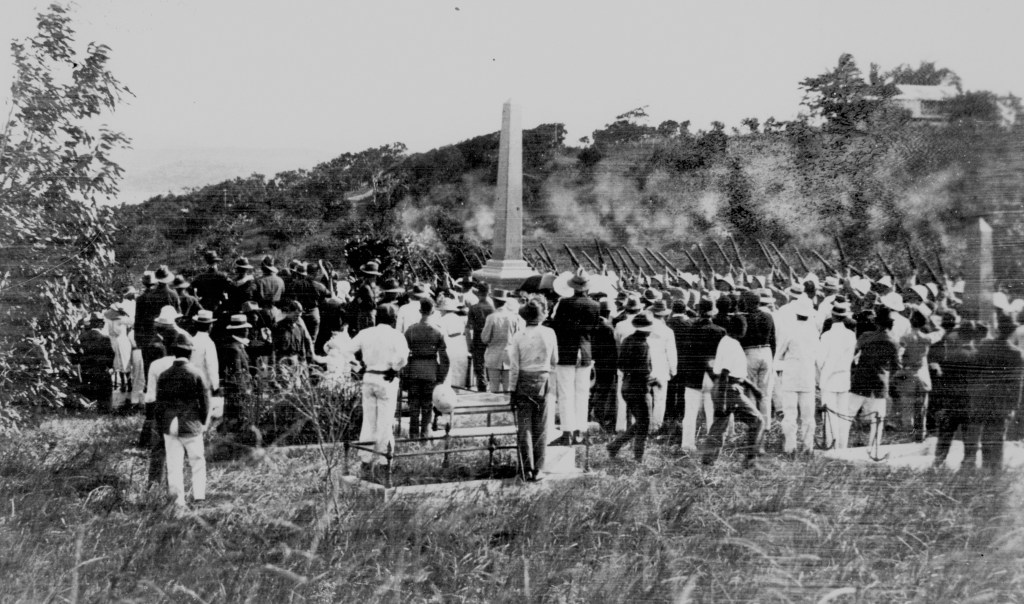
“Almost the whole population of the Island and Torres Strait were at his funeral, only the sick being the exception.
“Masonic ceremony was carried out, the firing of a salute and the sounding of the Last Post by the garrison bugles.
A salute being fired at John Douglas’s funeral.
Douglas was outlived by his second wife (his first having died) and four children.
Thursday Island, Queensland.
Sources: Darling Downs Gazette, Monday 25 July 1904, p2
Memorial window for John Douglas at Quetta Cathedral, Thursday Island, Queensland, ca. 1913 Retrieved November 12, 2022, from http://nla.gov.au/nla.obj-151172779
1878 – James Price was reported as “barbarously murdered’’ by natives when he was killed by a group of blackbirded pearl divers in the Torres Strait.
Murdered at Mulgrave Island… I will have mercy and not judgement read the words at the bottom of James Price’s gravestone in the Thursday Island cemetery. Image Sharyn Moodie 2022.
Price, 37, along with “two Malays and one Chinaman”, also crew of the pearl-shelling boat Flying Scud, lost their lives at Mulgrave Island, also known as Badu.
The remainder of the crew apparently “mutineed’’ and the ship’s mate, with a serious head wound, escaped after shooting several of the “natives”.
It was reported that “fifteen natives and four lubra afterwards took to their boats, and are supposed to have made for Port Essington, to which place they belonged”.
Price had been tasked by Captain Francis Cadell, who is today described as a slave trader, to form a pearl-fishing station at the island.
The mutineers were on a one-year contract with Captain Cadell and “had only three months to serve, “ Commissioner of Police Chester wrote to Price’s brother when he sought details of the death.
“Their motivation was attributed to a desire to return home.”
“As they had several days head start, no immediate action was taken to apprehend the murderers, “ Chester wrote.
There was one report in September that the culprits had reached the coast of New Guinea, several being killed by bushmen.
Price was temporarily buried on Mulgrave Island, then reinterred on Thursday Island. His family organized a monument to be raised over his grave. Today, 144 years later, the words on his stone are difficult to read.
Murdered at Mulgrave Island… I will have mercy and not judgement
James Price’s headstone
It is a surprising sentiment from a family who had had another son murdered by convicts in Victoria.
While Price’s murderers were known, could he be more accurately be labelled a victim of his boss Captain Cadell?
Cadell “owned’’ the workers, who hailed from Port Essington, about 800km away, on the Cobourg Peninsula north-east of Darwin. It had been set up as a military outpost to protect New Holland as a British settlement in 1838.
The original inhabitants had more than a decade of close contact with Europeans, and the relations were marked for their lack of violence.
But those relationships meant nothing decades later when the lure of cheap labour brought Captain Cadell to the area.
While there is no direct evidence the workers in this case were mistreated, Cadell had previously been charged with ill-treating his pearlers and fishermen. Various reports of his personality have him a “wonderful man, choke full of vital energy… possessed of undaunted enterprise and courage”. Yet another writer described him as pompous and bombastic. Wikipaedia describes him as a slave trader.
Cadell eventually met his maker when he was killed in his schooner Gem by the cook’s mate, who alleged Cadell had not paid him any wages for five years. The ship, with his body on board, was then scuttled.
Badu (Mulgrave Island), Queensland.
Sources: Australian Town and Country Journal, Saturday 14 September 1878, p 10
Evening News, Monday 9 September, p2
Mudie, Ian: ‘Cadell, Francis (1822–1879)’, Australian Dictionary of Biography, National Centre of Biography, Australian National University, https://adb.anu.edu.au/biography/cadell-francis-3136/text4675, published first in hardcopy 1969, accessed online 6 November 2022.
The Cornwall Chronicle, Wednesday 4 September 1878, p2
The Brisbane Courier, Wednesday 10 September 1879, p5
Teacher-missionary Mary Earl must have been a remarkable young woman.
She spent three years, from 1924-1927, in the remote Mitchell River mission in the Cape York peninsula, days travel away from the comfort she had probably grown up with.
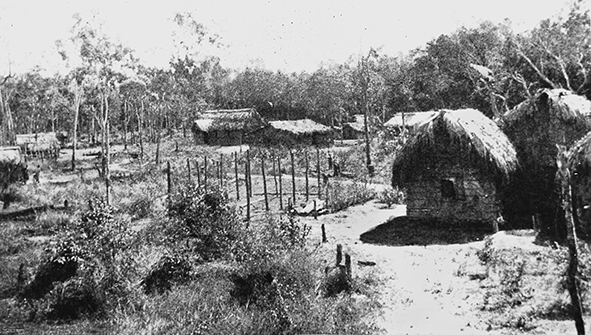
The MItchell River mission in 1919. The mission had moved by the time Mary was there. Picture courtesty of State Library of Queensland.
She taught 70 children from various Aboriginal groups during her three years at the mission station, “40 miles from the coast in the midst of wide, monotonous plains’’.
Despite the wrongs of a mission being set up on Aboriginal land to convert traditional owners, it cannot be denied that Mary’s faith must have taken her on an amazing adventure. What was her upbringing, to encourage her to take on such a challenge?.
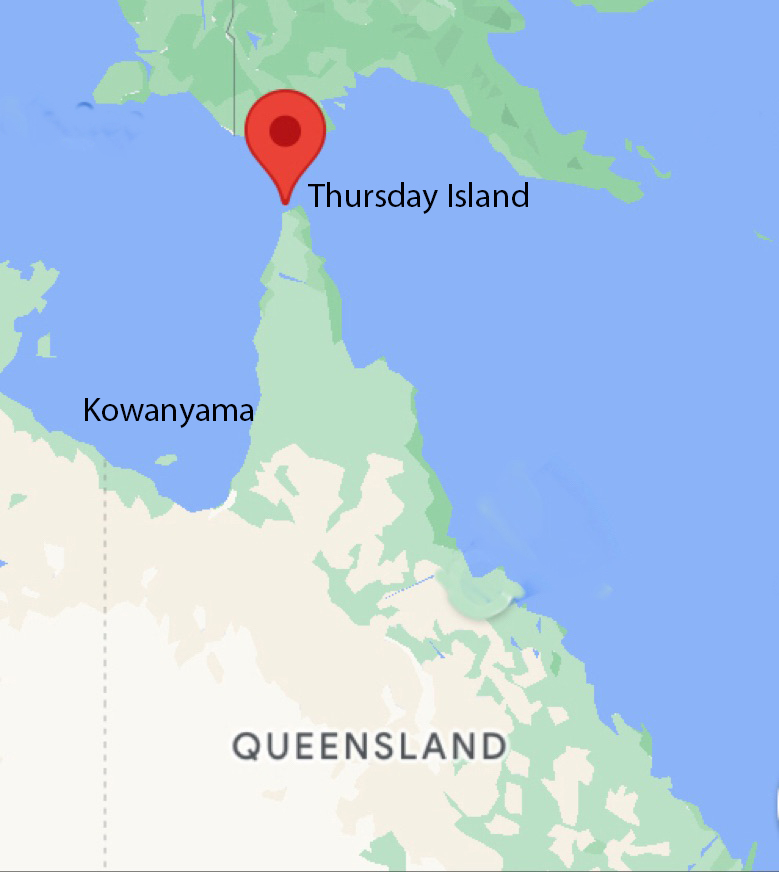
The nearest source of supplies was Thursday Island, 300 miles away. That was where she succumbed to tetanus as she was returning to her post to resume work after a southern trip and that is where her headstone can be found today. No more details are known of her death.
Mary’s headstone in the Thursday Island cemetery. Image Sharyn Moodie 2022.
On that trip south she had articles published in the newspapers, describing her life in the remote outpost.
She also told of one of several trips she made to Thursday Island, when she and all the Aboriginal crew except the captain became ill with the flu.
The mission’s lugger, the Francis Pritt, from Thursday Island, was “commanded by a black island captain, with a crew of three or four Aboriginal mission boys,’’
Relying on sail power, the trip could take anything from three to twelve days – as it did on one occasion when the crew became ill. They all survived.
The Mitchell River Mission was destroyed by a cyclone in 1964. Today, the township of Kowanyama , which is one of the largest communities on Cape York, stands on the site of the mission.
Thursday Island, Queensland
Sources:
New Call, Thursday 18 February 1932, p19
Sydney Mail, Wednesday 26 October 1932, p4
The Sun, Saturday 17 September 1932, p4
The Sydney Morning Herald, Thursday 4 February 1932, p8
It’s desolate and dry at Arltunga. It’s hard to see how people managed to live there, and very easy to see why they died.
At 100km east of Alice Springs, even today it’s a long way from anywhere. Yet it was the first substantial European settlement in Central Australia thanks to the lure of gold. Beginning in 1887, a rough settlement sprang up framed by the unforgiving East Mcdonnell ranges. By 1913, the town’s hey day was well over.
It would have been a tortuous place to eke out a living mining, and just as awful a place to die.
The remnants of the main township (pictured below) and the surrounding 5000 hectares are a historical reserve, a tourist attraction to those dedicated enough to make the drive.
There are multiple burial sites around the town with a scattering of graves, most marked quite scantily.
The White Range cemetery is the largest, and features mostly wooden crosses.
The White Range Cemetery today. Images Sharyn Moodie
It’s difficult to find information on the individual men buried there – there is no visible evidence of women or children’s graves or Aboriginal burials.
A cracked information sign gives some insight into the best marked sites.
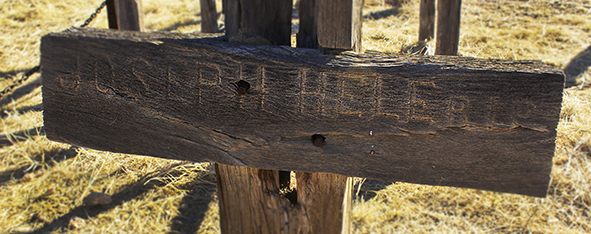
Joseph Hele was one of Arltunga’s pioneers. He had been a teamster who sold up to go prospecting in the early 1880s with his mate Isaac Smith, who was the first to find gold at Paddy’s Waterhole, the Arltunga field’s first name. But he was a poor man when he died of dysentery.
Medical problems in the goldfields were difficult to treat. Hazards included mining explosives, the very fine ore dust which caused lung disease, typhoid outbreaks, influenza, “dropsy’’, and alcohol related liver disease (Holmes 1980)
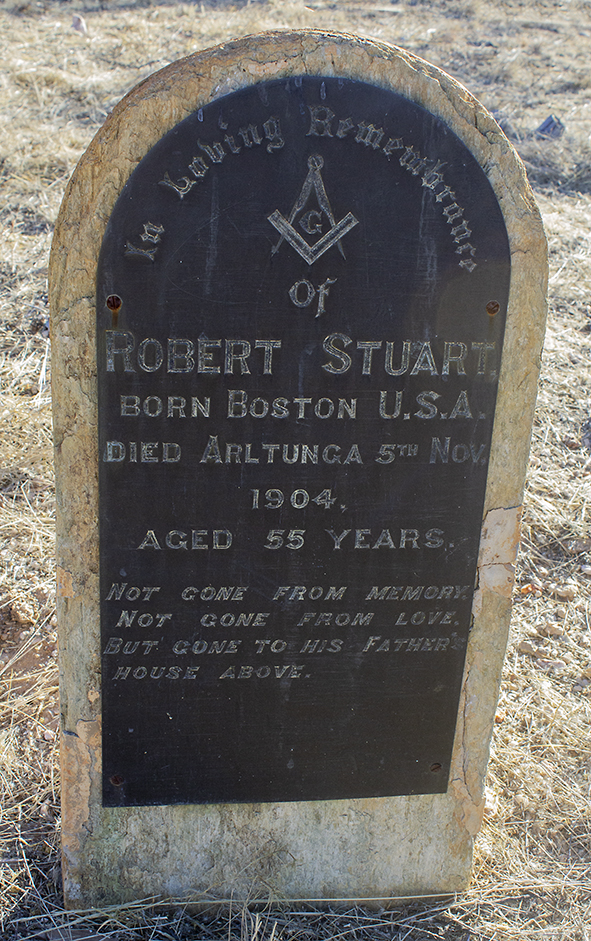
Robert Stuart (pictured left) was 63 when he died of an abscess of the throat. Yes, his tombstone says 55, but it was wrong.
The stone also displays the Masonic symbol. The fact he has a stone at all indicated he was important to the community, although he had only apparently been at Arltunga about five months when he died.
Charles William (right) was at Arltunga by 1896 and ran multiple claims over the years. He was doing well by local standards when he died of ‘exposure to cold and rain after a seizure, to which he was known to be subject’’.
Police constable Matthew Dowdy (pictured above far right, back row) is one of the later burials still evident. He died of gangrene on 17 June 1915. Conflict between miners and pastoralists would have kept him busy during his ten years stationed at Arltunga. He was known to have had personal disputes, particularly with the local battery manager. Dowdy was accused of insobriety, and was illegally keeping horses on the town common.
“One complaint of excess stock running loose on the town commonage was ignored because Constable Dowdy was breeding horses himself and running them on the common. An enquiry led to a recommendation that police should not be permitted to breed stock apart from that necessary for personal and household consumption” (Wilson 2000).
Pictured below are the town’s lock-up and Constable Dowdy’s headstone.
SOURCES: Holmes, K, 1980 ”The White Range Settlement Area, Arltunga Goldfield, Northern Territory; A look at the lifestyle of an isolated mining area using written and archeological records.”
WIlson, WR 2000; A FORCE APART? A History of the Northern Territory Police Force 1870 – 1926 W.R. (Bill) Wilson BA (Hons), Northern Territory University.
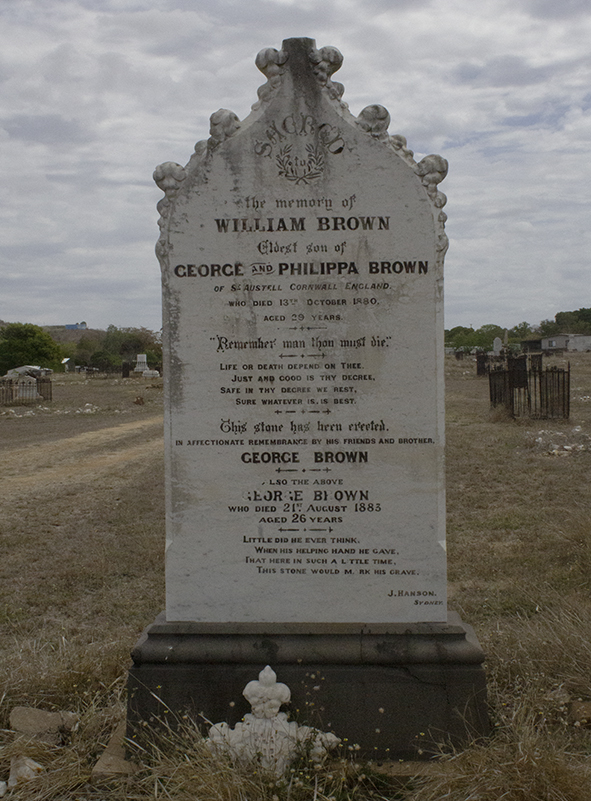
1880 – William Brown, a 29-year-old Englishman, was a well-known pugilist around Charters Towers.
William Brown is buried in the Charters Towers Pioneer Cemetery. Image Sharyn Moodie 2021
In the days before the Marquess of Queensberry rules were enforced by the legalization of boxing in the various colonies, watching and betting on illegal bare-knuckle fighting was a popular pastime.
Brown and another fighter were arrested about four miles from Charters Towers about 7.30 one morning in June, as the crowd of 50-100 onlookers scattered. He faced court, was ordered to keep the peace for six months, and fined 20 pounds.
By October, he had died, following an epilepsy attack – which often develops after brain injuries such as those one could suffer boxing. An information sign at the historic cemetery says Brown’s attack could have been treated had a doctor been available.
The sign also says Brown fought many prize fights, including one which lasted two hours with 52 rounds.
His brother George made sure he was marked by a substantial headstone, but died himself three years later of typhoid.
“Remember man, thou must die” is a memento mori meant to inspire a humble attitude – in this case hopefully in the reader, rather than the man beneath the gravestone.
Source: The Northern Miner (Charters Towers, Qld. : 1874 – 1954), Tuesday 22 June 1880, p2
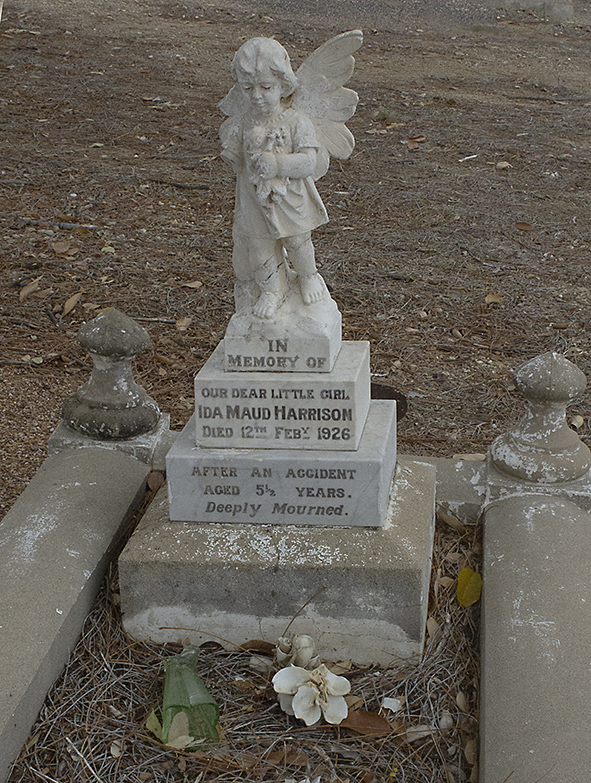
Hughenden, 1926 – A newspaper carried this story about an innocent bike ride to school ending in tragedy.
“Ida Harrison, aged 5½ years, only daughter of Mr and Mrs T. Harrison, of the Railway Department, met with a very sad accident on the 11th instant.
“She was, with her brother, riding a bicycle to school when a violin case which he was carrying caught in the wheel, and she fell heavily.
“She was conveyed to her home, where she expired next morning. The funeral was attended by the Girl Guide and Brownies, also a number of school children.”
Ida is buried in the Hughenden cemetery. Images Sharyn Moodie 2021
Click here for another Hughenden cemetery story, in which a grazier dies while fixing a windmill.
Source: The Daily Mail (Brisbane, Qld. : 1903 – 1926), Saturday 20 February 1926, p14
There are some poignantly historic markers of death in the Springsure region, the most notable the remote cemetery marking the Wills massacre at Cullin-la-ringo.
But in the town’s spread-out cemetery lie some fading remnants of people whose tales are slowly being lost to history.
John George Wheeler was instrumental in getting the early town’s hospital and church going, but died just before the hospital became functional – bad timing on his part. He may have also had an innocent link to the controversially named Mt Wheeler near Yeppoon. Read his story here.
Image Sharyn Moodie 2021
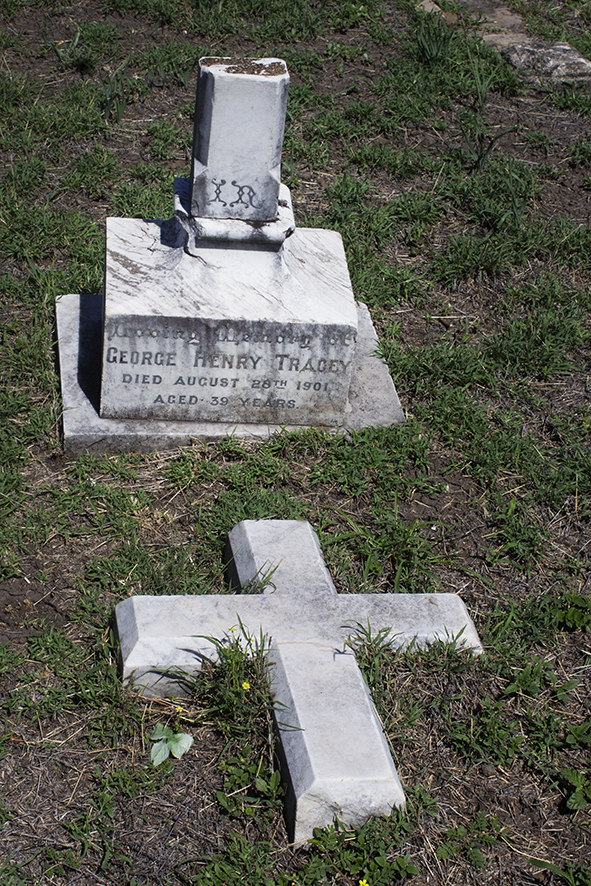
Newly assigned Springsure postmaster George Tracey did not have a good year, despite expecting his third child.
First his father died at Croyden, then his father’s business partner and uncle Joseph died in George’s home, at the Post and Telegraph station.
George followed him to the grave a week later, dying of pneumonia on August 28,1901.
George’s grieving wife Maggie went to Bowen to give birth to their son, who entered the world on October 5. She named the boy, who had followed two sisters, George Henry Scott Tracey. They had married in Normanton five years earlier.
Image Sharyn Moodie 2021
Then there was Ernest Robert Fisher, who “sank to rest”, an unusual epitaph. He of course, had drowned. The 21-year-old telegraph operater was bathing in a creek with a friend when it happened on 15th March, 1898. His mother Kate died in July, leaving a husband and five children.
“By some means he got into deep water, and, being unable to swim, was drowned before assistance could be given. Deceased was a general favourite, and much respected by all who knew him.”
Image Sharyn Moodie 2021
George Kembrey’s headstone is only kept upright by a rusted string of wire. It states that he lost his life in an accident, on April 27.
But the engine driver had fallen asleep on the railway tracks at Bogantungan where he worked, and he had a rude awakening when an incoming train’s cowcatcher dragged him a considerable distance.
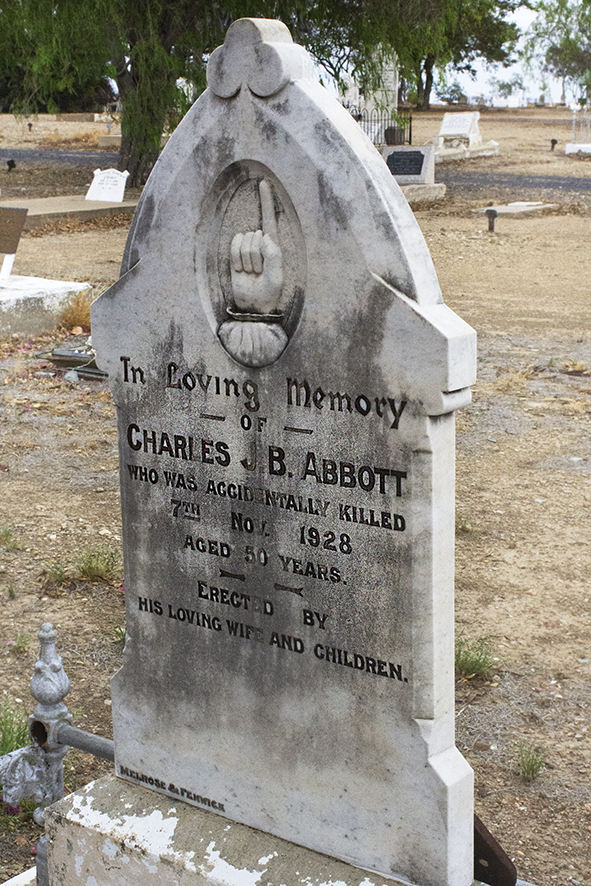
Hughenden, 1928 – Fifty-year-old Charles John Burdekin Abbott had made sure the windmill was turned off before he climbed up to do some repairs.
Image: Sharyn Moodie 2021
According to newspaper reports, he and a workboy were at his neighbour’s property Wyoming. His neighbour was in hospital, so he was doing him a favour.
But a gust of wind was enough to move the sails, somehow crushing his head.
A lad who was working with him noticed a drop of blood fall to the ground and “made the sad discovery”.
Charles was a true outback Queenslander, having been born in Charters Towers, where his family had land interests.
The Abbott’s property Abbortsford was about 40 miles from Hughenden, Queensland.
A poem found online written about a family reunion in 2012 tells how Charles’ body was brought home to his wife Bea with a sack over his face.
The poem tells a little more about their life at their property Abbottsford, about 40 miles from Hughenden.
It says Charles and Bea brought a house from Charters Towers, board by board, to the property in 1912.
It was considered a prime selection because of its access to sub-artesian water, ironically linked to the cause of his death.
A male child born that year died from blood loss after a gunshot wound to his knee.
The family was joined by two more children and prospered as demand for wool rose due to its use in solder’s uniforms during WWI.
The poem tells of Charles’ death.
Tragedy struck the family again when Charlie died too soon, While working on a windmill the wind picked up ’round noon, A mate brought him to the homestead with a sack upon his face, Bea was left to cope alone with little help to run the place.


















 Way to go Australia