Convict lived long life of excitements

John Pedley’s headstone in the Bathurst cemetery

John Pedley’s newspaper obituary described him as “quite a character, with a fine Roman head, and a splendid memory, which he retained almost to the last.”

This character was forged in the flames of transportation as a convict as a teenager, the harshness of frontier life, Aboriginal massacres and being kidnapped by bushrangers.

Aged 90, in 1895, Pedley visited Bathurst’s newspapers and told of his colourful life. Breaking into poetry as he told the stories, it is apparent he was an irrepressible character, and as verbally athletic as any modern-day rapper.

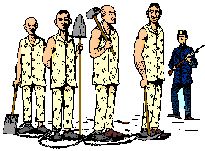
He said he came to the colony in 1821 from Middlesex as a 16-year-old named John Pedley Jones – left the country for the country’s good – as they said. In other words, as a convict.

He spoke to the Bathurst Free Press and Mining Journal

‘What was I sent out for? Well, you knew I was great at what they called poaching, but it wasn’t for poachin’ exactly that I was transported. It was over a spade. We were going to dig out rabbits, you see, and although we had the ferrets, we wanted something to dig with and — well, I took a spade worth about 7d, and for that sevenpenny spade I got seven years.

Pretty stiff, wasn’t it ?

John Pedley, on his seven-year sentence for stealing a spade

After telling a bit more, he breaks into poetry

‘But I’ll give you a bit of poetry about that if you like. Oh, yes, I used to be pretty good in the poetry line — like this, you know : —

When first I left the old land in London

The voyage by sea I did boldly steer,

To new Port Jackson, that far destination,

That foreign station I at length drew near.

‘Pretty good, isn’t it ? But here’s some more : —

Hard was the place of confinement

That kept me from my heart’s delight,

Cold chains and strong irons around me,

And a plank for my pillow at night.

‘That’s better! yes, I know – it is, but don’t interrupt me — and on he went…

He appears to have been set to work on arrival, and talks about crossing the mountains to Bathurst several times in the days before a road was built.
“It was in 1822 I first crossed with the bullock dray with Gov’ment stores for the settlement. It wasn’t travelling like they’re used to now-a-days, I can tell you. The teams were in charge of soldiers, and it took us six weeks to go up and down, and even the bullocks wouldn’ face old Mount Victoria.

‘When I first came the blacks were very troublesome,’ the old man continued his story.

He tells of a massacre while he was working at Winburndale Creek, most likely part of what is now known at the Bathurst Uprising.

“They had just killed fourteen or fifteen whites, and there was a raid against them, in which I joined. We shot them down, hundreds of ’em, and buried ’em on the Winburndale in two or three graves, which they tell me are there yet ; but the king of the tribe escaped, although the Government offered a reward of £50 and a free pardon to any prisoner for his capture.

He may have been referring to Waradjari warrior Windradyne, whose fight for his lands and his people’s rights is a fascinating story.

Pedley was assigned to a magistrate in 1827 – perhaps this was when his seven years were up – and then transferred to General William Stewart at Mount Pleasant. This lucrative 3200 acres of land near Bathurst was a gift to the General for his role in helping oversee the response to the Aboriginal problem, as it was then seen.

Pedley lived at The Mount for the rest of his long life, but his excitement was not yet over.

While still a youngster, he says,

I was minding cattle and the bushrangers caught me and beat me, threatening to kill me, because they thought I had told the General where they were planted.

Ah, them was stirring days I can tell you.’

JOhn Pedley, on having been captured by bushrangers

At the grand old age of 90, his stories were rambling and a time line of events was difficult to work out. However, as he left the newpaper offices, he declared, he was good for 100.

He died in hospital four years before that goal, a simple man whose life was shaped by the attitudes and events of the times.

Sources: Bathurst Free Press and Mining Journal (NSW : 1851 – 1904) Wednesday 5 June 1895 p 2 Article

National Advocate (Bathurst, NSW : 1889 – 1954) Wednesday 28 August 1901 – Page 2

National Advocate (Bathurst, NSW : 1889 – 1954) Wednesday 5 June 1895
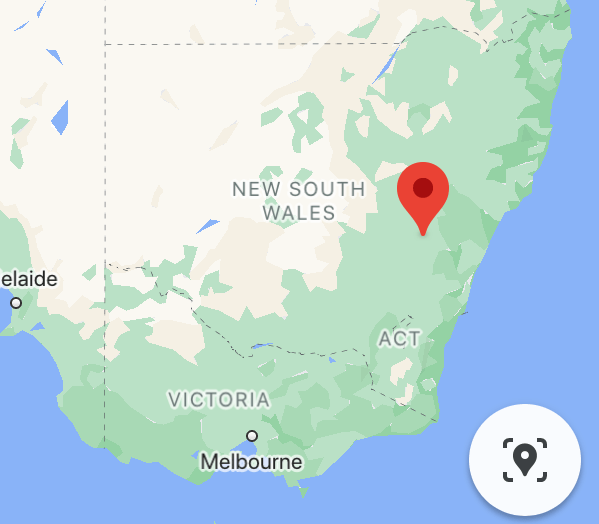
Bathurst, NSW

Strychnine ends sorrows

The No. 4 pumping station at Merredin, part of the Golden Pipeline
The old number 4 pump station, Merredin, Western Australia, where William Stamp took strychnine in March 1928

William Stamp, 54, was chief engineer at No 4 Pump Station on the outskirts of Merredin.

One day in March, 1928, he walked into the engine room dripping wet and asked a fellow employee “how’s things?’’

When his co-worker asked why he was wet, he said “Things are not too good with me.

“I have just taken a dose of strychnine. I also jumped into the dam, but could not stand it any longer, so got out again.”

He threw his keys on the flue, saying he would not need them any more.

Stamp was taken to Merredin to have his stomach pumped, violently convulsing on the way,  but died within a few minutes of receiving treatment.

He told the doctor he did it due to worry.

His wife and family had just left for a visit to Perth, and a friend told the inquiry he had spent an uncomfortable afternoon with Stamp, who was talking about the second coming of Christ and being spied on.

Stamp’s headstone no longer exists, but he is buried in the Merredin Cemetery.

William Stamp’s resting place is near to, and looks similar to, the above piece of dirt in the Merredin Cemetery, WA

 The pumping station was part of the Golden Pipeline, which helped open up Western Australia’ goldfields. It was built in 1902 as one of eight pumping stations of the Goldfields Water Supply Scheme.

The Irish engineer who designed the important scheme, Charles Yelverton O’Connor, also committed a determined suicide – by shooting himself as he rode a horse into the ocean at Robb Jetty, south of Fremantle.

Sources: Merredin Mercury and Central Districts Index (WA : 1912 – 1954) Thursday 22 March 1928 p 5, Thursday 15 March 1928 p 5

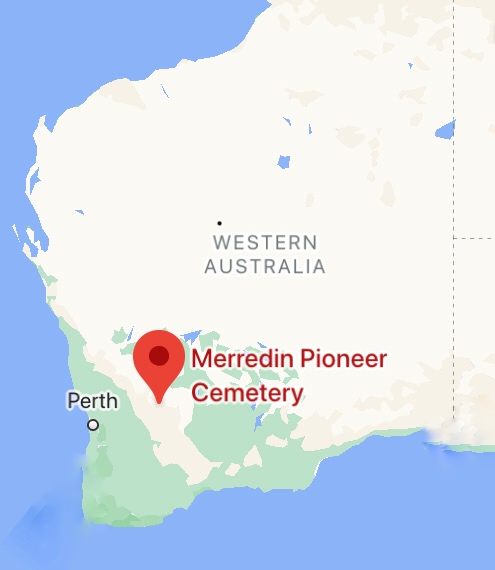
Merredin Pioneer Cemetery, NSW

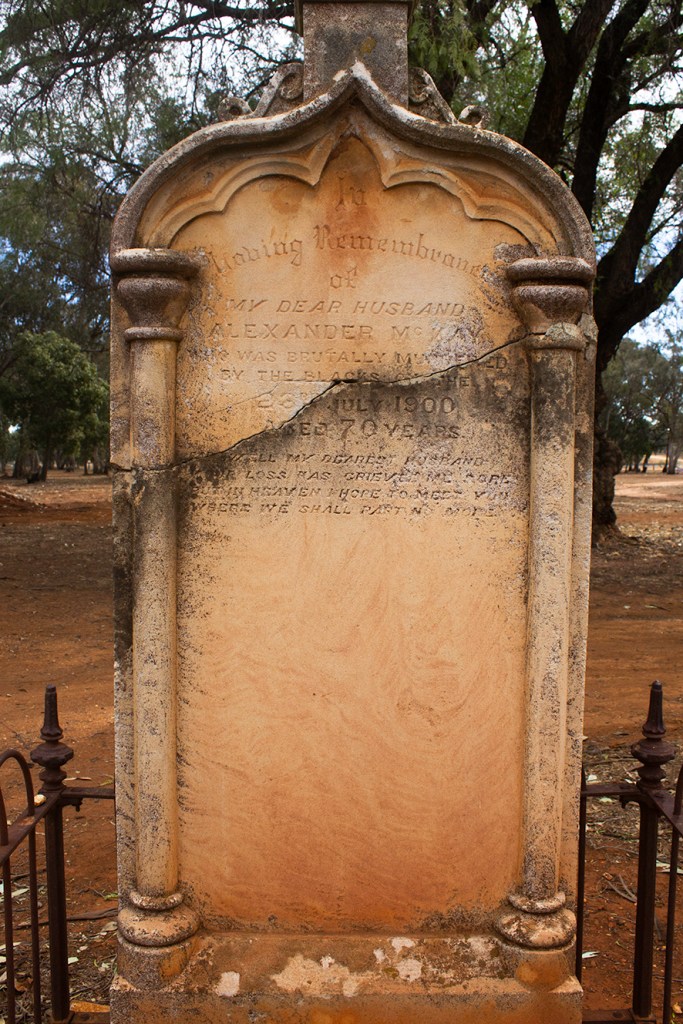
A bitter epitath

Alexander McKay, who was brutally murdered by the blacks 23 July 1900

Alex McKay was one of nine people murdered by the Jimmy Governor gang, touted as Australia’s last outlaws.

McKay’s gravestone stands proudly in the Gulgong Cemetery, New South Wales, slightly apart from other graves.

It declares he was “brutally murdered by the blacks.”

The Governor story is well studied in Australian history, with its overtones of racial tension. Governor was ¾ Aboriginal and had married a 16-year-old white Australian girl.

The first murders are said to have been sparked by his bosses’ wife, Mrs Mawbey, taunting Jimmy’s wife over their mixed marriage.

Three days later Alex McKay became the next victim.

Mr McKay, 70, was outside pruning a fruit tree at his property at Sportsman’s Hollow, 12 miles from Gulgong,  when Jimmy Governor and another man, smashed in his skull.

A report in the Sydney Morning Herald tells the story. Please note the use of the word “blacks” is true to the newspapers reportage and was accepted terminology of the time.

Mrs McKay was inside  when their adopted daughter came running saying  “Two blacks are coming here; one has a rifle.”

While Mrs McKay was gashed with a tomahawk as she swung around to shut the door, and both the women were hit by stones being used to smash windows, the women were otherwise unhurt.

However, the intruders threatened them with their lives.

The blacks said, ‘If you don’t open the door we will kill the lot of you: if you do we won’t.”
Mrs. McKay said to the girl,

“We might as well be killed outside as inside,”

and opened the door and walked outside with the child in her arms.


The blacks ordered them to stand on the verandah, searched the place all over, took some food and left.

The women found Mr McKay lying on his back with his head split open.


They carried him inside and laid him on the bed, and then the gang returned, demanding money.

Having gained a pound, in addition to eight pounds they had found in the old man’s pockets, they took Mr Mackay’s saddle and horse and left.

Governor and his brother Joe were on the run for three months, covering 3000 kilometres  while dodging  a huge manhunt.

Jimmy was caught on October 27, 1900 and hung for his offences.

Alex McKay’s headstone stands as a bitter epitath to the times.

Source: The Sydney Morning Herald, Wednesday 25 July 1900

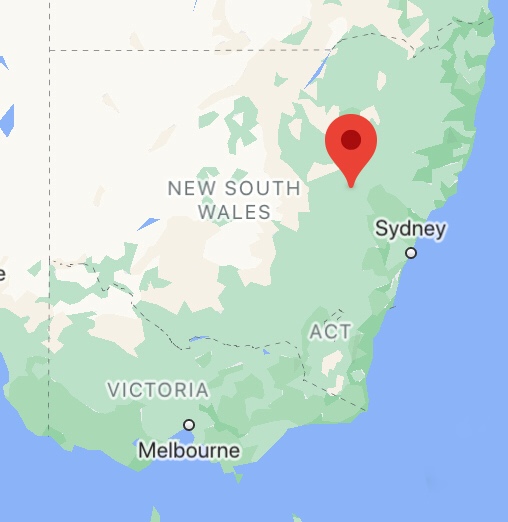
Gulgong, NSW

Ornaments and oddities

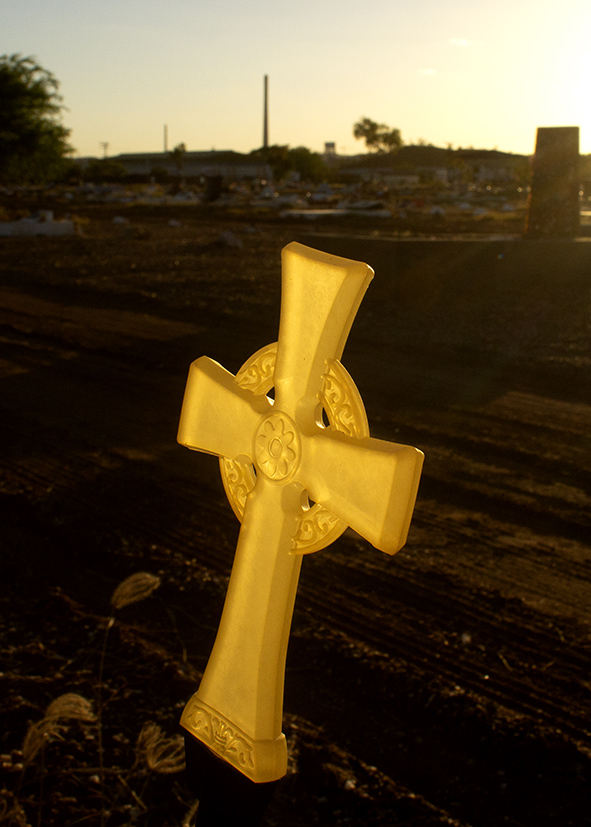
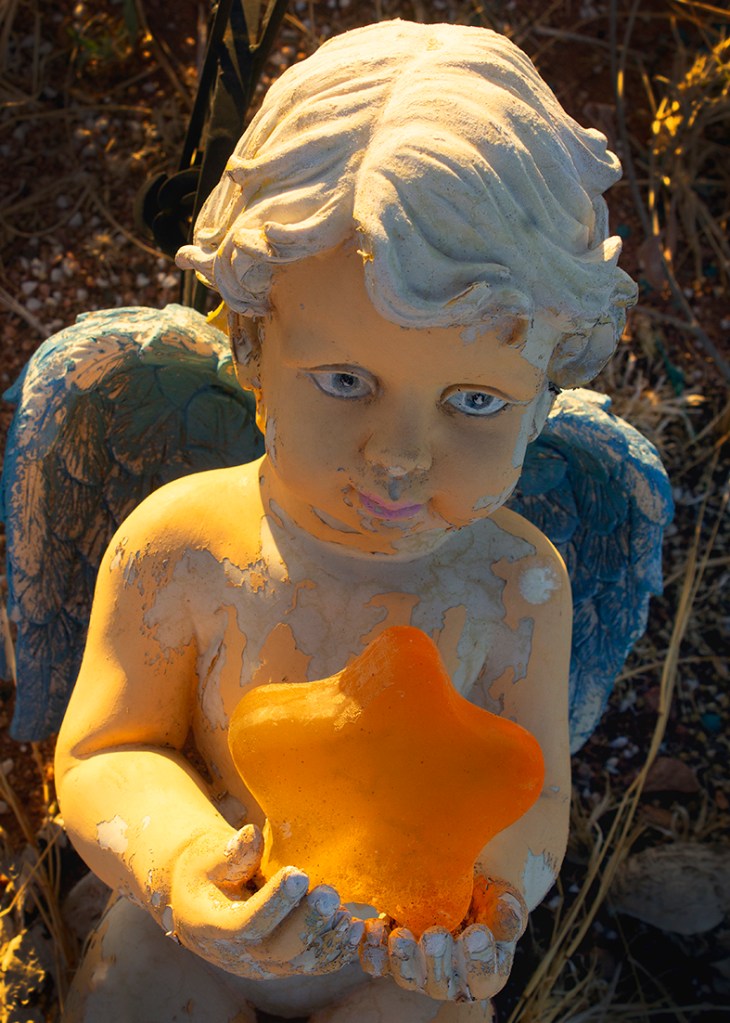
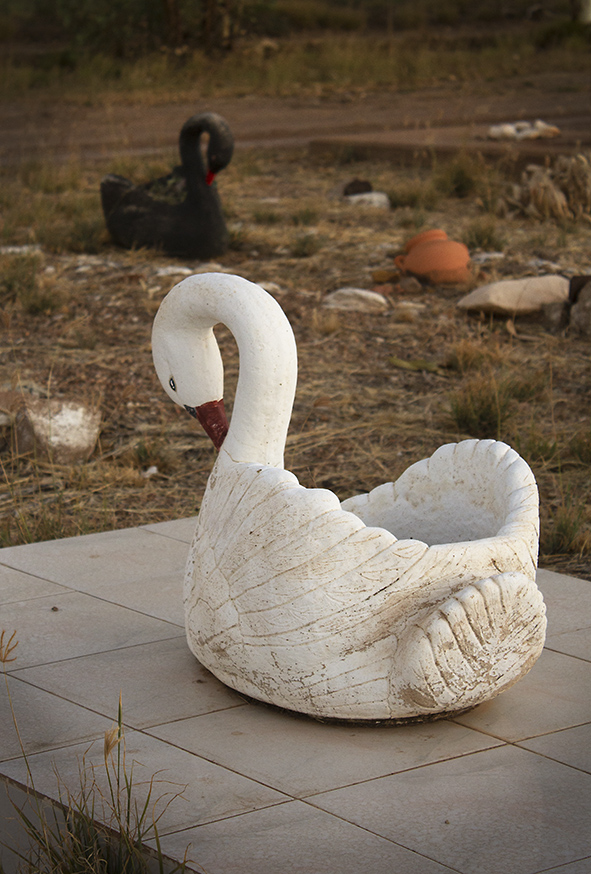
Graves are sometimes embellished in intensely personal ways, which tell a bit about the person and the times in which they lived.

Here are some of the meaningful, poignant or sometimes plain strange things I have seen decorating graves.

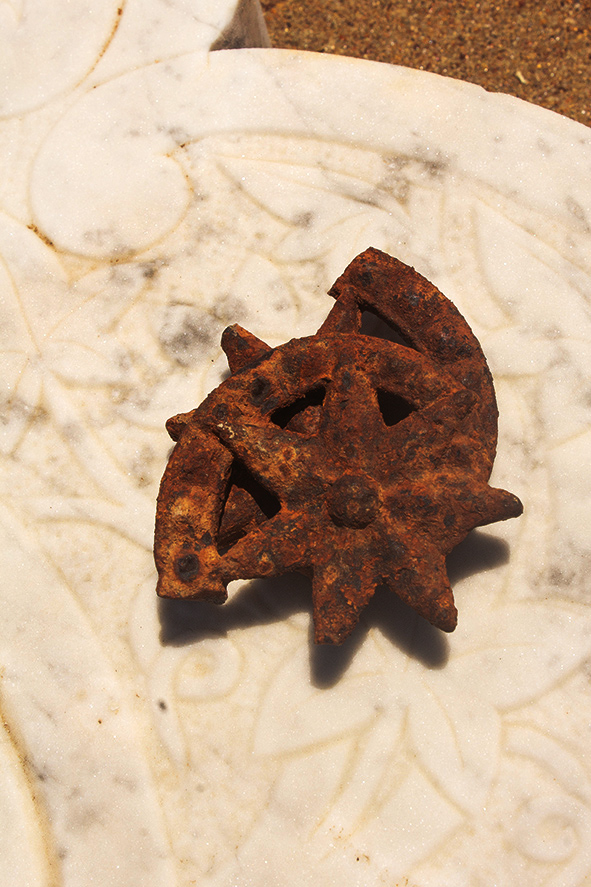
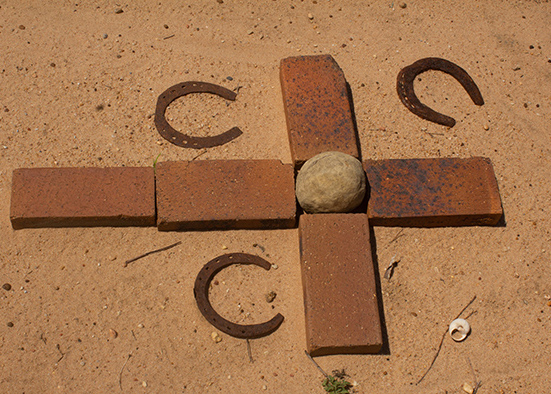
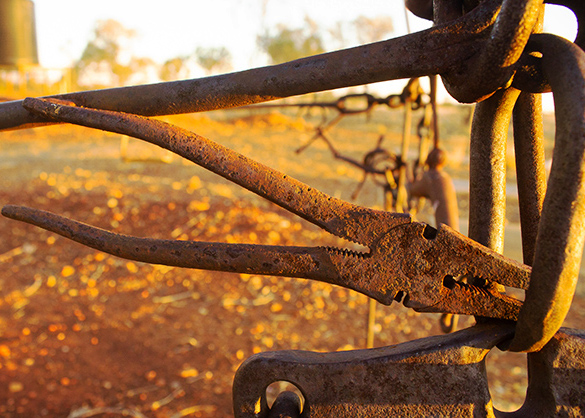
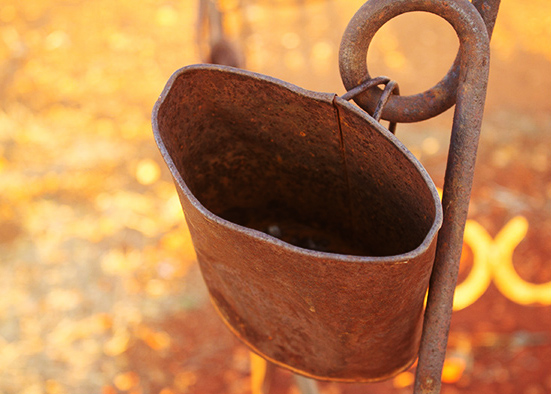
Then there are embellishments which stand for hard work.

I can’t quite get my head around the use of what I think are Ponds face cream jars as grave markers. I’ve seen this phenomenon in a few different places, but only in Western Australia.

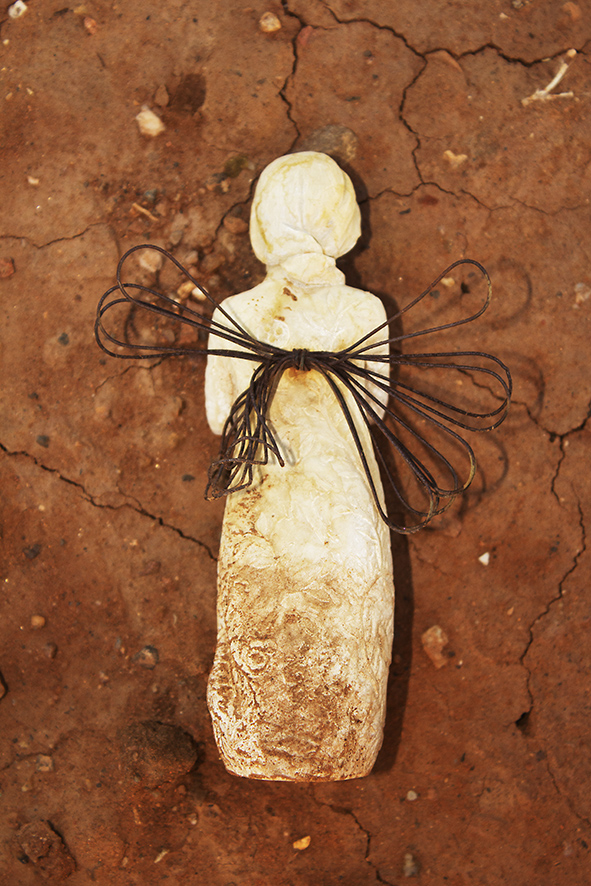
Then there are the garden ornament-type embellishments. Mount Isa cemetery was a particularly rich place for those.

These two ornaments were lying on the ground, having been separated from their owners.

Many children’s graves have toys on them, but this one at the outpost of Duchess, 100 long dirt kilometres from Mt Isa, Queensland, was poignant. The 1924 grave belongs to six-year-old Grace Rosetta Margaret Barry who, according to Findagrave.com, died from diphtheria in the arms of her father. The dolls could not be almost 100 years old, so someone still cares for the little girl. Perhaps they were put there when the concrete and metal plate were installed.

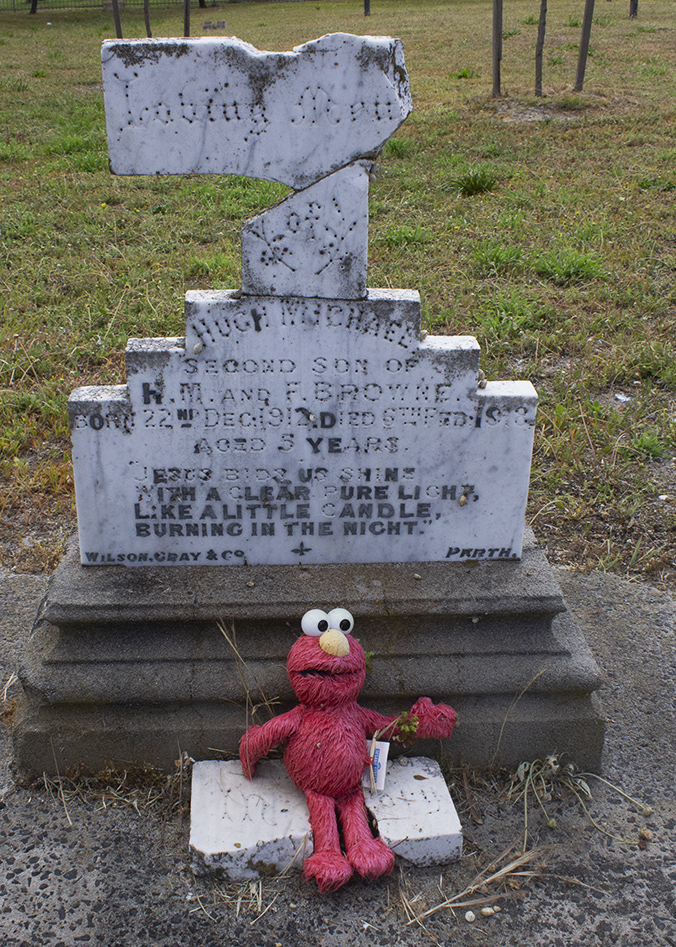
Another toy which obviously doesn’t come from the era of its grave owner was this one, in Busselton, WA. But I’m sure five-year-old Hugh Browne would have loved him anyway.

Dying so far from home

In Australia’s pioneering days, many died far from home.

Rev John Otley Rhodes, missionary in Ceylon who died in Bathurst, March 21, 1881 on his way to England in search of health, aged 36 years.” – Bathurst cemetery

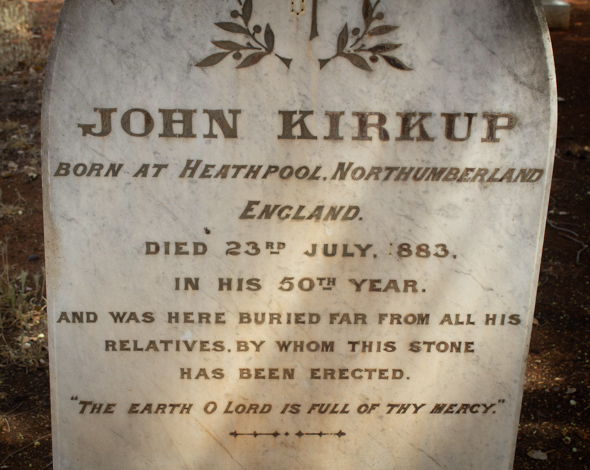
“John Kirkup born at Healthpool, Northumberland, England, died 23rd July 1883 in his 50th year, and was buried here far from all his relatives, by whom this stone has been erected.” – Parkes cemetery

The Wesleyan minister  Reverend John Otley  Rhodes, had contracted a “liver complaint’’ while spreading God’s word in Ceylon (now Sri Lanka).

According to newspaper reports of the day, he intended to recover in Bathurst – why is not revealed –  before continuing home to England.

 “But, already weakened by protracted suffering, his constitution gave away.’

He was only 36. His well-weathered headstone now sits in the Bathurst Cemetery, far from his place of birth.

John Kirkup, buried in the New South Wales town of Parkes, was also buried far from his family in the north of England.

Kirkup had made considerable wealth as a miner of local goldfields, and invested some of that money in a farm of 640 choice acres 12 miles from Parkes. After his death, it sold for 700 pounds.

SOURCES: The Sydney Morning Herald (NSW : 1842 – 1954) Tuesday 15 March 1881 p 6, Mudgee Guardian and North-Western Representative (NSW : 1890 – 1954) Thursday 4 February 1915

Bathurst, NSW, Australia
Parkes, NSW, Australia

Barman kills policemen

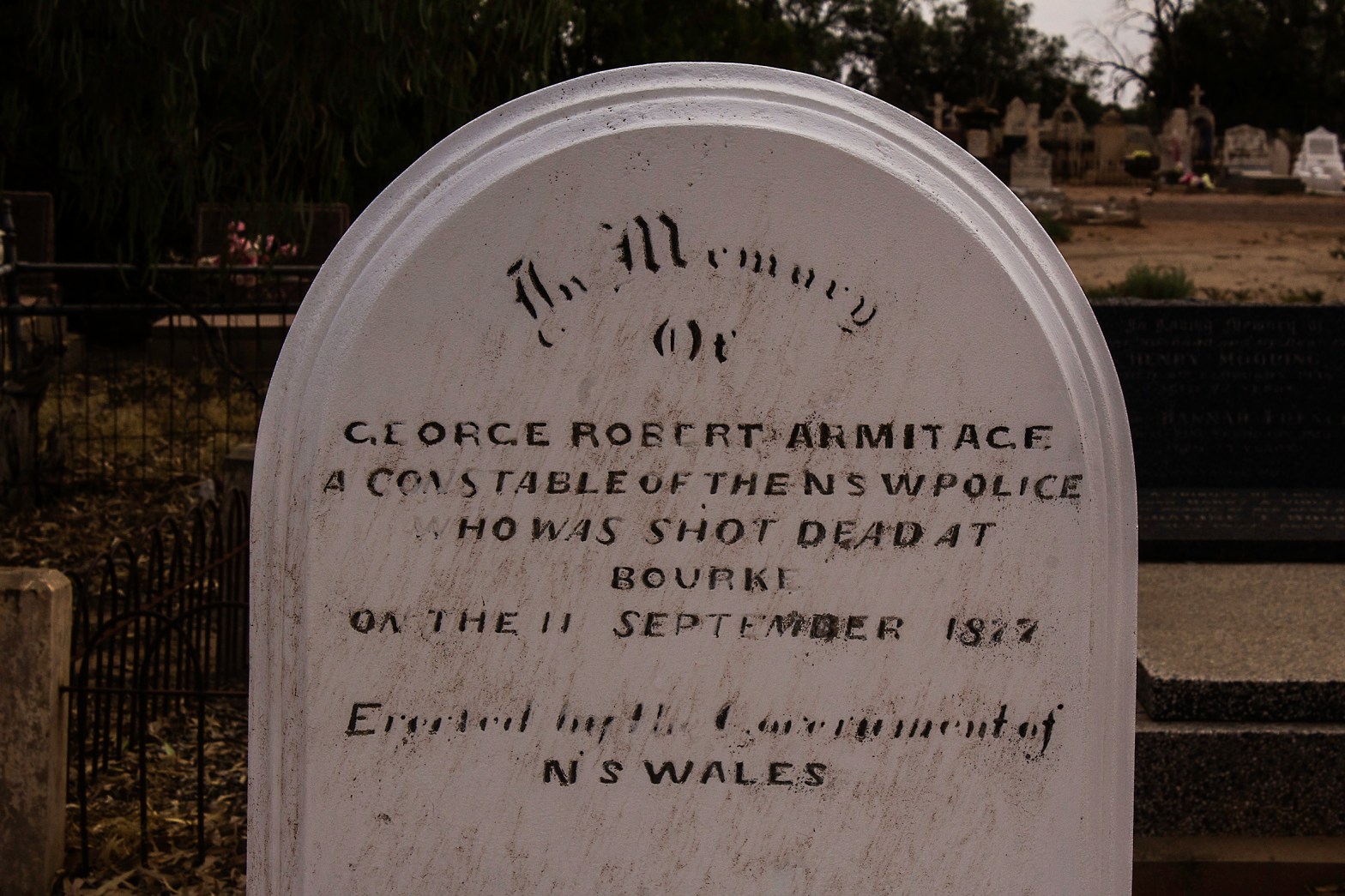
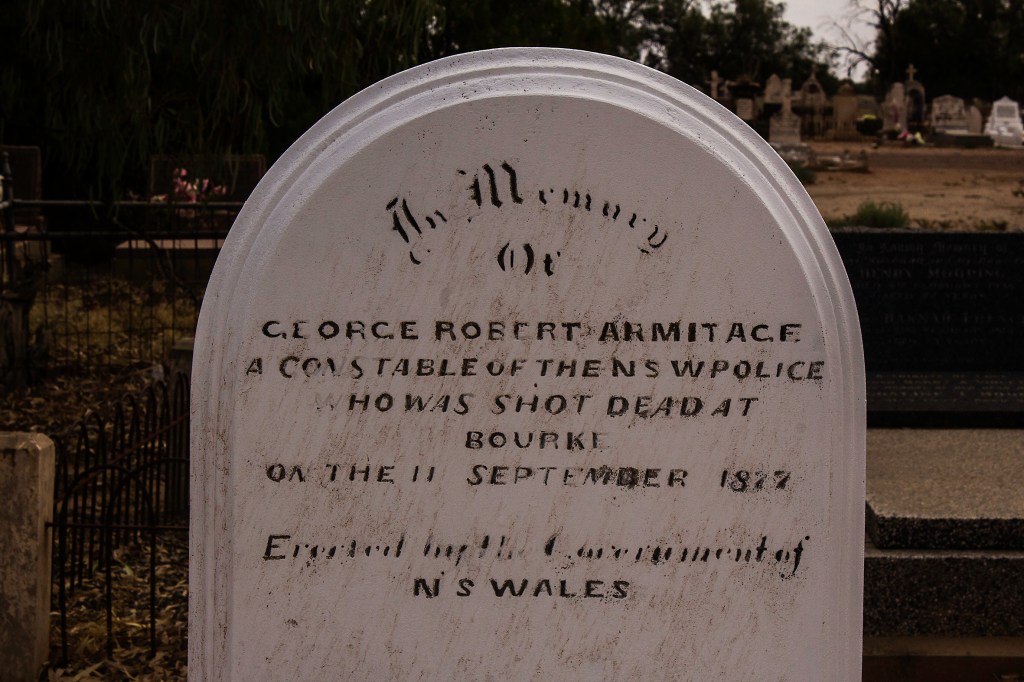
Constable Armitage was part of a deadly attack on police by a crazed barman.

Why would a barman shoot two policemen dead and wound a third in Bourke in 1877?

No-one really knows, but newspapers of the day blamed either the delirium tremors, or a temporary madness on the part of one Samuel Getting.

“ He must, it is thought, have been suddenly afflicted with homicidal mania, or madness, in order to commit the dreadful crimes”

Northern Star

Getting, aged about 33, was a barman at the Royal Hotel.

While newspaper reports don’t say where the actual attack took place on September 11, they told how Getting made a “desperate and unexpected attack on the police”.

 He shot the first policeman, Constable Costigan, dead on the spot. The second, Constable Armitage,  attempted to arrest the assassin, but fell wounded by a revolver ball. He did not die until five hours later.

The infuriated gunman ran towards the river, loading as he ran, and threatening anyone who tried to stop him  “but the people were aroused’’ and pursued him, with another policeman, Inspector Keegan, at the lead.

At a short distance from the town the “murderous wretch halted and parleyed with Keegan,” who had outrun the other pursuers.

 He stated that no one should take him alive but Doctor Browne, and so a messenger was sent for the doctor.

 In the meantime, Inspector Keegan approached nearer and nearer to the fugitive, all the while reasoning with the murderer, who stood on the defensive with his gun loaded, and his finger on the trigger.

 The Inspector promised that if Getting would give himself up, he would not be harmed.

 Getting asked “Will you swear that on the cross of Christ,’ at the same time crossing himself on the forehead, breast, and shoulders.

He seemed to have calmed down, and Keegan, now about 12 metres away, took his chance and rushed him.

But, having grasped hold of Getting, he slipped. Getting, released, stepped back a few paces and fired deliberately but hurriedly at the officer on the ground.

 The shot tore up Keegan’s clothes and wounded him in the chest, but not seriously.

 Keegan sprang up and again approached Getting, receiving blows over the head from the butt end of the gun.  

 “The murderer again succeeded in getting free, and dashed away up the river bank, with Keegan, bleeding from his wounds, on his trail.

 “Suddenly Getting turned, and plunged into a deep part of the river, where he deliberately drowned himself”.

When Getting’s drowned body was recovered, the people of Bourke refused to allow it to be buried in the cemetery.  A grave dug during the night for his burial was filled up. Getting was consequently buried near the hospital.

Sources: The Wallaroo Times and Mining Journal (Port Wallaroo, SA : 1865 – 1881) Wednesday 19 September 1877 p 2 Article

Northern Star (Lismore, NSW : 1876 – 1954) Saturday 29 September 1877 p 2 Article

Avoca Mail (Vic. : 1863 – 1900; 1915 – 1918) Friday 14 September 1877 p 2 Article

Geelong Advertiser (Vic. : 1859 – 1929) Tuesday 18 September 1877 p 3 Article

Bourke, NSW, Australia

Returned home a corpse

george fullerton
gravestone
georgiana sarah fullerton

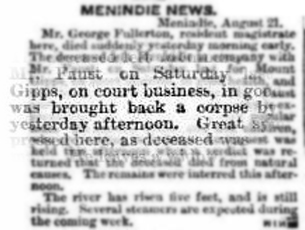
Menindee magistrate George Fullerton, 39, left town for Mount Gipps, about 150 kilometres away, on court business, but did not make it home alive.

newspaper clipping george fullerton
Newspapers did not sugar-coat the death of the magistrate

”’Was brought back a corpse” is how the South Australian Weekly Chronicle and a number of other papers reported the death of the popular father-of-five in August, 1882.

An inquest determined he died from natural causes.

Sources; South Australian Weekly Chronicle (Adelaide, SA : 1881 – 1889) Saturday 26 August 1882 

Menindee, NSW – previously also spelt Menindie

A deadly explosion

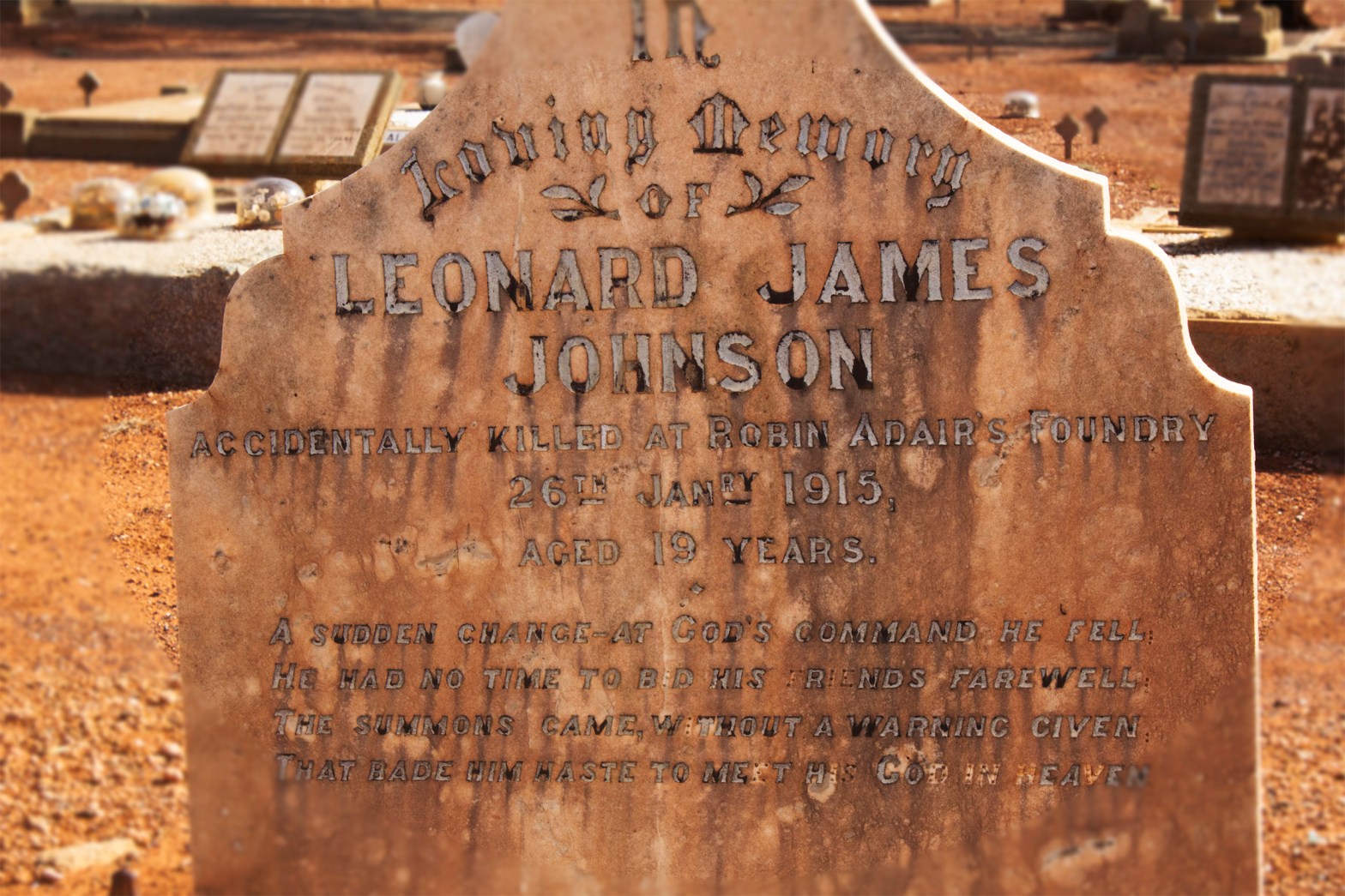
The explosion that killed 19-year-old Leonard Johnson was heard two miles away.

Leonard was at work at the Robin Adair Ironworks in Kalgoorlie, Western Australia, along with another man named named Moiler.

They needed to break apart a brass piston cylinder, and decided to heat the hermetically sealed head in the flames of the blacksmith fire.

 Moiler left Johnson holding the piston.

Soon after, an explosion threw Johnson five metres and scattered live coals everywhere.

When the remains of Johnson’s body were picked up, his clothes were still on fire.

“The lower portion of his abdomen had been torn away, his right leg was severely broken and almost taken off, and he sustained many other terrible injuries about the head and body”.

Moisture within the piston expanding in the heat was blamed for the explosion, which also sent debris hurtling into the street. One portion shot through the galvanised iron building, and struck the veranda of a house 80 yards away.

Another just missed hitting the driver of a passing steam roller.

Leonard’s mother lived nearby and rushed to the scene when she heard the explosion and there was a “pathetic scene when she was informed that her son had been killed’’.

Johnson’s grave is in the red dirt of the Kalgoorlie cemetery

Sources: Barrier Miner (Broken Hill, NSW : 1888 – 1954) Thursday 28 January 1915 p 2

Kalgoorlie Miner (WA : 1895 – 1954) Tuesday 2 February 1915 p 3
Kalgoorlie, Western Australia

Bringing in the cows

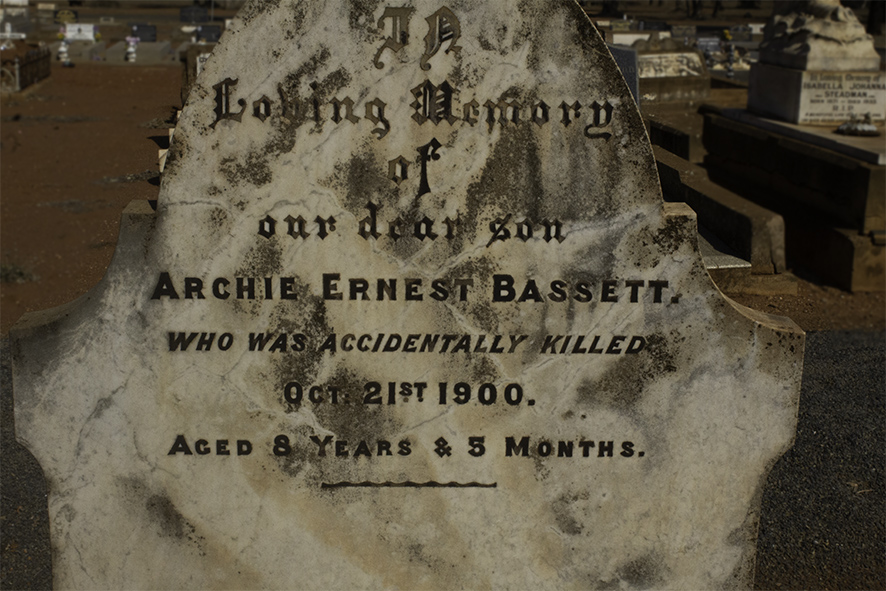
Eight-year-old Archie was sent “out after cows’’ at his parents’ property 12 miles from Condobolin, NSW, one Saturday afternoon.

His horse came home riderless about 20 minutes later, and the boy was found unconscious about 400 metres from the house.

From an open gate and a stirrup iron lying close to the body, it was surmised

“the boy had lost his balance whilst opening the gate and the horse had made off, dragging its rider along with one foot caught in the stirrup iron until it broke free’’.

He was hurriedly taken to town in a buggy, but despite medical attention died about 12 hours later, without having regained consciousness. The medicaal opinion was that he suffered a concussion of the brain, shock and bruising from the head along the back and arms.

Sources: The Argus (Melbourne, Vic. : 1848 – 1957) Tuesday 23 October 1900 p 6 Lachlander and Condobolin and Western Districts Recorder (NSW : 1899 – 1952) Friday 26 October 1900 p 5

Condobolin, NSW, Australia

What is the real story?

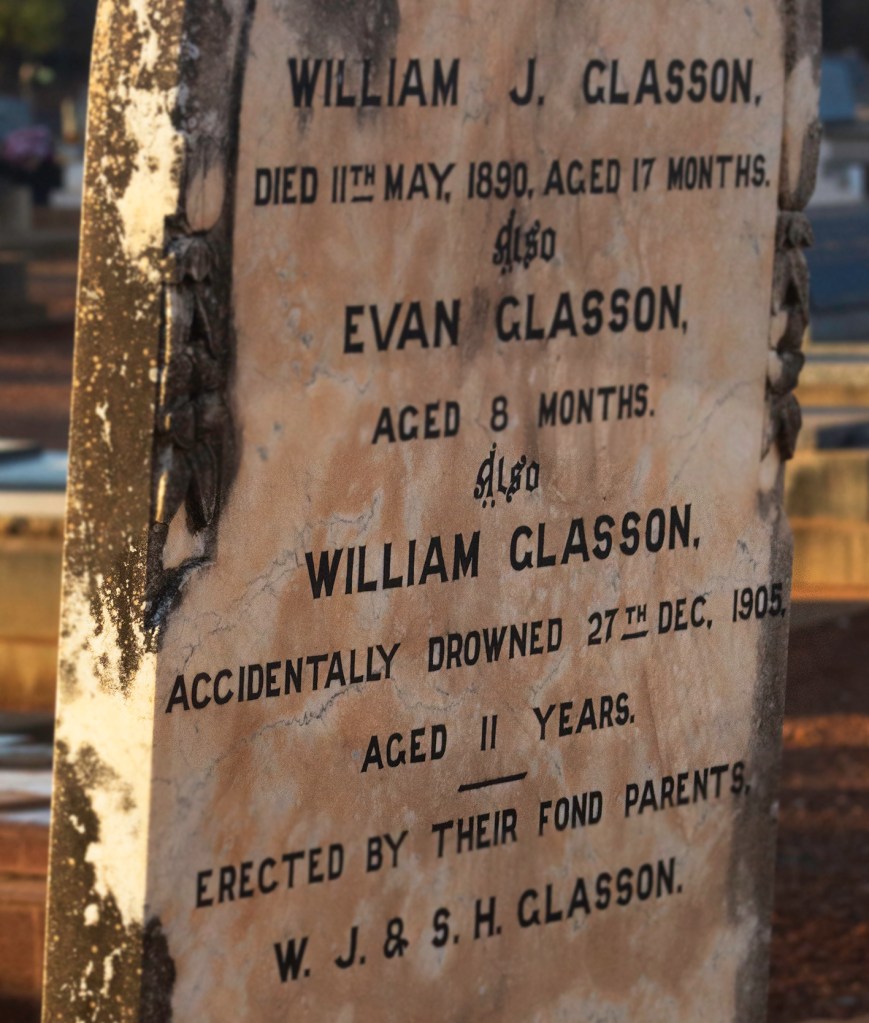
Image: Sharyn Moodie

There are a few differing accounts of why 11-year-old William Glasson ended up drowned in the Cobar Gold Mines reservoir in the last days of 1905.

One report says that he was with some other children bathing in the 15ft deep reservoir when they saw a man coming round the side of the reservoir, and thinking they would get into trouble, picked up their clothes and ran up the roadway out of the reservoir.  Glasson fell over the side into the water and was drowned.

However, a local report from the day before said the boys were out rabbit hunting and Glasson, having become warm, decided to take a swim.

“The young fellow was first noticed by the man who attends to the pumping plant, and he was then some 12ft. from the edge and appeared to be in distress. The man shouted to the other boys that their companion seemed to be in trouble, and he himself rushed round to where he was, but the deceased had disappeared.”

William’s parents William and Sara had lost a previous child also called William.

Source: The Cobar Herald (NSW : 1899 – 1914) Saturday 30 December 1905 p 4, The Sydney Morning Herald (NSW : 1842 – 1954) Monday 1 January 1906 p 6 Article

Cobar, NSW