Shark alarm led to drowning

1910 – A dark night, a precarious fishing spot, a meat truck and a cry of “shark’’ came together in the death of 18-year-old Alexander Stemp.

Stemp, a New Zealander, was a seaman on the cargo and passenger ship Rippingham Grange, which was loading meat at the Parsons Point jetty at Gladstone, Central Queensland on May 3.

He, a fellow seaman named  Oscar Harman and another man were fishing at the jetty on a Monday night.

At about six-thirty in the evening, the magisterial inquiry into the death was told, they had set up on a one-foot wide plank parallel to the jetty, a short distance from its end and close to their ship.

The rails of the horse-drawn truckway which brought meat from the nearby works ran very close to the edge of the jetty.

The Parsons Point jetty.

But the men had seen others fishing from that spot the previous evening and presumed the truck drivers would know what they were doing.

The night was very dark, and suddenly Harman heard a truck driver shout ‘Look-out for the truck.’

 He turned round and found a horse almost behind him, going towards the meatworks from the steamer.

Truck driver Henri Lewis said he had cried out, ‘Look out for yourselves” and that one of the men replied, “We can see you.”

Lewis said he told them they did not have enough room and tried to stop the horse. But the truck pushed it forward and the lubricating wheel on the box of the truck struck Stemp, sweeping him along the plank, causing him to collide with Harman and throwing both into the water.

 “When Harman came to the surface he began to swim towards the jetty and caught hold of a pile. He saw his mate was in difficulties and went back to him.

 Stemp was able to swim, but he could not do so that night, probably, Harman thought, because he had a back injury from the collision with the oil box.

 “Harman struggled to help Stemp towards the jetty and both were making their way nicely, if slowly, when some fool on the wharf raised the cry of ‘sharks’.”

newspaper report

 “Stemp at once lost all presence of mind, and tried to climb on Harman’s shoulders, with the result that both went down.

“Harman disengaged himself, and, on rising to the surface, swam to the jetty, calling out to Stemp to keep up, as he would bring a buoy to him.

“By some mischance when Harman got to the jetty, the buoy, which had been flung in with a line attached, was pulled back for the purpose of clearing the line which was fouled, and so was unavailable at a time when every moment was precious.”

Meanwhile, on board the Rippingham Grange, one Harry (Percy) Barton heard the shout  of man overboard, rushed onto the wharf,  “took a header off the jetty” and swam to the rescue.

 He was too late, for when he got within four yards of Stemp the latter disappeared.

Stemp’s body was not found until Thursday afternoon, with no shark injuries.

Barton was presented the certificate of the Royal Humane Society for his efforts to save Stemp’s life.

The crew of the Rippingham Grange took up a collection to help with the cost of a tombstone which 100 years later lies flat on the ground at the Gladstone cemetery.

The Parson Point jetty got electric lights the next year. The jetty was used until the late 1920s.

The Rippinghan Grange was sunk off the United Kingdom coast by a German U-boat on May 28, 1917, with the loss of eight lives.

Image: National Museums Liverpool.
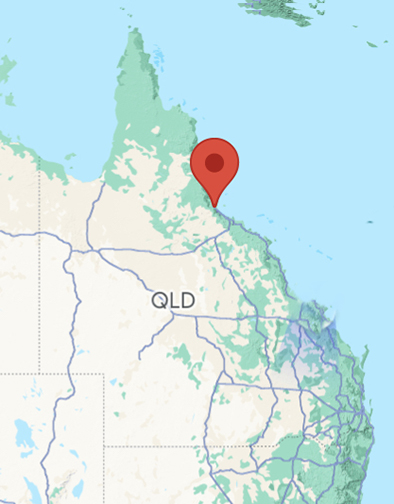
Gladstone, Central Queensland.

Sources: The Brisbane Courier, Saturday 14 May 1910, p4

Morning Bulletin, Thursday 25 August 1910

Wikitree: Rippingham Grange ( 1898) viewed at  https://www.wikitree.com/wiki/Category:Rippingham_Grange_(1898)

National Museums Liverpool viewed at https://www.liverpoolmuseums.org.uk/artifact/photograph-of-limerick-ex-rippingham-grange-new-zealand-shipping-company-ltd

Laver, Betty Here in History: by Betty Laver: the meatworks jetty viewed at https://gladstonenews.com.au/here-in-history-by-betty-laver-the-meatworks-jetty/
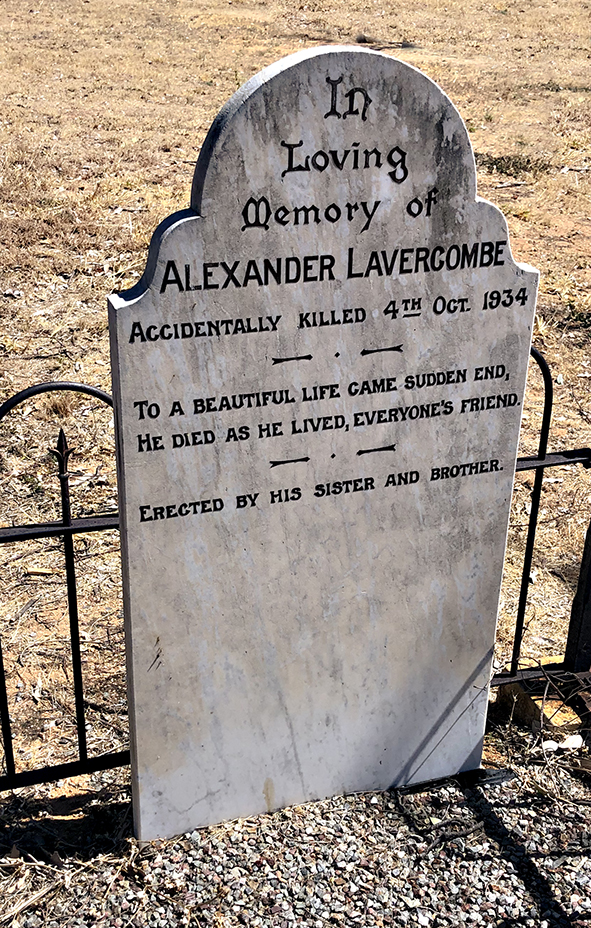
Third death was looming

1934 – The superstitious around Forsayth were only too well aware that there had been two deaths in the community in the past months, and were crossing their fingers against a third.

But luck was firmly against Alex Lavercombe, (age unknown but probably younger than 45 based on his parents’ year of marriage) who was soon to follow old district identities William Neal and Margaret Fitzsimmons on “the long journey’’ as death was described.

Image Sharyn Moodie 2023

Lavercombe was working on the closure of a gold mine called the Big Reef, three miles south-south-east of Forsayth in the Etheridge mining fields. The formerly productive mine had closed years ago but had recently been given a limited licence to be opened to explore for new payable ore.

Most of the machinery and workers had already moved to another venture.

Several men were busy cleaning out the pumps, when, at about 11am, a ladder that was being raised to the surface broke and swept Lavercombe 24 metres to the bottom of the shaft.

Here is how one newspaper described the results.

“The body was frightfully lacerated, one arm being broken in three places, the other arm splintered at the elbow; one leg was also broken, the skull fractured, and the neck broken; the jugular was severed, a frightful gash running from the left base of the neck to the right ear.

“The left eye had completely disappeared and the side of the face was broken and torn.

“When recovered, the body was lying in 15 feet of water at the bottom of the shaft but deceased was dead before he hit the water.

the northoern herald

The returned solder is buried in the sparsely populated Forsayth cemetery.

Image Sharyn Moodie 2023
Forsayth, Far North Queensland gold Etheridge gold fields.

Source: The Northern Herald, Saturday 3 November 1934, p36

Inaugural races a success – apart from the deaths

1900 – The Mount Garnet races were held on Saturday, last, and proved a great success in every way, begins a newspaper report on the first ever such event at the Far North Queensland mining town.

It’s not until the end of the story that the story mentions two deaths and one serious injury. Granted they didn’t happen during the races themselves…

Image Sharyn Moodie 2023

First, the correspondent congratulates everyone involved in the development of the racetrack, volunteers on the day…

"Mr Brownlee, of Herberton, acted as judge; he had nothing much to do except look nice (which, by the way comes natural to him", 

the winners of the races and the good behaviour of the crowd…

"not a single drunk among them".

The lunch was good, he continues, and that…

"hotel-keeper Mrs Lillicrap ought to have a first prize for the excellent spread she provided".

It is only then he mentions the sad fate of two people travelling home from the occasion.

One Jack Stubley, when returning home from the races, had a spill which unfortunately resulted in fracturing his skull.
“Charlie Spranklin put him in his buggy and drove him to the hospital. He (Spranklin) then was returning to the racecourse to pick up his family, when unfortunately he struck a stump and was thrown out; his face was cut in two places, and his arm dislocated.

Stubley died in hospital.

The report continues, possibly less accurately as we shall see below, that

“On Sunday morning a young man named Ted Lees, of Herberton, accompanied by young Bimrose, rode from Mount Garnet to Woodleigh Station (about 20km east), and when near the station the former was dashed against a tree and killed instantaneously.

Later more accurate reports made no link between Lee’s death and the races, saying he had been mustering cattle at his uncle’s property at Woodleigh Station with “his particular chum’’ Bimrose. They were galloping when a martingale ring got caught on the buckle of the bit, meaning he could not steer his horse and they hit a tree “within sight and hearing of his uncle’s house”.

Ted was 22. Although the newspapers called him either Ted or Edward, his headstone calls him Ernest.

The newspaper correspondent admitted the events had cast a gloom about the district, then went on to announce the races had made a profit of about 90 pounds.

Image Sharyn Moodie 2023

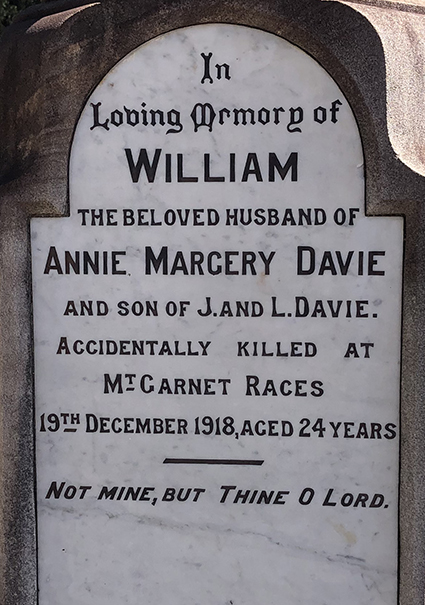
Eighteen years later, a 24-year-old man named William Davie died at the Mount Garnet races, racing in the Hospital Handicap. His horse fell on him.

Mount Garnet is a mining town on the south-western edge of the Atherton Tablelands and both Lees and Davie are buried in its cemetery.

Today, racing in the town  of  400 people is still strong with an annual rodeo and race day among the events enlivening the district.

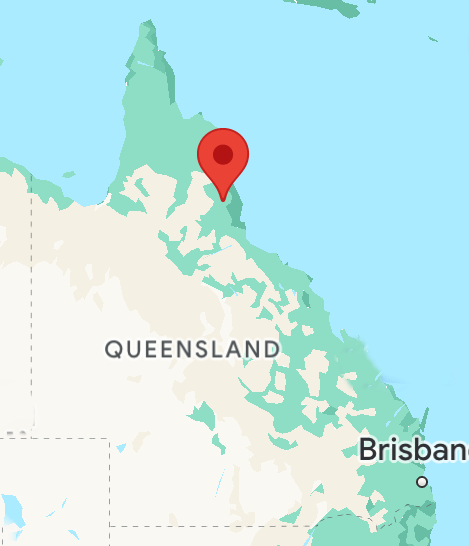
Mount Garnet, Queensland, Australia

Sources: Morning Post, Friday 8 June 1900, p3

 The Week, Friday 22 June 1900, p13

The Northern Herald, Thursday 16 January 1919, p30

The Northern Miner, Tuesday 5 June 1900, p2

Help came too late for starving traveller

1901 – The Mount Garnet coach driver wasn’t so curious about the man he had seen several times sitting outside a tent on the side of the road outside Herberton.

Image Sharyn Moodie 2023

But when he realized he had not seen the man on several of his trips, he decided to investigate further.

Unfortunately it was some time before he could leave his coach and horses to do so. A more urgent curiosity may have saved the man’s life.

On March 31, a Sunday, he was able to stop and sent his friend John Ferris over to the tent.

There was witnessed a “shocking and heart-rending spectacle”.

At the door of the tent, in a position that spoke of an attempt to get outside, was “a human being in a most emaciated condition, with eyes glaring, utterly speechless, and small black ants crawling over him and around his mouth and eyes, and still alive.

Lees took one of his leading horses out of its harness and galloped into town for help, which was faster than taking the coach. A trap was dispatched back to the scene, and the man was lifted from the white-ant riddled bark he was resting on.

The Brisbane Courier described what happened next.

 “the hapless being the while, with terribly glaring eyes fixed upon them, emitting unearthly sounds from his throat, was conveyed to the hospital, in which institution he breathed his last half-an-hour later.’’

sunday times

The hospital surgeon opined that the man had died from starvation but was unable to say whether there had been an underlying condition.

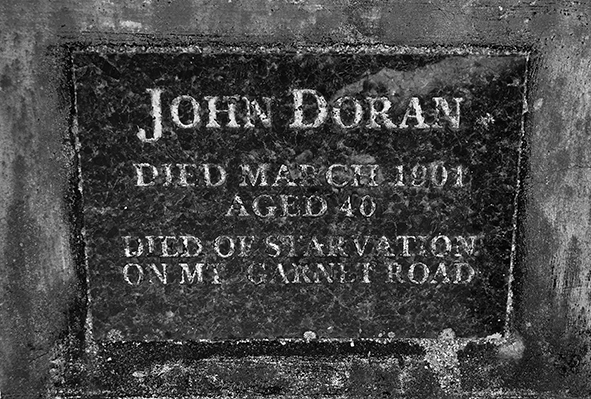
A pocketbook with the name “John Doran” in it was the best clue as to the man’s identity. Writing within mentioned that he had travelled through Mareeba and Hughenden.

The newspaper described the man as about 45, with medium build and a “rather active appearance (a bit of a stretch considering he showed severe malnutrition), with  dark hair, turned partly gray; ginger moustache, with three weeks’ growth of beard, which was partly gray; blue eyes, large Roman nose, and good even set of teeth; would be of fresh complexion when in full health”.

He was well dressed and other clothes in his tent were in good condition. The tent also contained a towel, a rug, a broad-leafed hat and a brass watch chain with a magnifying  glass attached to the end.

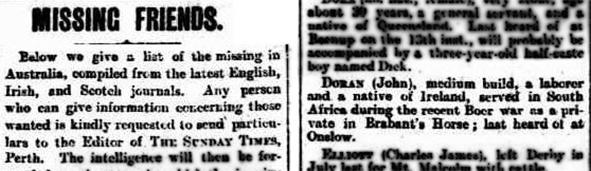
There is no reportage to say that anyone came forward to claim the body. A missing person’s notice for a man of that name appears in a Western Australian newspaper in 1904.

Could it have been the same John Doran? It was a relatively common name.

Some one in the Herberton community was good-hearted enough to ensure that Doran was buried with a headstone in the expansive Herberton cemetery in Far North Queensland.

Sources:   Friday 19 April 1901, p 6

Sunday Times Sunday 28 February 1904, p7

Great flood takes eight lives during fruitless rescue

1894 – Albert Cummins and the Buchanan family refused to leave their houses when the waters rose. They changed their minds when rescuers came, only to drown before reaching safety.

Albert Cummins stately headstone in the Old Ingham cemetery. Image: Sharyn Moodie 2023

The highest floods yet recorded at Ingham in Far North Queensland came early on a Sunday in April.

The town had already had 111 inches of rain that year, when on Saturday, April 7 word came  by telegram from Herberton, about 160 kilometres inland, of heavy downpours of about eight inches  (200mm). This could only result in flooding of the Herbert River at Ingham.

The water, rushing with terrific force, was miles wide, according to the Northern Miner. It was preceded by a gales, then a hurricane, and flooding was exacerbated by spring tides.

Only a very small portion of the town remained as dry ground.

The water diverted through the paddocks of the Colonial Sugar company, carrying away hundreds of cattle and horses.

The early warning on Saturday, issued by the Postmaster and the police, saw some people take refuge with friends or in the town’s hotel, others at the Divisional Board Hall.

A second, and then a third warning, was issued.

The papers reported that Albert and Mr Buchanan “remained obturate’’, saying the flood would not rise far enough to do any material damage. After all, it had not done so in the flood of 1881, the worst in the past 30 years. Albert, 48, had a wife and five children, who were possibly moved from danger.  

But by Sunday morning, Cummins and the Buchanans had hoisted distress signals, Cummins was ensconced on his roof, while the Buchanans had rigged up tables and chairs to keep the children dry.  

The only boat available for a rescue effort was “really a small punt’’.  It had already been used in a rescue effort that morning and then beached as it was “leaking like a sieve’’. Running repairs were made with white lead and rags stuffed into leaks .

It only had to travel half a mile from the banks of Palm Creek across the flooded plains to reach the marooned eight.

Four men from the Palmer’s Rest hotel –  Wickham, Anderson, Selby and Rogers, set out with two men rowing while one baled out water. They struggled hard  to reach the houses, and had to make more repairs with white lead before setting off for the return journey.  

The boat, with 12 weary and bedraggled people on board, was then swirled across the terrific current through a forest of pandanus.

“Just as open water was…about to be reached they were smashed against a tree and capsized.

“The force of the blow and pressure of the water almost lifted the occupants into the air and the unfortunate occupants were in less than a second struggling in the roaring torrent.’’

northern miner

 Mrs Buchanan clutched Anderson around the neck but was swept away.

 The eldest two Buchanan boys “got hold of Wickham and held him under for some time with their struggling”. Wickham was “thoroughly exhausted’ when he was dragged back onto the punt by Selby and Anderson. No further mention is made of the boys so it can be presumed they had also been washed away.

Rogers, meanwhile, was holding on to a pandanus. Fighting against the surging waters, he decided his best bet was to make for the punt, which by then was quite a distance downstream. He was a strong swimmer and managed to make it.

“Cummins evidently lost his presence of mind, for when last seen he was wildly fighting against the water instead of trying to swim with it.

brisbane courier

The rescuers were now badly in need of rescuing themselves. They hung on to the remains of the punt – although Wickham was twice washed off as they battled the water for another three hours until, exhausted, they were washed up at J McDonald’s farm. McDonald and two other men swam/waded out with a rope and pulled them into his house, which was awash with three feet of water.

 None of the Buchanans or Albert Cummins were seen alive again.

The bodies of Cummins, Archie and Martha Buchanan, children Archibald,  10, Marian,  8, William 7, and Robert, 4, were recovered by the next Wednesday, and almost the entire town attended their funeral on the Thursday.

Baby Jemima’s body was never found.  

Buchanan family memorial in the Old Ingham cemetery. Before these plaques were erected there was no marker for the family.

Sources: The Northern Miner, Saturday 14 April 1894, p3

The Queenslander, Saturday 21 April 1894, p27

The Brisbane Courier, Wednesday 25 April 1894, p6

Ingham, Queensland

Fell from his horse and drowned

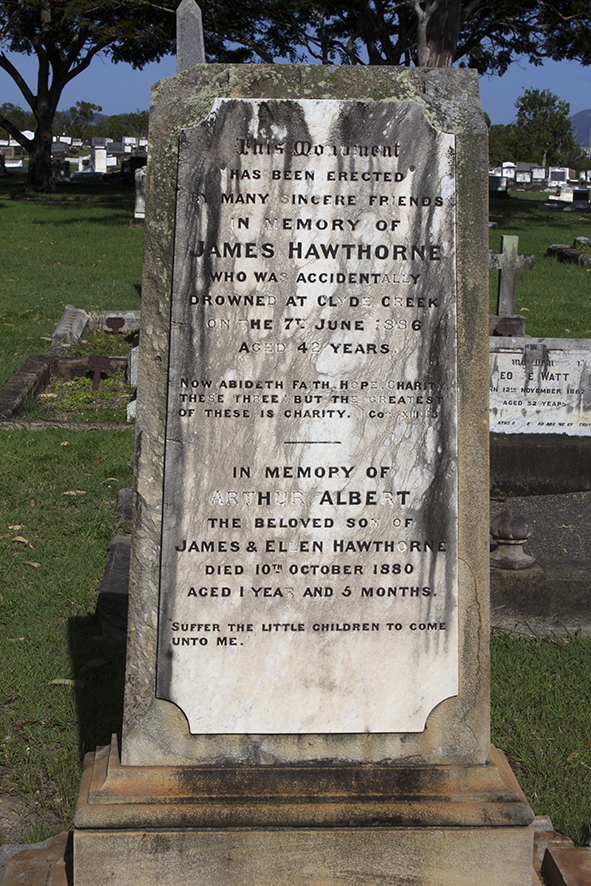
1886 – “No-one was better known or more respected in Gladstone than James Hawthorne”, a newspaper declared when he suddenly met his end.

Image: Sharyn Moodie 2023

While death notices described the 42-year-old as a saddler, a James Hawthorne was mayor of the town some years earlier and it can be assumed it was the same person.

James was returning on horseback from Calliope, about 20 kilometres away.

“His body was found lying in a waterhole, face downwards, about seven o’clock on the morning of the 7th instant, near the Ten Mile Creek (now known as Clyde Creek), ” announced a local newspaper.

The creek was the first coach stop out of Gladstone towards Calliope, meaning James was close to home.

“It would appear that his horse had fallen over an embankment, and injured its rider, who was also thrown into the hole and remained in an insensible condition.

“This at least is the surmise, as there were not more than 6 in. or 8 in. of water where he was discovered.

The media was lavish in its praise of the man.

“For more than a quarter of a century he figured prominently as a good colonist, a zealous worker for the interests of this town, a good husband and father, and a generous-hearted man.”

The funeral on Tuesday was attended by almost every townsman.

If James worked as a saddler, one could assume he knew his way around horses and that it was indeed a tragic accident that took his life, leaving his wife Ellen a widow and at least eight children fatherless.

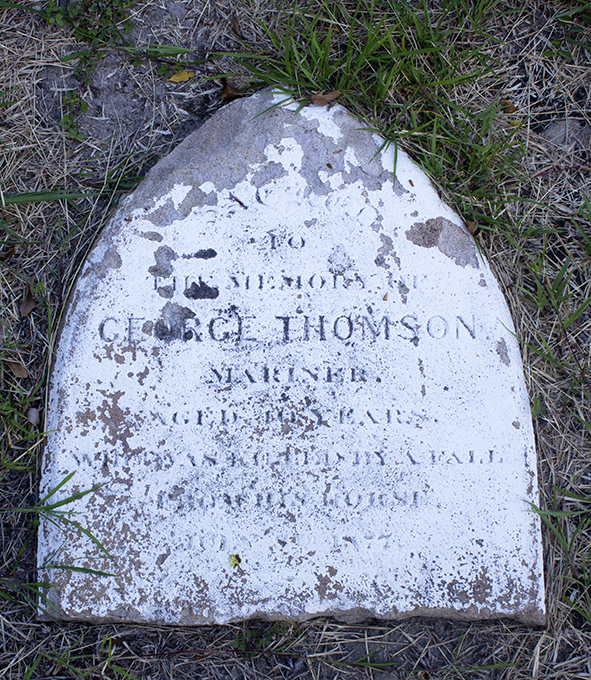
Another man in the Gladstone cemetery who was killed by a fall from his steed, and perhaps could be forgiven for not being horse-savvy, was mariner  George Thomson, who died back in 1877. His broken gravestone lies on the ground..

Gladstone, Queensland, where James Hawthorne and George Thomson share space in the cemetery.

Sources: Maryborough Chronicle, Wide Bay and Burnett Advertiser, Thursday 17 June 1886, p3

Morning Bulletin,  Saturday 19 June 1886, p4, Saturday 26 June 1886, p6

Reputation trashed after explosive death

How do I choose which historic death to investigate? There is no database of “fascinating cause of demises’’.

What I do is trawl through cemeteries. I walk around, tripping on rabbit holes and the like – because I’m walking and quickly scanning headstones at the same time,  until I find a headstone with the words “accidentally killed’’ or the such on it. It’s a hit-and-miss approach – not all interesting deaths are advertised on marble, and cemeteries are rambling places.

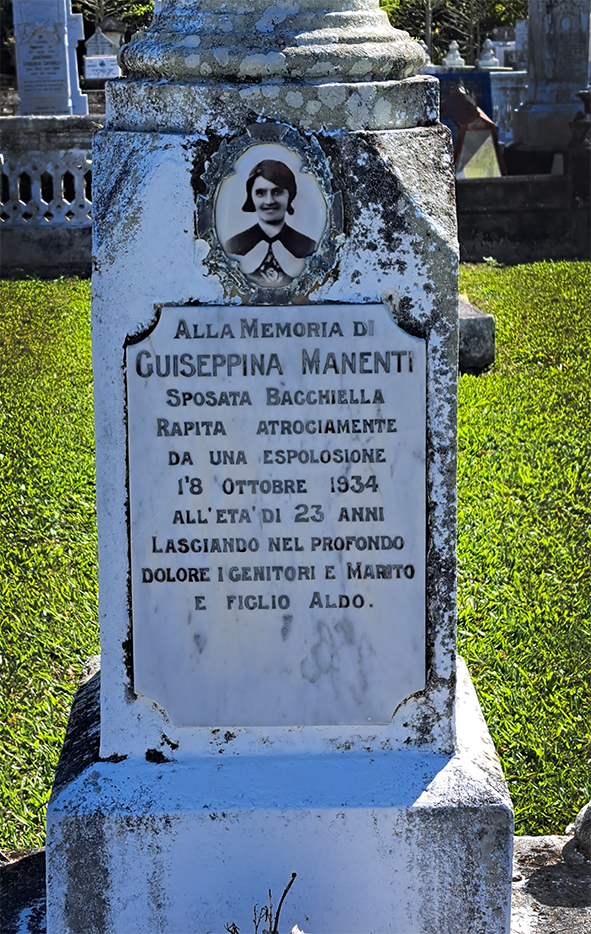
Ingham cemetery. The name is spelt “Guiseppina” on the stone, but newspaper reports spelt it often as starting with Giu”. Apparently the different spellings are used in different regions of Italy. Image: Sharyn Moodie

So I could have passed over this headstone in the Ingham cemetery. It’s not in English, but the word “espolosione” caught my eye.

When Google translate told me “atrociamenta da una espolosione” meant “atrociously kidnapped by an explosion” I knew I had to find out more.

What I found was …

a story of a local Italian Mafia-like gang, carrying out extortions and retributory murders.

Guiseppina Bacchiella was one of three such murders linked with the Black Hand Gang, although no-one was ever charged with her death and no definite link could be established. But in an environment where regular fire-bombings and at least 11 murders were carried out by the group, suspicions were high. And the reticence of the community to give information didn’t help.

Guiseppina Bacchiella, 23, her husband Giuseppe and four-year-old son, lived in a little galvanised iron cottage on Morebilli’s farm, at Palm Creek, half a mile from Ingham township.

They were part of a Sicilian community of cane workers, lured to North Queensland lured by the promise of employment.

About 2 on the morning of October 8, 1934, an explosion hurled her to her death.

Attending police officer Constable Thomas Alexander Smith told the inquest that one side of the galvanized iron cottage was blown right out, and a portion was on fire; while sheets of iron had been blown from the roof and from the other side of the cottage.

Guiseppina Bacchiella’s body was lying near where the bed had been.

 “The remains of the bed, bedclothes, and bedding were strewn around the cottage floor, kapok from the mattress was scattered about, some being afire, and a mosquito net was smouldering.

Her son, Aldo Bacchiella, had been found on top of the roof, injured with a broken arm, part of his elbow blown away and internal injuries.

Her husband Guiseppe had slept overnight at a cane-farm he was working on, four miles away.

At daylight, Smith went on, he found in the ground beneath a window of the hut a large hole, two feet in circumference, and nearby four inches of burnt fuse, while a torch was lying in the bush about four feet from the hole.

Ensuing police inquiries were hampered by language difficulties. But headlines like

Dead Wife’s Love Affairs

SENSATIONAL BOMB INQUEST

NIGHT EXPLOSION UNSOLVED

kept interest high.

Several witnesses attested to the good nature of both husband and wife, and that their relationship was friendly. But questions about Guissepina’s relationship with several men meant her reputation was soon besmirched.

Guiseppina’s mother Maria Manenti,  said her daughter married Bacchiella early in 1929.

“Bacchiella, thinking her daughter (then aged 17) was in a certain condition, was anxious to marry her, but had not been forced to do so. The child, Aldo, was born seven months after the marriage.

Mrs Manenti said that her daughter had had an affair with the part-owner of a farm they lived at in  1930, Guiseppe Cresta.

“Bacchiella had threatened to get a divorce, but, witness said, she induced him to change his mind and forgive his wife.

Giving evidence, Cresta initially denied an affair, but later admitted it, and said Guiseppina was not frightened of her husband or any other man , and knew her husband also saw other women.

Bachiella himself told the inquest he had relations with another woman and told his wife about it, but they never quarrelled over it.

His wife’s mother gave her a good “talking to,” Bacchiella said, and that was the end of the matter.  

Ingham butcher Sebastiano Faru, in evidence, stated that he had had improper relations with Mrs Bacchiella.

Faru’s own sweetheart had left him on account of his relations with the deceased.

Faru said he did not know if Bacchiella knew of his intrigue with his wife.

He hadn’t – but learnt about it during the inquest.

Another suspect was Saverio Scarcella, from whom the couple had borrowed £42. They still  owed him £7 and Guisepe had said his wife had complained that Scarcella had been asking her for the money.

Article image from the National Library of Australia’s Newspaper Digitisation Program

Poor Aldo, 4, was unable to shed any light on what had happened. He was obviously confused, and had come up with different stories –

That his injuries were caused by a man, or a bomb, and that his mother had climbed a ladder and put him on the roof, then later saying the bomb put him there. He also  said there was a man there that night with a stick, but he did not know who the man was.

Every male connected with the case was questioned about ownership of explosives and torches.

Whe, several months later, another Sicilan, Domenico Scarcella, was murdered, there were quickly links made with Giuseppina’s death.

“The police are not overlooking the possibility that the motive for Domenico’s murder may have been desire to seal for ever the lips of one who might have possessed the facts of the Bacchiella bombing.”

Why? For one, Domenico was a (variously named) cousin/brother of Severio Scarcella, who could not be found at the time of his death. But he was later found to be in Italy at the time, on trial for shooting another man, who had relatives in the Innisfail region.

Ingham, Queensland, Australia.

Sources: Truth (Brisbane) Sunday 16 June 1935, p 24, Sunday 14 July 1935, p17, Sunday 8 December 1935, ps 23,24)

Mafia in Australia Part 1 – Queensland Black Hand https://mafiainaustralia.wordpress.com/the-mafia-in-australia-introduction-early-history-of-italians-down-under/queensland-black-hand/

Townsville Daily Bulletin, Monday 17 June 1935, p4

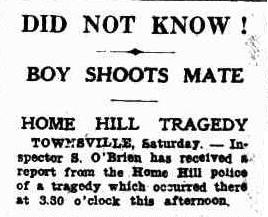
Shooting game leads to tragedy

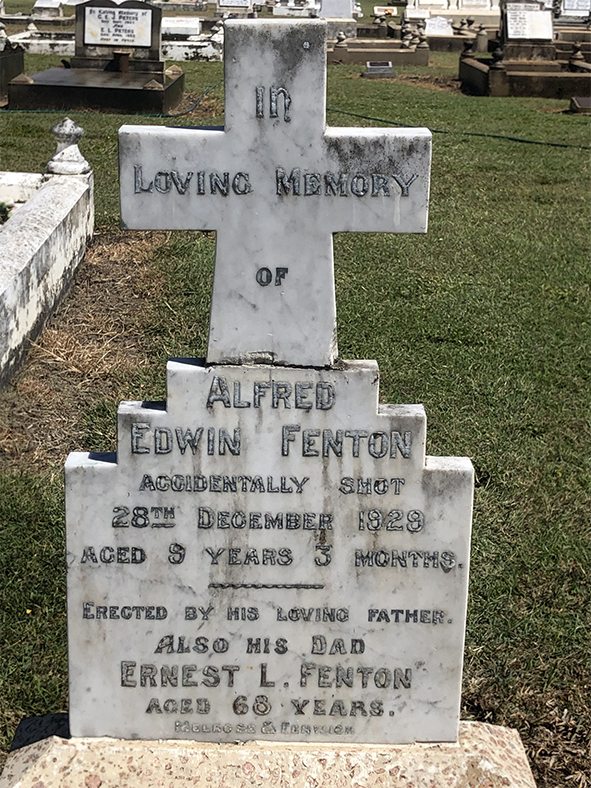
1929 – Two little boys playing with guns, both thinking they weren’t loaded.

One was wrong.

Fenton’s headstone in the Home Hill Cemetery, Queensland. Image Sharyn Moodie 2023

Alfred Fenton, nine, had an air-gun and his friend and neighbour William Brown a 22-calibre pea rifle. It was a few days after Christmas – perhaps one or the other was a gift.

Fenton pointed his air-gun at Brown and fired, but no damage resulted.

Brown did the same, and a projectile from his gun went into his friend’s throat, coming out under his left shoulder blade. Fenton died instantly.

Newspapers reported his name as Edward.


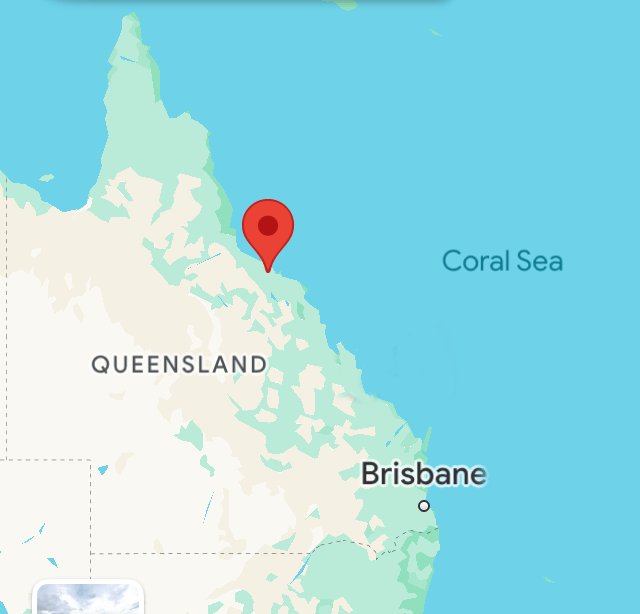
Home Hill, Queensland, Australia

Sources: Worker, Wednesday 1 January 1930, p17

The Brisbane Courier Monday 30 December 1929, p10

Great flood takes eight lives during fruitless rescue

1894 – Albert Cummins and the Buchanan family refused to leave their houses when the waters rose. They changed their minds when rescuers came, only to drown before reaching safety.

Albert Cummins stately headstone in the Old Ingham cemetery. Image: Sharyn Moodie 2023

The highest floods yet recorded at Ingham in Far North Queensland came early on a Sunday in April.

The town had already had 111 inches of rain that year, when on Saturday, April 7 word came  by telegram from Herberton, about 160 kilometres inland, of heavy downpours of about eight inches  (200mm). This could only result in flooding of the Herbert River at Ingham.

The water, rushing with terrific force, was miles wide, according to the Northern Miner. It was preceded by a gales, then a hurricane, and flooding was exacerbated by spring tides.

Only a very small portion of the town remained as dry ground.

The water diverted through the paddocks of the Colonial Sugar company, carrying away hundreds of cattle and horses.

The early warning on Saturday, issued by the Postmaster and the police, saw some people take refuge with friends or in the town’s hotel, others at the Divisional Board Hall.

A second, and then a third warning, was issued.

The papers reported that Albert and Mr Buchanan “remained obturate’’, saying the flood would not rise far enough to do any material damage. After all, it had not done so in the flood of 1881, the worst in the past 30 years. Albert, 48, had a wife and five children, who were possibly moved from danger.  

But by Sunday morning, Cummins and the Buchanans had hoisted distress signals, Cummins was ensconced on his roof, while the Buchanans had rigged up tables and chairs to keep the children dry.  

The only boat available for a rescue effort was “really a small punt’’.  It had already been used in a rescue effort that morning and then beached as it was “leaking like a sieve’’. Running repairs were made with white lead and rags stuffed into leaks .

It only had to travel half a mile from the banks of Palm Creek across the flooded plains to reach the marooned eight.

Four men from the Palmer’s Rest hotel –  Wickham, Anderson, Selby and Rogers, set out with two men rowing while one baled out water. They struggled hard  to reach the houses, and had to make more repairs with white lead before setting off for the return journey.  

The boat, with 12 weary and bedraggled people on board, was then swirled across the terrific current through a forest of pandanus.

“Just as open water was…about to be reached they were smashed against a tree and capsized.

“The force of the blow and pressure of the water almost lifted the occupants into the air and the unfortunate occupants were in less than a second struggling in the roaring torrent.’’

northern miner

 Mrs Buchanan clutched Anderson around the neck but was swept away.

 The eldest two Buchanan boys “got hold of Wickham and held him under for some time with their struggling”. Wickham was “thoroughly exhausted’ when he was dragged back onto the punt by Selby and Anderson. No further mention is made of the boys so it can be presumed they had also been washed away.

Rogers, meanwhile, was holding on to a pandanus. Fighting against the surging waters, he decided his best bet was to make for the punt, which by then was quite a distance downstream. He was a strong swimmer and managed to make it.

“Cummins evidently lost his presence of mind, for when last seen he was wildly fighting against the water instead of trying to swim with it.

brisbane courier

The rescuers were now badly in need of rescuing themselves. They hung on to the remains of the punt – although Wickham was twice washed off as they battled the water for another three hours until, exhausted, they were washed up at J McDonalds farm. McDonald and two other men swam/waded out with a rope and pulled them into his house, which was awash with three feet of water.

 None of the Buchanans or Albert Cummins were seen alive again.

The bodies of Cummins, Archie and Martha Buchanan, children Archibald,  10, Marian,  8, William 7, and Robert, 4, were recovered by the next Wednesday, and almost the entire town attended their funeral on the Thursday.

Baby Jemima’s body was never found.  

Buchanan family memorial in the Old Ingham cemetery. Before these plaques were erected there was no marker for the family.

Sources: The Northern Miner, Saturday 14 April 1894, p3

The Queenslander, Saturday 21 April 1894, p27

The Brisbane Courier, Wednesday 25 April 1894, p6

Ingham, Queensland

Innocence protested at gallows

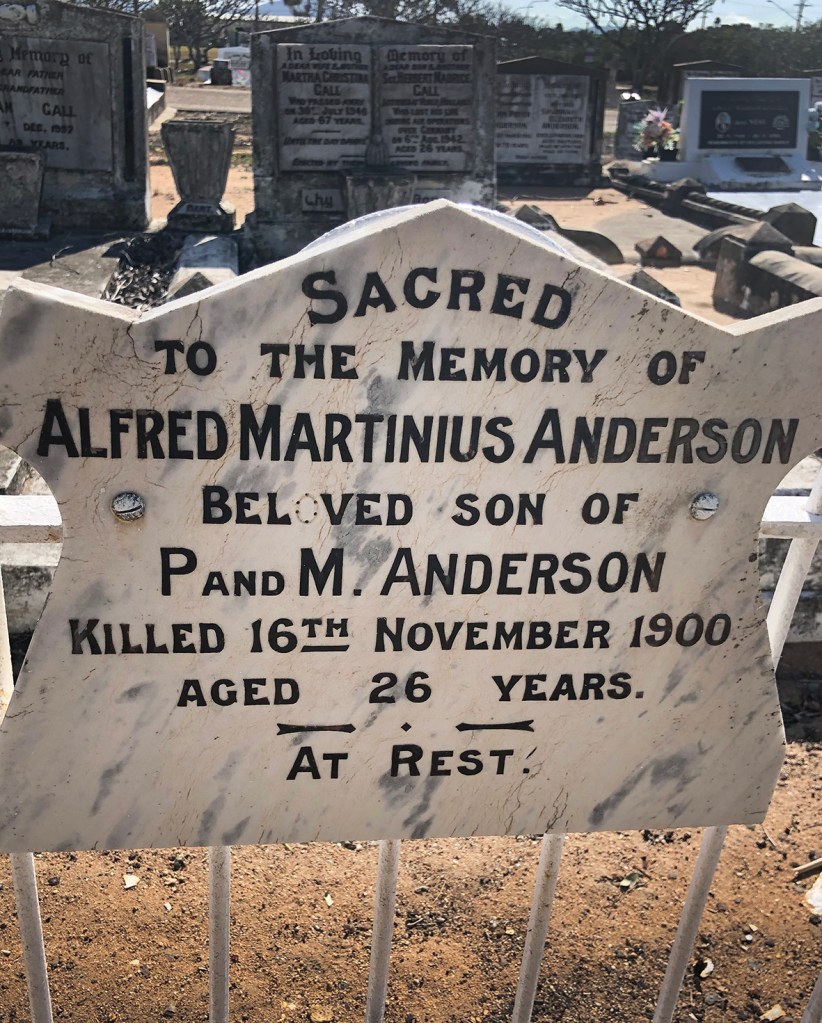
Anderson’s grave at the Bowen Cemetery, Queensland. Image: Sharyn Moodie

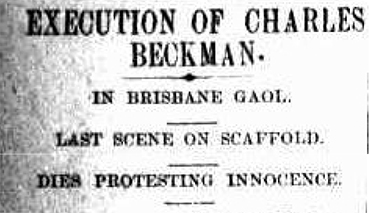
1901 – Charles Beckman declared he did not kill Alfred Anderson, even as he stood on the gallows at Brisbane’s Boggo Road Gaol awaiting hanging for the crime.

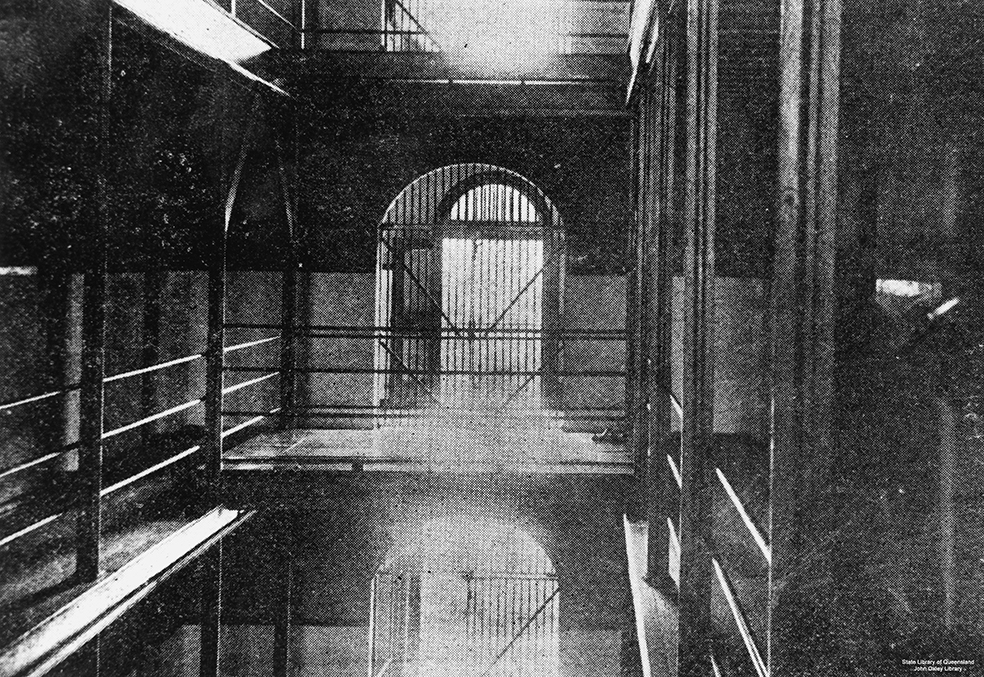
Boggo Road Gaol gallows in 1903. Image State Lilbrary of Queensland.

“I am now going to my end, and before my Maker, and I know it, I know this is my end, and again I say I am innocent of this charge.

“That’s all I have to say.”

It was indeed – the bolt was drawn, and the body soon hung lifeless, newspapers reported.

German-born Beckman, in his early 40s, and Anderson, 26, had left the Don River region near Bowen, Queensland to go prospecting in November, 1900.

Anderson’s brother received a letter from him on November 24, with no indication of anything being amiss.

In early January concern grew at Anderson’s prolonged absence, but it wasn’t until Beckman was seen at Euri Creek with Anderson’s horses and some of his belongings on January 19 that suspicions were heightened. By then, he had actually been dead for three days.

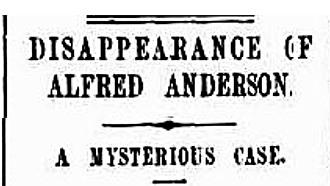
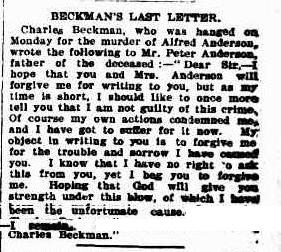
Article image from the National Library of Australia’s Newspaper Digitisation Program

One of the horses belonged to Anderson’s father, who pressed a charge of horse stealing, and a warrant was issued for Beckman’s arrest.

On January 26, Beckman’s gun and swag, together with a letter saying that he  had accidentally shot Anderson and was going to drown himself,  was found on the Bowen jetty.

But the authorities thought this was merely a ruse – and they were right. The harbour was dragged for the body, but the on-land search continued and Beckman was tracked down on February 1 near the Don River by Bowen’s Sergeant Denis Kean (also Keene),  a constable and two Aboriginal trackers.

When Beckman led police to Anderson’s body, near Macarthy Creek on February 7,  it was buried in rocks.

It showed no signs of a gunshot wound – but the severed skull was smashed into 15 or 16 pieces, depending on various accounts.

Before the Bowen Magistrates Court, Beckman was said to have accidentally shot Anderson while coming down a hill.

 “He attributed his not reporting the accident to cowardice.”

Dr Browne, who had attended the body as it lay at the creek,  told the court  he was of opinion that the skull was broken by a blunt instrument.

“He considered that the prisoner was in perfect health and quite sane.”

Beckman was committed for trial on the 4th March next.

Here is Beckman’s account of what happened

” Anderson and I left our camp in the morning. Anderson was carrying a double-barelled gun.

We travelled to the head of the creek. When returning the country was very rough, and Anderson, not being  accustomed to rough country, I took the gun from him.

“We travelled some distance down the creek, when Anderson slipped and fell I laughed at him. Young Anderson remarked, ‘You need not laugh at me; it may come to your turn very soon.’

“We only travelled a few yards, when I slipped and fell. The stock  of the gun struck the rocks, which caused it to explode, striking Anderson in the back of the  head and killing him instantly,  he was only three or four feet from me at the time.

“I was nearly mad at what had occurred. I went to the camp and got a bag and covered the body over with it.

Charles BEckman

“I remained with  the body all night and buried it in the creek. I got my horses and cleared out.

“I was… for three or four days before I got to a house, or it may be a week. Sometimes I go mad for three or four days at a time… I intended to give myself up to the police, hut I had not the heart to do so.

“I brought a gun to the jetty wharf and I intended to commit suicide but my heart failed me.

At the conclusion of his trial, Beckman said: “I should only like to say that Alfred Anderson and I have been on very intimate terms for five or six years, and there is no earthly reason whatever to gain by the death of Alfred Anderson.

 “I had no reason whatever to commit such a crime intentionally.

“I here declare before all that I am not guilty of this charge intentionally.

“The prisoner, whose voice had faltered towards the end of his remarks, now buried his face in his hands, evidently completely overcome.”

Beckman, who was married with three children, was hanged on May 13, 1901, still protesting his innocence. He was one of 42 people to face capital punishment at Boggo Road Gaol.

Article image from the National Library of Australia’s Newspaper Digitisation Program

Sources: The Bundaberg Mail and Burnett Advertiser, Friday 22 February 1901, p 2

The North Queensland Register, Monday 28 January 1901, p 53, Monday 11 March 1901 , p 26

Warwick Examiner and Times, Wednesday 15 May 1901, p 3

The Morning Bulletin, Wednesday February 6, 1901, p 6

Darling Downs Gazette, Wednesday 15 May 190, p 4