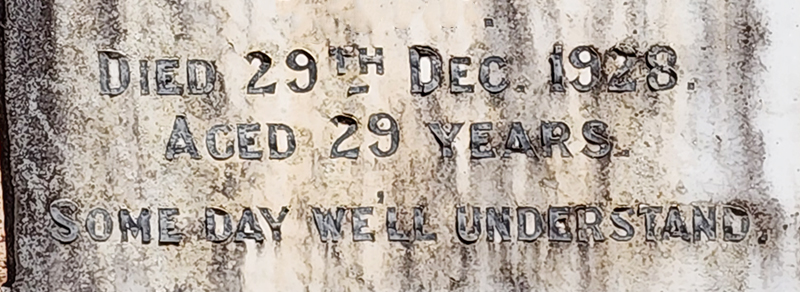
“Some day we’ll understand”
Peter Duff’s headstone
1929 – Peter Duff, 29, was known as a popular and leading businessman in the Northcliffe region of southern Western Australia.
So the community was surprised when he was found dead in the scrub, having died by suicide.
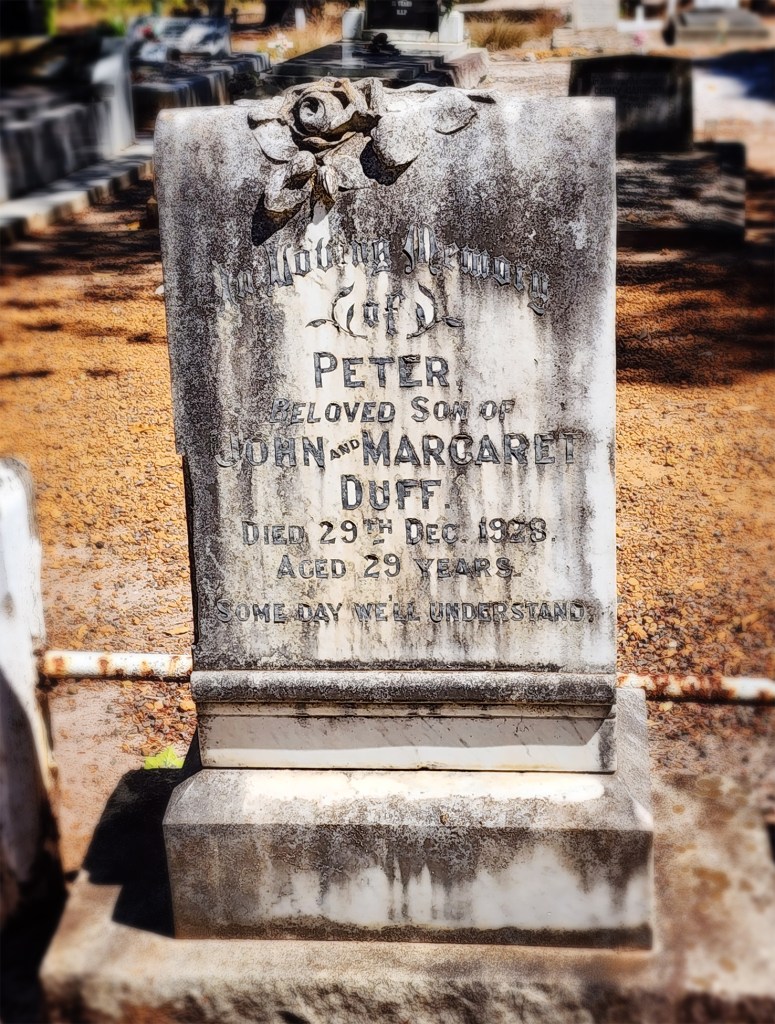
It was only three days after Christmas, on a Saturday night, when friends noticed that he was missing. He appears to have been unmarried.
His continued absence the next morning prompted police to be notified and a search revealed his body in a patch of scrub with a bullet wound through the head.
The resulting inquest found that
“the deceased, Peter Morrison Duff, came to his death….from a bullet wound through the roof of the mouth, such bullet wound being self-inflicted during a period of temporary insanity.’’
This finding was part of a societal shift towards more understanding of death by one’s own hand.
Legal loopholes were developed, such that if an inquest or coroner ruled that the deceased was not in full possession of his facilities, a Christian burial would then be allowed.
So coroner’s findings often gave verdicts of suicide “while of unsound mind”; ”while suffering temporary insanity”; or ”not in full possession of facilities” due to severe depression, illness or substance dependency.
Formerly, many people who had died by suicide were either buried where they lay, or outside the bounds of a cemetery. Those buried inside a cemetery would often be in the furthest northern or western corners, sometimes facing west rather than east, or in special areas set aside for the unbaptised, outcasts or those who had self-inflicted deaths.
This shift in understanding of such deaths was accompanied by a change in how newspapers reported them.
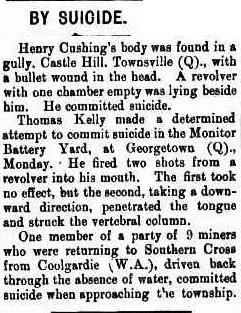
Previously In the early 1900s, newspaper coverage often featured sensationalist headlines, the address of the deceased, and explicit details about the method used. This approach often romanticized or normalized the act.
But it wasn’t until that 1980s, with studies showing links between suicide reportage and ensuing cases, that specific privacy and coverage rules were established by the Australian Press Council.
Today, such stories are usually treated carefully and respectfully, with links to mental helplines prominently displayed.

Sources:
Manjimup and Warren Times, Thursday 3 January 1929, p2
The Blackwood Times, Friday 18 January 1929, p1

