How do I choose which historic death to investigate? There is no database of “fascinating cause of demises’’.
What I do is trawl through cemeteries. I walk around, tripping on rabbit holes and the like – because I’m walking and quickly scanning headstones at the same time, until I find a headstone with the words “accidentally killed’’ or the such on it. It’s a hit-and-miss approach – not all interesting deaths are advertised on marble, and cemeteries are rambling places.
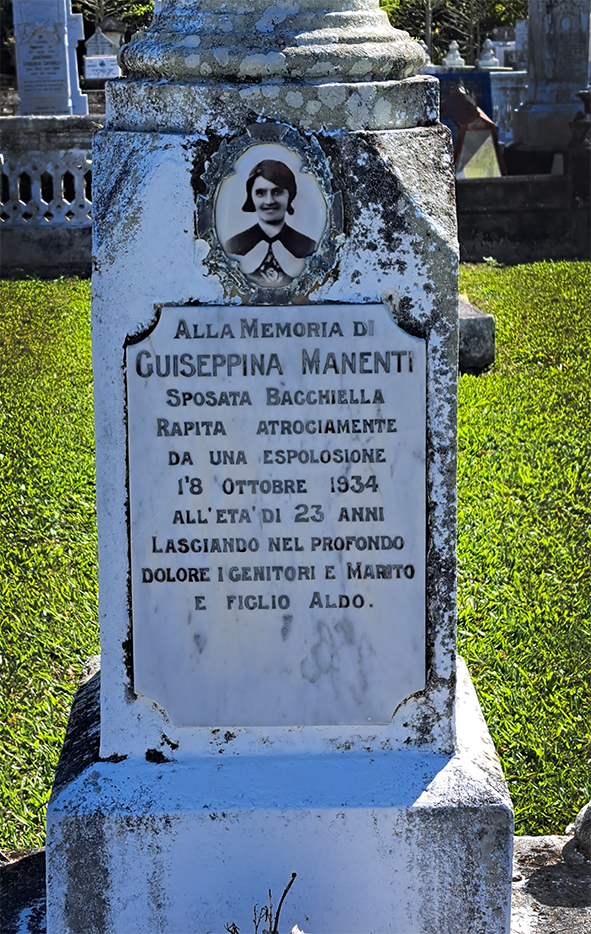
So I could have passed over this headstone in the Ingham cemetery. It’s not in English, but the word “espolosione” caught my eye.
When Google translate told me “atrociamenta da una espolosione” meant “atrociously kidnapped by an explosion” I knew I had to find out more.
What I found was …
a story of a local Italian Mafia-like gang, carrying out extortions and retributory murders.
Guiseppina Bacchiella was one of three such murders linked with the Black Hand Gang, although no-one was ever charged with her death and no definite link could be established. But in an environment where regular fire-bombings and at least 11 murders were carried out by the group, suspicions were high. And the reticence of the community to give information didn’t help.
Guiseppina Bacchiella, 23, her husband Giuseppe and four-year-old son, lived in a little galvanised iron cottage on Morebilli’s farm, at Palm Creek, half a mile from Ingham township.
They were part of a Sicilian community of cane workers, lured to North Queensland lured by the promise of employment.
About 2 on the morning of October 8, 1934, an explosion hurled her to her death.
Attending police officer Constable Thomas Alexander Smith told the inquest that one side of the galvanized iron cottage was blown right out, and a portion was on fire; while sheets of iron had been blown from the roof and from the other side of the cottage.
Guiseppina Bacchiella’s body was lying near where the bed had been.
“The remains of the bed, bedclothes, and bedding were strewn around the cottage floor, kapok from the mattress was scattered about, some being afire, and a mosquito net was smouldering.
Her son, Aldo Bacchiella, had been found on top of the roof, injured with a broken arm, part of his elbow blown away and internal injuries.
Her husband Guiseppe had slept overnight at a cane-farm he was working on, four miles away.
At daylight, Smith went on, he found in the ground beneath a window of the hut a large hole, two feet in circumference, and nearby four inches of burnt fuse, while a torch was lying in the bush about four feet from the hole.
Ensuing police inquiries were hampered by language difficulties. But headlines like
Dead Wife’s Love Affairs
SENSATIONAL BOMB INQUEST
NIGHT EXPLOSION UNSOLVED
kept interest high.
Several witnesses attested to the good nature of both husband and wife, and that their relationship was friendly. But questions about Guissepina’s relationship with several men meant her reputation was soon besmirched.
Guiseppina’s mother Maria Manenti, said her daughter married Bacchiella early in 1929.
“Bacchiella, thinking her daughter (then aged 17) was in a certain condition, was anxious to marry her, but had not been forced to do so. The child, Aldo, was born seven months after the marriage.
Mrs Manenti said that her daughter had had an affair with the part-owner of a farm they lived at in 1930, Guiseppe Cresta.
“Bacchiella had threatened to get a divorce, but, witness said, she induced him to change his mind and forgive his wife.
Giving evidence, Cresta initially denied an affair, but later admitted it, and said Guiseppina was not frightened of her husband or any other man , and knew her husband also saw other women.
Bachiella himself told the inquest he had relations with another woman and told his wife about it, but they never quarrelled over it.
His wife’s mother gave her a good “talking to,” Bacchiella said, and that was the end of the matter.
Ingham butcher Sebastiano Faru, in evidence, stated that he had had improper relations with Mrs Bacchiella.
Faru’s own sweetheart had left him on account of his relations with the deceased.
Faru said he did not know if Bacchiella knew of his intrigue with his wife.
He hadn’t – but learnt about it during the inquest.
Another suspect was Saverio Scarcella, from whom the couple had borrowed £42. They still owed him £7 and Guisepe had said his wife had complained that Scarcella had been asking her for the money.

Poor Aldo, 4, was unable to shed any light on what had happened. He was obviously confused, and had come up with different stories –
That his injuries were caused by a man, or a bomb, and that his mother had climbed a ladder and put him on the roof, then later saying the bomb put him there. He also said there was a man there that night with a stick, but he did not know who the man was.
Every male connected with the case was questioned about ownership of explosives and torches.
Whe, several months later, another Sicilan, Domenico Scarcella, was murdered, there were quickly links made with Giuseppina’s death.
“The police are not overlooking the possibility that the motive for Domenico’s murder may have been desire to seal for ever the lips of one who might have possessed the facts of the Bacchiella bombing.”
Why? For one, Domenico was a (variously named) cousin/brother of Severio Scarcella, who could not be found at the time of his death. But he was later found to be in Italy at the time, on trial for shooting another man, who had relatives in the Innisfail region.
Sources: Truth (Brisbane) Sunday 16 June 1935, p 24, Sunday 14 July 1935, p17, Sunday 8 December 1935, ps 23,24)
Mafia in Australia Part 1 – Queensland Black Hand https://mafiainaustralia.wordpress.com/the-mafia-in-australia-introduction-early-history-of-italians-down-under/queensland-black-hand/
Townsville Daily Bulletin, Monday 17 June 1935, p4
 Way to go Australia